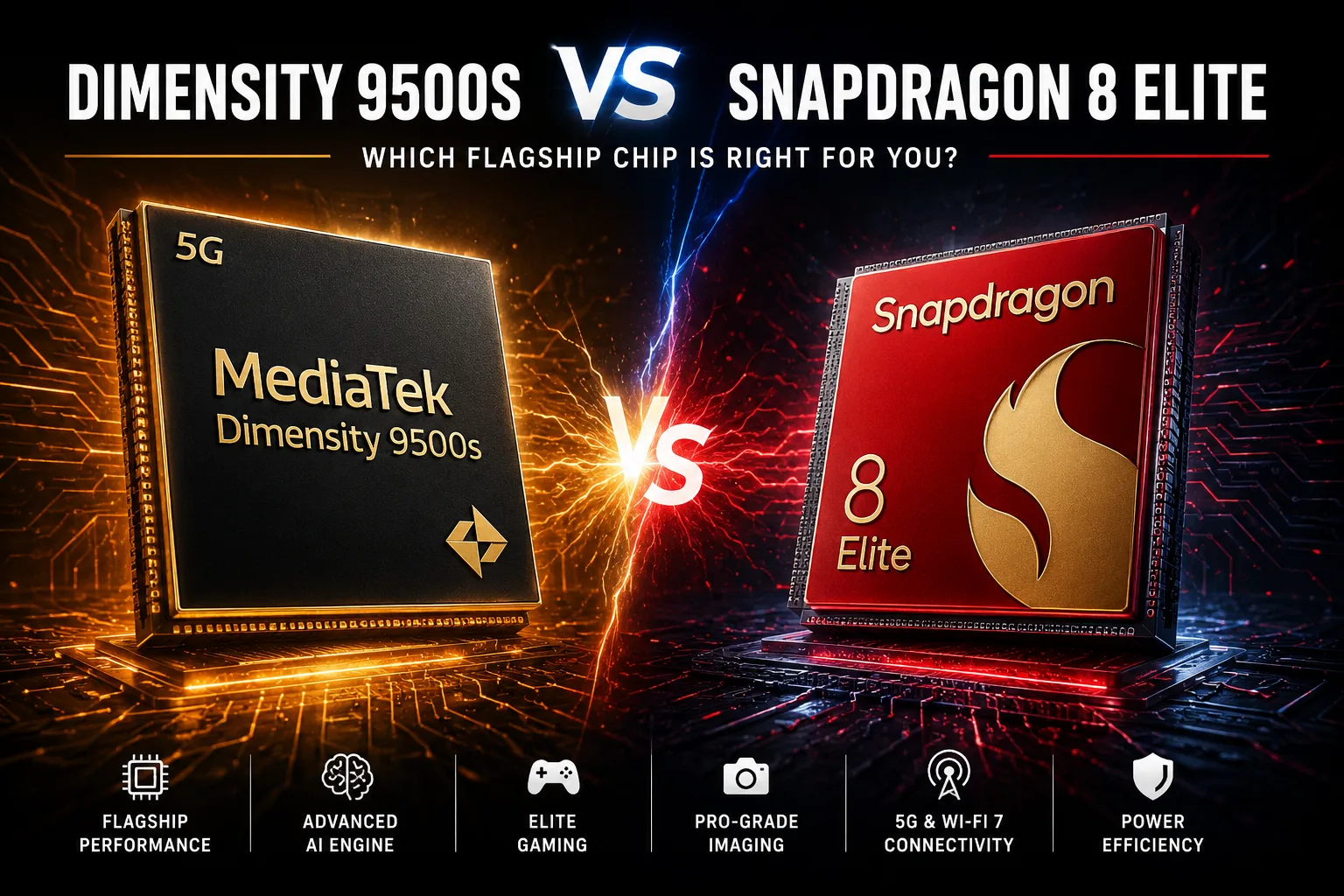
MediaTek Dimensity 9500s
vs
Qualcomm Snapdragon 8 Elite

SoC Comparison Result
MediaTek Dimensity 9500s vs Qualcomm Snapdragon 8 Elite: Can MediaTek Catch Up to Qualcomm's Flagship?
MediaTek Dimensity 9500s and Qualcomm Snapdragon 8 Elite are two flagship chips designed for powerful Android smartphones, but they have different strengths. The Dimensity 9500s focuses on a fresh Arm architecture, large cache, fast memory, and a strong AI block. The Snapdragon 8 Elite boasts custom Oryon cores, powerful Adreno graphics, an extensive gaming ecosystem, and a richer platform infrastructure.
It is important not to confuse the Snapdragon 8 Elite with the Snapdragon 8 Elite Gen 5. This article specifically discusses the Snapdragon 8 Elite SM8750 - Qualcomm's flagship platform that represents the next major step after the Snapdragon 8 Gen 3.
Architecture and Key Differences
The Dimensity 9500s uses an 8-core setup with Arm cores: one super-powerful Cortex-X925, three Cortex-X4, and four Cortex-A720. This configuration lacks small Cortex-A5xx cores, meaning even the smaller cluster is designed not just for background tasks, but for reasonably serious workloads. Additionally, the chip features 12 MB of L3 cache and 10 MB of system cache SLC.
The Snapdragon 8 Elite is configured differently. Qualcomm employs its own Oryon cores: two performance Prime cores and six Performance cores. The clock speed depends on the platform version and specific smartphone: the base version is typically stated to reach up to 4.32 GHz, with some variants reaching up to 4.47 GHz. The main difference lies not only in clock speeds but in the architecture itself: Qualcomm has moved away from standard Cortex cores to its own CPU development.
| Difference | MediaTek Dimensity 9500s | Qualcomm Snapdragon 8 Elite |
|---|---|---|
| CPU | 1x Cortex-X925 + 3x Cortex-X4 + 4x Cortex-A720 | 2x Oryon Prime + 6x Oryon Performance |
| Maximum Frequency | Up to 3.73 GHz | Up to 4.32/4.47 GHz, depending on version |
| Graphics | Arm Immortalis-G925 | Adreno |
| Cache | 12 MB L3 + 10 MB SLC | 24 MB shared L2: 12 MB for Prime + 12 MB for Performance |
| Memory | LPDDR5X up to 10667 Mbps | LPDDR5X up to 10600 Mbps |
| Storage | UFS 4 + MCQ | UFS 4.0 |
| Connectivity | 5G Sub-6, Wi-Fi 7, Bluetooth 5.4 | 5G Sub-6/mmWave, Wi-Fi 7, Bluetooth 6.0, UWB |
Performance
Based on the available results, the Snapdragon 8 Elite appears to be slightly stronger for now. In AnTuTu 11, it can score around 3.3 million points, while the Dimensity 9500s is closer to 3.0 million. The difference is more noticeable in overall performance and graphics than in pure CPU multi-threading capabilities.
In Geekbench 6, the picture is closer. The Snapdragon 8 Elite typically leads in single-core performance: about 3000+ points compared to approximately 2850-2900 for the Dimensity 9500s. In multi-core tests, the gap is smaller: both chips score around 9200-9400 points.
The conclusion regarding CPU performance is straightforward: the Dimensity 9500s excels in multi-threaded workloads, but the Snapdragon 8 Elite maintains an edge in peak single-thread performance and overall result stability.
Graphics and Gaming
In gaming, the Snapdragon 8 Elite is seen as a more predictable choice. The reason lies not only in the power of Adreno but also in the platform's prevalence. Games, graphical settings, emulators, and drivers are more often optimized for flagship Snapdragon processors. As a result, in demanding titles, Snapdragon generally offers fewer surprises and is better suited for those purchasing a smartphone primarily for gaming.
The Dimensity 9500s cannot be considered a weak gaming solution either. The Immortalis-G925 supports modern graphical features, including hardware ray tracing, and the chip is designed for a high frame rate. However, much depends on the specific smartphone: cooling, power limits, and firmware can significantly alter the actual performance.
In short, the Snapdragon 8 Elite is a more predictable gaming choice. The Dimensity 9500s can be very fast, but its overall strength is more heavily influenced by the specific smartphone model.
Memory, Storage, and Connectivity
In terms of memory, the Dimensity 9500s appears very modern: LPDDR5X up to 10667 Mbps and UFS 4 + MCQ are well-suited for a flagship smartphone, where fast app loading, handling large files, photos, videos, and AI tasks are critical.
The Snapdragon 8 Elite offers similar memory specifications: LPDDR5X up to 10600 Mbps. However, Qualcomm distinguishes itself with a richer platform infrastructure. The Snapdragon 8 Elite includes an X80 modem, support for mmWave in addition to Sub-6, Wi-Fi 7, Bluetooth 6.0, and UWB. In many markets, users may not notice these advantages daily, but for a premium smartphone, Qualcomm's connectivity capabilities appear more convincing.
Camera, Video, and AI
Both chips are geared toward expensive smartphones with advanced cameras. The Dimensity 9500s supports cameras up to 320 MP, 8K60 video recording, 18-bit RAW processing, and places significant emphasis on generative AI. This is an important point: MediaTek promotes the chip not just as a gaming solution but also as a platform for camera phones and local AI functionalities.
The Snapdragon 8 Elite is also strong in this area. It features a Spectra AI ISP, Hexagon NPU, and a suite of features for processing photos, videos, and AI scenarios directly on the device. However, in camera performance, the difference between chips often matters less than the configurations of the specific smartphone. The sensor, optics, manufacturer algorithms, and firmware quality can influence outcomes more than the SoC itself.
What to Choose?
The Snapdragon 8 Elite appears to be the better choice for those seeking a maximally proven flagship platform. It excels in single-thread performance, is more predictable in gaming, offers richer connectivity, and is more readily available in the market. If the smartphone is intended for long-term use, especially with gaming, emulators, and demanding applications in mind, the Snapdragon 8 Elite remains the more reliable choice.
The Dimensity 9500s is intriguing as a very powerful alternative. It features a modern CPU architecture, large cache, fast memory, strong AI capabilities, and substantial multimedia capabilities. This chip may be particularly attractive if a smartphone based on it is priced lower than its Snapdragon counterpart, has good cooling, and does not fall short in terms of display, memory, cameras, and battery.
The main takeaway: The Snapdragon 8 Elite currently appears slightly stronger and more predictable as a universal flagship choice. The Dimensity 9500s is not a weak alternative but a full-fledged competitor that can be more advantageous in specific smartphones, especially if the manufacturer has well-optimized cooling and pricing.
Advantages
- Newer Launch Date: January 2026 (January 2026 vs October 2024)
- Higher Frequency: 4320 MHz (3730 MHz vs 4320 MHz)
Basic
3x 3.3 GHz – Cortex-X4
4x 2.4 GHz – Cortex-A720
GPU Specifications
Connectivity
Memory Specifications
Miscellaneous
- FLAC
- HE-AACv1
- HE-AACv2
- MP3
- H.265
- AV1
- VP9
Benchmarks
Comparison of Devices
Related SoC Comparisons




Share in social media
Or Link To Us
<a href="https://cputronic.com/index.php/soc/compare/mediatek-dimensity-9500s-vs-qualcomm-snapdragon-8-elite" target="_blank">MediaTek Dimensity 9500s vs Qualcomm Snapdragon 8 Elite</a>