Apple A19

Apple A19: Why the iPhone 17 and 17e Differ in Speed Despite Using the Same Chip
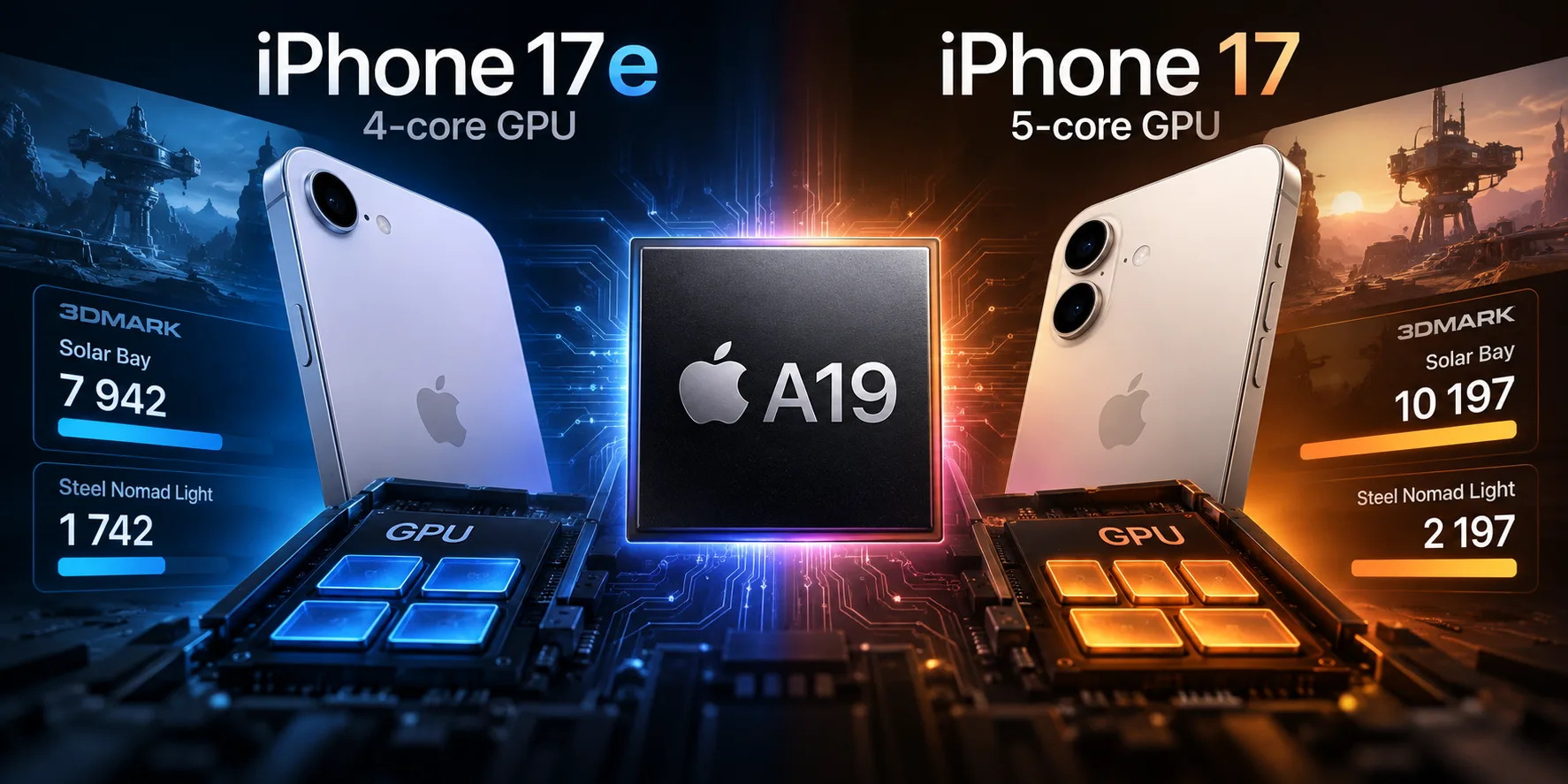
Apple A19 is used in the iPhone 17 and iPhone 17e, but the graphics performance of these smartphones differs noticeably. The former has five GPU cores, while the latter has four. In 3DMark, the iPhone 17’s advantage reaches 26-28%, even though both devices have the same six-core CPU configuration.
The processor debuted in September 2025, replacing the A18. Apple retained the same number of CPU cores but updated the architecture. The biggest performance gains came in graphics.
CPU Architecture and Performance
Apple A19 is manufactured by TSMC using the improved 3nm N3P process. The processor has two performance cores and four efficiency cores. The maximum frequency of the performance cores increased from 4.04 GHz on the A18 to 4.26 GHz.
The number of CPU cores remains unchanged, so the performance gains come from architectural improvements and higher clock speeds.
Geekbench 6 and Geekbench 7
| Processor | GB6 Single | GB6 Multi | GB7 Single | GB7 Multi |
|---|---|---|---|---|
| Apple A18 | 3 403 | 7 828 | 2 799 | 7 593 |
| Apple A19 | 3 559 | 8 710 | 2 993 | 8 273 |
| Apple A19 Pro | 3 744 | 9 758 | 3 168 | 8 804 |
In Geekbench 6, the A19 is 5% faster than the A18 in the Single-Core test and 11% faster in the Multi-Core test. In Geekbench 7, the advantages are 7% and 9%, respectively.
The A19 Pro is 5% faster than the standard A19 in the single-threaded Geekbench 6 test and 12% faster in the multithreaded test. The difference is small in everyday applications, but the higher-end processor has a more noticeable advantage in multithreaded CPU workloads.
AnTuTu 10 and AnTuTu 11
| Processor | AnTuTu 10 | AnTuTu 11 |
|---|---|---|
| Apple A18 | 1 490 144 | 1 972 476 |
| Apple A19 | 1 918 578 | 2 156 126 |
| Apple A19 Pro | 2 112 459 | 2 538 751 |
In AnTuTu 10, the A19 scores 29% more points than the A18, while its advantage in AnTuTu 11 is 9%. The difference is related to the testing methodology: the two versions assess the processor, graphics, and memory differently.
The A19 Pro is 18% ahead of the A19 in AnTuTu 11. The higher-end model’s advantage is more noticeable here than in Geekbench because AnTuTu takes more than just the CPU into account.
Graphics: Five Cores Versus Four
The GPU is the main upgrade in Apple A19. It supports hardware-accelerated ray tracing and is available in two configurations:
- iPhone 17 - five-core GPU.
- iPhone 17e - four-core GPU.
The difference is particularly clear in the 3DMark graphics tests.
3DMark: Comparing Five iPhones
| Smartphone | Processor / GPU | Solar Bay | Steel Nomad Light |
|---|---|---|---|
| iPhone 16e | A18, 4 cores | 6 120 | 1 517 |
| iPhone 16 | A18, 5 cores | 7 453 | 1 803 |
| iPhone 17e | A19, 4 cores | 7 942 | 1 742 |
| iPhone 17 | A19, 5 cores | 10 197 | 2 197 |
| iPhone 17 Pro | A19 Pro, 6 cores | 11 442 | 2 698 |
The iPhone 17 is 28% faster than the iPhone 17e in Solar Bay and 26% faster in Steel Nomad Light. That is a significant difference between two smartphones with the same processor name. However, results are affected not only by the number of GPU cores but also by cooling, clock speeds, and power limits.
Compared with the iPhone 16, the new iPhone 17 is 37% faster in Solar Bay and 22% faster in Steel Nomad Light. The gains are significantly greater than in the CPU tests.
The lower-end models show a different pattern. The iPhone 17e is 30% faster than the iPhone 16e in Solar Bay, but only 15% faster in Steel Nomad Light.
The A19 Pro in the iPhone 17 Pro is 12% faster than the standard A19 in Solar Bay and 23% faster in Steel Nomad Light. The higher-end model also has a vapor chamber, which helps it maintain performance for longer under heavy loads.
In games, the graphics differences matter more than the small Geekbench gap. However, 3DMark results cannot be directly converted into FPS. Actual performance depends on the game and graphics settings, while heat and the smartphone’s power limits also affect performance under sustained loads.
Artificial Intelligence and Image Processing
Apple A19 combines a 16-core Neural Engine with neural accelerators inside each GPU core. These allow supported AI workloads to run on the graphics processor, supplementing the dedicated neural engine.
The updated ISP contributes to photo and video processing. However, camera capabilities depend on more than just the processor: the lens configuration and available shooting modes are determined by the specific iPhone model.
Which Smartphones Use Apple A19
As of October 2026, the A19 is installed in two iPhone models. They differ in graphics, displays, cameras, and price.
| Smartphone | GPU | Display | Launch Price in the US |
|---|---|---|---|
| iPhone 17e | 4 cores | 6.1", 60 Hz | $599 |
| iPhone 17 | 5 cores | 6.3", up to 120 Hz | $799 |
| iPhone 17 Pro (A19 Pro) | 6 cores | 6.3", up to 120 Hz | $1 099 |
The price difference between the iPhone 17e and iPhone 17 at launch was $200. For that money, buyers got an additional GPU core, a ProMotion display with a refresh rate of up to 120 Hz, and a more versatile camera system, including an ultrawide module.
If a smartphone is used primarily for messaging, browsing, photos, and video, the four-core version of the A19 does not create noticeable CPU performance limitations. In everyday applications, both devices perform at a similar level.
The iPhone 17 is preferable for demanding games. The additional GPU core provides a measurable performance increase, while the 120 Hz display allows users to see a higher frame rate when supported by the game and GPU performance.
The iPhone 17 Pro features the faster A19 Pro and six-core graphics. Its advantages are more noticeable in resource-intensive tasks and extended gaming sessions than during typical smartphone use.
Conclusion
Apple A19 delivers a moderate CPU improvement and a much more noticeable graphics performance increase. Compared with the A18, CPU core performance increased by 5-11% in Geekbench 6, while the five-core GPU in the iPhone 17 delivered a substantial gain in 3DMark.
In everyday tasks, the iPhone 17 and 17e are similar in speed. The premium for the iPhone 17 is justified primarily by demanding games, its 120 Hz display, and its more versatile camera system. If these advantages are not needed, the iPhone 17e offers comparable CPU performance for less money.
SOC Comparison
Compare Apple A19 with other SOCs
Basic
GPU Specifications
Connectivity
Miscellaneous
Benchmarks
Phones with A19


Comparison of Devices with A19
Compared to Other SoC
Related SoC Comparisons



Share in social media
Or Link To Us
<a href="https://cputronic.com/index.php/soc/apple-a19" target="_blank">Apple A19</a>