Apple A19 Pro
Apple A19 Pro: Why the iPhone Air Is Slower Than the Regular iPhone 17 in Graphics Tests
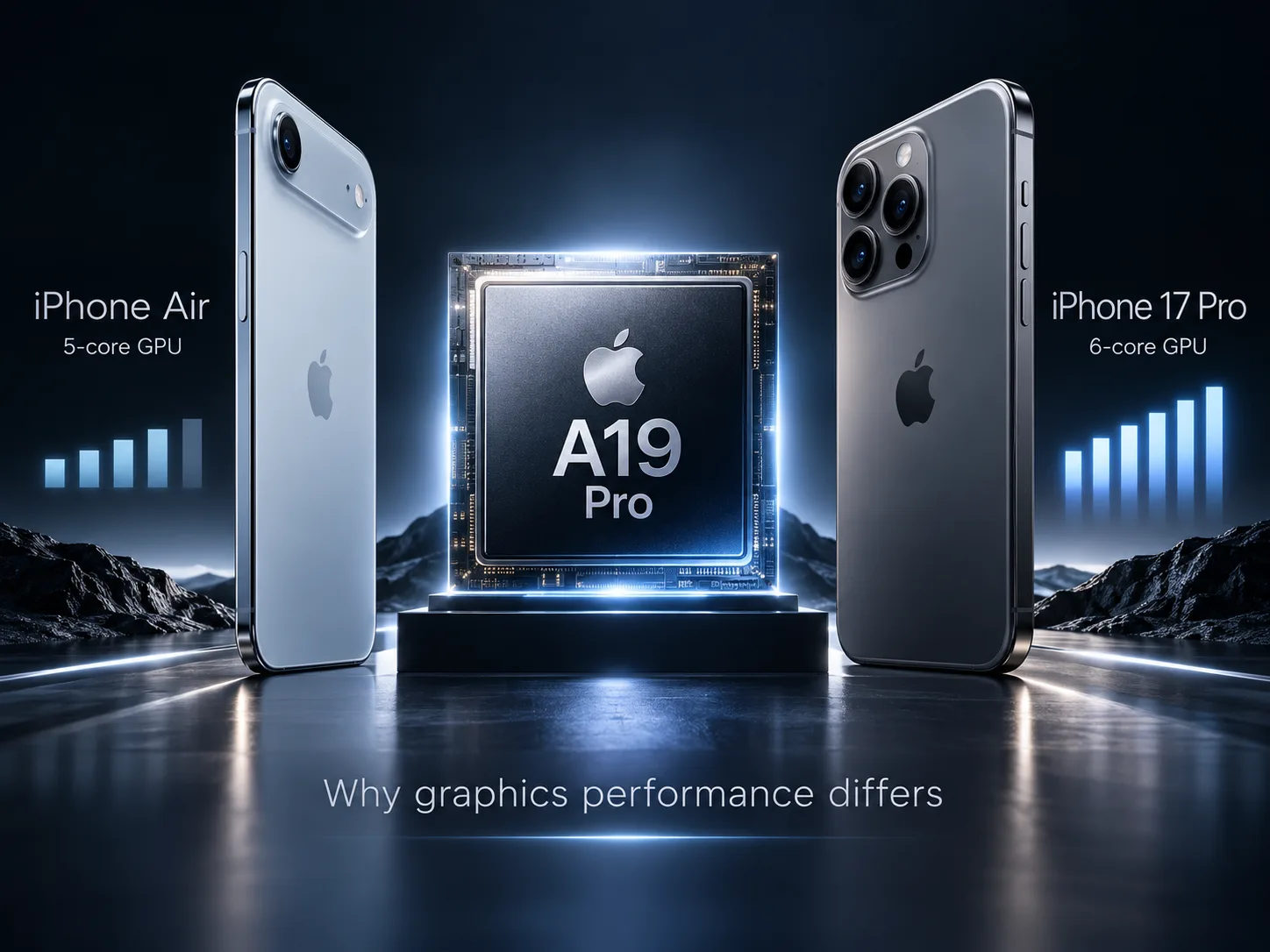
The Apple A19 Pro launched in September 2025 with a six-core CPU, updated graphics, and dedicated AI accelerators inside each GPU core. However, it delivers unexpectedly different results in different smartphones. The iPhone Air has a 5-core GPU, while the iPhone 17 Pro and Pro Max have 6-core GPUs. In 3DMark tests, the Pro models score 36-42% higher than the Air. The latter even trails the regular iPhone 17 with its A19 processor.
With the release of the A20 Pro, the A19 Pro is no longer Apple’s fastest mobile processor. Nevertheless, its CPU retains high performance, and the comparison between the iPhone Air and 17 Pro shows how strongly a smartphone’s design affects graphics performance.
CPU: A modest improvement over the A18 Pro
The A19 Pro uses two performance cores and four efficiency cores. Its maximum CPU clock speed reaches approximately 4.26 GHz. The chip is manufactured by TSMC using a third-generation 3nm process.
Apple retained the A18 Pro’s six-core configuration, focusing on improving the cores themselves rather than increasing their number.
CPU benchmark results
| Processor | Geekbench 6 Single-Core | Geekbench 6 Multi-Core |
|---|---|---|
| Apple A18 Pro | 3,408 | 9,092 |
| Apple A19 | 3,559 | 8,710 |
| Apple A19 Pro | 3,744 | 9,758 |
| Apple A20 Pro | 4,713 | 12,599 |
Compared with the A18 Pro, the new chip gained about 10% in the single-threaded test and 7% in the multi-threaded test. That is a moderate improvement, especially compared with the changes in graphics performance seen in the iPhone 17 Pro.
The regular A19 is not far behind either: in Single-Core, it trails the Pro version by about 5%. Such a difference is difficult to notice when browsing the web, using messaging apps, and running everyday applications.
At the same time, the CPUs in the two A19 Pro smartphones operate at similar speeds. For example, in LTT Labs tests, the iPhone Air scored 3,724 and 9,467 points in Geekbench 6, while the iPhone 17 Pro scored 3,895 and 10,155. The Pro’s advantage was about 5% in Single-Core and 7% in Multi-Core. That is significantly smaller than the difference in their graphics results.
The move to the A20 Pro brought a more substantial performance increase. Its Geekbench 6 scores are approximately 26% higher in Single-Core and 29% higher in Multi-Core than those of the A19 Pro.
GPU: Five cores in the Air versus six in the Pro
The A19 Pro GPU supports hardware ray tracing and contains Neural Accelerators in every GPU core. They are designed for AI-related computations and complement the separate 16-core Neural Engine.
There are two graphics configurations:
- iPhone Air: 5 GPU cores in a body just 5.6 mm thick.
- iPhone 17 Pro and Pro Max: 6 GPU cores, a vapor chamber, and an aluminum chassis that helps dissipate heat.
The Pro models have 20% more graphics cores. However, the difference in benchmarks is significantly larger.
Graphics tests: comparing five iPhones
| Device | Processor / GPU | 3DMark Solar Bay | Steel Nomad Light | Launch price |
|---|---|---|---|---|
| iPhone 17 Pro Max | A19 Pro, 6 cores | 10,894 | 2,447 | $1,199 |
| iPhone 17 Pro | A19 Pro, 6 cores | 10,712 | 2,412 | $1,099 |
| iPhone 17 | A19, 5 cores | 9,421 | 2,130 | $799 |
| iPhone Air | A19 Pro, 5 cores | 7,851 | 1,700 | $999 |
| iPhone 16 Pro | A18 Pro, 6 cores | 7,578 | 1,715 | $999 |
The results were obtained on specific smartphones. Prices are for the US market at the time the devices launched.
The iPhone 17 Pro is approximately 36% ahead of the iPhone Air in Solar Bay and 42% ahead in Steel Nomad Light. The Pro Max is only slightly faster than the regular Pro-in these tests, their graphics performance is virtually identical.
The most unexpected comparison is between the iPhone Air and the standard iPhone 17.
Despite having a higher-tier processor, the Air trails the regular iPhone 17 by approximately 17% in Solar Bay and 20% in Steel Nomad Light. Moreover, its results in both tests are close to those of the previous-generation iPhone 16 Pro.
The A19 Pro name alone does not guarantee superior graphics performance. The number of cores, power limits, and cooling of a particular smartphone are no less important.
Cooling: Why the iPhone 17 Pro is faster
The iPhone 17 Pro and Pro Max feature a vapor chamber integrated into an aluminum chassis. Heat from the A19 Pro is distributed across a larger area, helping the processor sustain high performance for longer under extended loads.
Apple claimed up to a 40% improvement in sustained performance over the previous generation of iPhone Pro. However, that figure applies to a smartphone with a new cooling system; it does not mean that the A19 Pro itself is 40% faster than the A18 Pro in every workload.
The iPhone Air has different limitations. Its body is just 5.6 mm thick, leaving less room to dissipate heat. The difference between the smartphones in graphics tests exceeds the 20% difference in GPU core count, so the results cannot be explained by the graphics configuration alone.
However, individual 3DMark runs cannot precisely determine the contribution of cooling, clock speeds, and power-consumption limits. That would require extended stress tests and frame-rate measurements in games.
Based on the available results, the iPhone 17 Pro is noticeably stronger in graphics. The Air’s CPU operates at a similar speed, but its GPU scores at the level of previous-generation flagships.
Artificial intelligence and video processing
The A19 Pro combines a 16-core Neural Engine with Neural Accelerators built into the GPU cores. The latter accelerate supported AI workloads on the GPU, complementing the capabilities of the dedicated neural processor.
The GPU also supports hardware ray tracing for more complex lighting and reflections in compatible games.
Video-recording capabilities depend on more than just the processor. For example, the iPhone 17 Pro supports 4K at 120 fps, ProRes RAW, and Apple Log 2, while the iPhone Air is limited to 4K Dolby Vision at 60 fps. The available modes are affected by the device’s cameras, cooling, and software limitations.
Similarly, Wi-Fi 7 and Bluetooth 6 are provided by a separate Apple N1 chip, while cellular connectivity in the iPhone Air is handled by the C1X modem. These components are not part of the A19 Pro itself.
How relevant is the Apple A19 Pro in 2026?
The A19 Pro trails the new A20 Pro in CPU performance, but the difference in everyday tasks is unlikely to be a reason to replace a smartphone. It is much more important to choose the right version of the A19 Pro itself. In the iPhone 17 Pro and Pro Max, the six-core GPU delivers 36-42% higher 3DMark results than the five-core version in the iPhone Air. Therefore, the Pro models are preferable for demanding games and extended workloads. The iPhone Air offers comparable CPU speed in a thinner body, but it falls noticeably behind in graphics performance.
SOC Comparison
Compare Apple A19 Pro with other SOCs
Basic
GPU Specifications
Connectivity
Memory Specifications
Miscellaneous
- AAX
- AAX+
- AC-3
- AIFF
- CAF
- E-AC-3
- MP3
- MP4
- WAV
- H.265
- AV1
- VP8
- VP9
- Motion JPEG
Benchmarks
Phones with A19 Pro


Comparison of Devices with A19 Pro
Compared to Other SoC
Related SoC Comparisons




Share in social media
Or Link To Us
<a href="https://cputronic.com/index.php/soc/apple-a19-pro" target="_blank">Apple A19 Pro</a>