Qualcomm Snapdragon 7 Gen 4
vs
MediaTek Dimensity 9500s

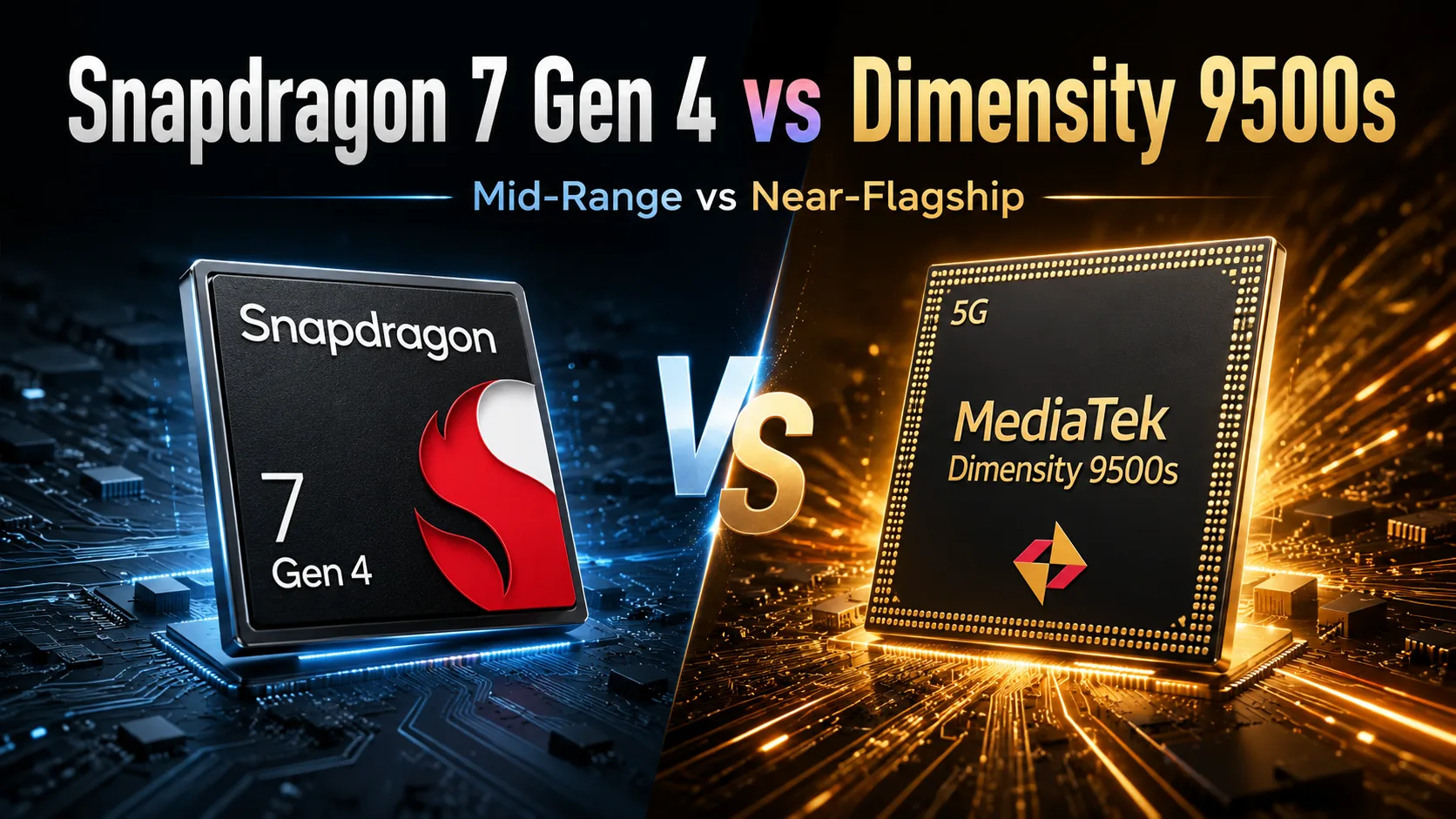
SoC Comparison Result
Snapdragon 7 Gen 4 vs Dimensity 9500s: Is it worth overpaying for an almost flagship SoC?
This comparison is not about a winner, but about the price-performance ratio
Snapdragon 7 Gen 4 lags behind Dimensity 9500s in almost every aspect except for the key argument in the mid-range class - the price of the finished smartphone. This is not a level duel: Qualcomm offers a high mid-range product here, while MediaTek provides an almost flagship platform. In such a comparison, Snapdragon 7 Gen 4 is not a competitor, but a measure of sufficiency: where the mid-range is still sufficient and where Dimensity 9500s already provides a noticeable advantage in gaming, camera, video, and the longevity of the smartphone.
Positioning
Snapdragon 7 Gen 4 is a modern platform for smartphones above the basic mid-range. It features a 4nm manufacturing process, eight CPU cores, Adreno 722 graphics, support for LPDDR5X, Wi-Fi 7, Bluetooth 6.0, and camera support up to 200 MP. For browsing, messaging, social media, navigation, video, casual photography, and gaming without maximum settings, this is sufficient. At launch, a smartphone with this chip will not look outdated.
Dimensity 9500s is designed for heavier workloads. It is a 3nm SoC with a Cortex-X925 core clocked up to 3.73 GHz, three Cortex-X4 cores, four Cortex-A720 cores, a larger cache, fast LPDDR5X memory, and Immortalis-G925 graphics. Such a chip is needed for heavy gaming, photo and video processing, local AI functions, and extended longevity.
In Brief: Where the Difference Really Matters
| Parameter | Snapdragon 7 Gen 4 | Dimensity 9500s | Practical Implication |
|---|---|---|---|
| Class | upper mid-range | almost flagship | Chips from different segments |
| Process Technology | 4 nm | 3 nm | MediaTek has a more modern manufacturing process |
| CPU | 1× Cortex-A720 + 4× Cortex-A720 + 3× Cortex-A520 | 1× Cortex-X925 + 3× Cortex-X4 + 4× Cortex-A720 | Dimensity is faster not by percentages, but by class |
| Geekbench 6 Single-Core | around 1270 | around 2680 | MediaTek excels in single-threaded workloads |
| Geekbench 6 Multi-Core | around 4100 | around 8350 | The gap is clearly visible in multi-threading |
| GPU | Adreno 722 | Immortalis-G925 | The main argument in favor of Dimensity |
| Camera | up to 200 MP | up to 320 MP | Dimensity offers wider possibilities for expensive cameras |
| Video | 4K up to 60 FPS | 8K up to 60 FPS, 4K up to 120 FPS | MediaTek is better suited for advanced shooting |
| Memory | LPDDR5X | LPDDR5X up to 10667 Mbps | Dimensity has higher bandwidth |
| Connectivity | 5G, Wi-Fi 7, Bluetooth 6.0 | 5G, Wi-Fi 7, Bluetooth 5.4 | Both are modern; the final outcome depends on the smartphone |
CPU: The Difference is at the Architectural Level
Snapdragon 7 Gen 4 uses a 1+4+3 configuration: one fast Cortex-A720 up to 2.8 GHz, four Cortex-A720 at lower frequencies, and three energy-efficient Cortex-A520 cores. This is typical logic for the mid-range: quick response in the interface, decent multi-threaded performance, and moderate power consumption.
Dimensity 9500s has a more powerful configuration: one Cortex-X925, three Cortex-X4, and four Cortex-A720. Here, not only are the frequencies higher, but the class of the cores is also superior. Therefore, the double gap in Geekbench 6 seems natural. It is explained by the platform level, not just the smartphone settings.
In everyday tasks, Snapdragon 7 Gen 4 should not feel slow. However, in video editing, processing large photos, heavy gaming, installing large applications, and sustained multi-threaded workloads, Dimensity 9500s will be noticeably faster.
GPU: The Main Gap Between the Chips
The most significant difference is not in the CPU but in the graphics. Adreno 722 is suitable for a mid-range smartphone: user interface, video, simple games, and some heavy projects at medium settings. For users who rarely play or are not chasing maximum graphics, this level is sufficient.
Immortalis-G925 in Dimensity 9500s is from a different segment. In graphical tests, the gap can be multiplicative, and in games, this is more important than the raw CPU difference. A stronger GPU provides higher FPS, more stable frame rates, better handling of high resolutions, heavy effects, and future projects. It is in graphics that Dimensity 9500s pulls away the most from Snapdragon 7 Gen 4.
Hardware ray tracing should not be overestimated: it is not yet critical for most mobile games. However, its presence indicates the class of the GPU. Snapdragon 7 Gen 4 remains a good mid-range option, while Dimensity 9500s is closer to flagship gaming platforms.
Camera and Video: More Possibilities, but No Guarantee of Better Photos
Snapdragon 7 Gen 4 supports cameras up to 200 MP and records 4K video up to 60 frames per second. This is sufficient for the mid-range. The actual photo quality still depends on the sensor, optics, stabilization, processing algorithms, and manufacturer's settings.
Dimensity 9500s offers more possibilities at the platform level: support for cameras up to 320 MP, 8K video up to 60 frames per second, and 4K up to 120 frames per second. This does not mean that any smartphone with Dimensity will shoot better. However, it is easier for manufacturers to build an expensive model on it with advanced shooting, fast HDR, heavy post-processing, and camera AI functions.
The logic is the same as with graphics: Snapdragon 7 Gen 4 covers the basic scenarios, while Dimensity 9500s leaves more room for complex modes and future features.
Other: AI, Connectivity, and Battery Life
For its class, Snapdragon 7 Gen 4 offers a sufficient set of AI capabilities: noise reduction, photo enhancement, object recognition, voice features, and some local processing. Dimensity 9500s has a more powerful NPU, faster memory, and more resources for local AI scenarios. The difference will only be noticeable where the manufacturer has added useful features rather than limited itself to marketing.
In terms of connectivity, both chips are modern: 5G and Wi-Fi 7 are available in both cases, with Bluetooth being newer in Snapdragon 7 Gen 4. Dimensity has a higher modem ceiling, but in a real network, factors like the operator, antennas, firmware, and the specific smartphone model are more important.
Battery life cannot be judged solely by the manufacturing process. Dimensity 9500s is made using a finer 3nm process, but it is typically found in more powerful devices with high energy consumption. Final battery life depends on the display, battery capacity, cooling, and power limits.
What to Choose
- Snapdragon 7 Gen 4 - if the smartphone is significantly cheaper and the main tasks are browsing, messaging, video, social media, navigation, casual shooting, and gaming without maximum settings.
- Dimensity 9500s - if heavy gaming, more powerful graphics, 4K120/8K video, an advanced camera, local AI functions, and a long lifespan for the smartphone are important.
- With a small price difference, Dimensity 9500s looks much stronger. With a large price difference, Snapdragon 7 Gen 4 may be more reasonable: it does not compete with MediaTek in power but covers a larger part of the typical user experience.
Conclusion
Snapdragon 7 Gen 4 does not lose due to a weak platform, but due to differences in class. This is an SoC for mid-range smartphones, where factors like price, modern connectivity, and sufficient performance are important.
Dimensity 9500s is stronger in gaming, photography, local AI functions, and sustained workloads. It not only wins in benchmarks but also offers better platform capabilities. Therefore, the comparison is useful not for finding a winner but for understanding the boundary: where the mid-range is still sufficient and where it makes sense to pay extra for an almost flagship SoC.
Advantages
- Higher Technology: 3 nm (4 nm vs 3 nm)
- Higher Frequency: 3730 MHz (2800 MHz vs 3730 MHz)
- Newer Launch Date: January 2026 (May 2025 vs January 2026)
Basic
3x 3.3 GHz – Cortex-X4
4x 2.4 GHz – Cortex-A720
GPU Specifications
Connectivity
Memory Specifications
Miscellaneous
- FLAC
- HE-AACv1
- HE-AACv2
- MP3
- H.265
- AV1
- VP9
Benchmarks
Comparison of Devices
Related SoC Comparisons



Share in social media
Or Link To Us
<a href="https://cputronic.com/index.php/soc/compare/qualcomm-snapdragon-7-gen-4-vs-mediatek-dimensity-9500s" target="_blank">Qualcomm Snapdragon 7 Gen 4 vs MediaTek Dimensity 9500s</a>