Qualcomm Snapdragon 7 Gen 3

Qualcomm Snapdragon 7 Gen 3: Performance, Benchmarks, and Smartphone Features
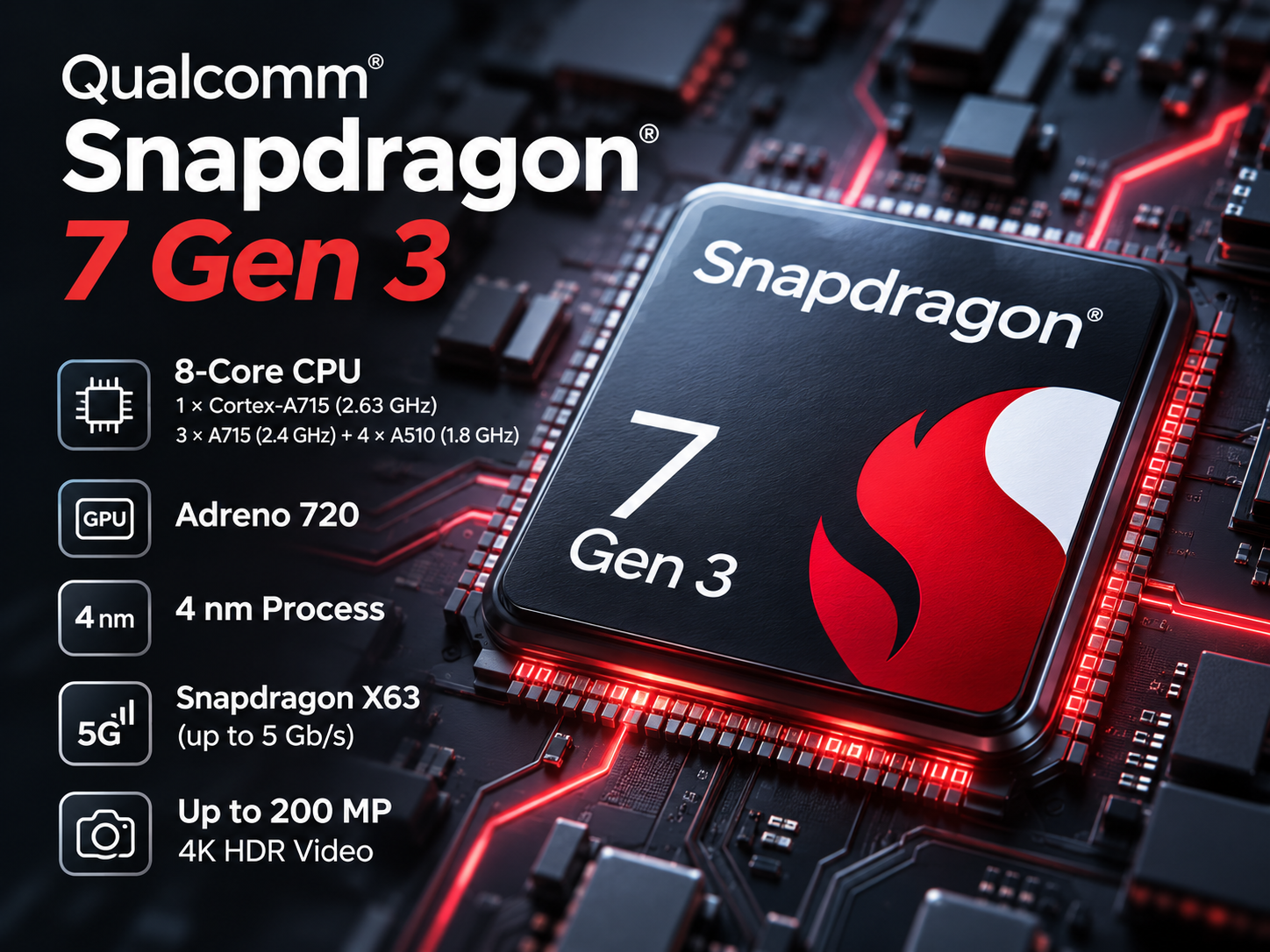
Qualcomm Snapdragon 7 Gen 3 is an eight-core mid-range mobile processor introduced in November 2023. The chip is manufactured using TSMC’s 4-nm process, uses Cortex-A715 and Cortex-A510 cores, and features an Adreno 720 GPU. The processor was used in the Honor 200, Motorola Edge 50 Pro, vivo V30, and other smartphones. Its performance is sufficient for everyday tasks and most mobile games, but it falls noticeably behind more powerful Snapdragon 7+ models in demanding titles.
Differences from Snapdragon 7s Gen 2
| Feature | Snapdragon 7 Gen 3 | Snapdragon 7s Gen 2 |
|---|---|---|
| Performance cores | 1 × A715, 2.63 GHz + 3 × A715, 2.4 GHz | 4 × A78, 2.4 GHz |
| Efficiency cores | 4 × A510, 1.8 GHz | 4 × A55, 1.95 GHz |
| Graphics | Adreno 720 | Adreno 710 |
| Modem | Snapdragon X63 | Snapdragon X62 |
| Maximum 5G speed | 5 Gb/s | 2.9 Gb/s |
| Bluetooth | 5.4 | 5.2 |
| Qualcomm fast charging | Quick Charge 5 | Quick Charge 4+ |
Both processors have eight cores, use a 4-nm process, and support Wi-Fi 6E. The main advantage of the Snapdragon 7 Gen 3 is its more modern CPU architecture and significantly more powerful graphics.
The difference is clearly visible in 3DMark Wild Life Extreme. The HTC U24 Pro with Snapdragon 7 Gen 3 scores 1595 points, while the HMD Skyline with Snapdragon 7s Gen 2 scores 808 points. The HTC’s result is approximately 97% higher. This comparison involves specific smartphones, but it shows the scale of the difference between the graphics subsystems of the two chips.
CPU Architecture and Performance
The Snapdragon 7 Gen 3 uses a 1 + 3 + 4 configuration. One Cortex-A715 core operates at up to 2.63 GHz, while three more run at up to 2.4 GHz. Four Cortex-A510 cores clocked at up to 1.8 GHz are intended for less demanding workloads.
Compared with the Snapdragon 7s Gen 2, which is based on Cortex-A78 and Cortex-A55 cores, the newer architecture provides higher per-core performance. This is useful when launching applications, processing photos, and browsing the web.
In Geekbench 6, smartphones powered by the Snapdragon 7 Gen 3 typically score around 1100-1200 points in the single-core test and 3000-3400 points in the multi-core test. Results are affected by cooling, firmware, and power-consumption settings.
This level of performance is sufficient for ordinary use. However, the advantage of more powerful processors becomes more noticeable during prolonged video processing, demanding calculations, and simultaneous use of resource-intensive applications.
Benchmark Results
The table shows results from specific smartphones rather than average Snapdragon 7 Gen 3 performance figures.
| Smartphone | Geekbench 6 Single | Geekbench 6 Multi | AnTuTu 10 | 3DMark Wild Life Extreme |
|---|---|---|---|---|
| Motorola Edge 50 Pro | 1147 | 3129 | 767 395 | 1474 |
| HTC U24 Pro | 1195 | 3410 | 781 785 | 1595 |
| Honor 200 | 1145 | 3304 | 821 670 | 1486 |
| Honor 400 | 1147 | 3189 | - | 1487 |
The results were taken from separate device tests. Testing conditions, benchmark versions, and smartphone configurations may have differed. A dash indicates that no comparable result was available.
Among the devices listed, the HTC U24 Pro achieves the highest Geekbench 6 Multi-Core result at 3410 points. This is approximately 9% higher than the Motorola Edge 50 Pro’s result. The difference between these models in 3DMark Wild Life Extreme is approximately 8%.
Differences in cooling and power settings affect the results but do not change the chip’s performance class. In Geekbench 6, all four smartphones produce similar results, especially in the single-core test.
In AnTuTu 10, the results are approximately in the range of 770,000-820,000 points. The comprehensive test takes into account not only the CPU and GPU but also RAM, storage, and software. Therefore, a difference in the overall score does not necessarily indicate a similar difference in the processor’s computing performance.
Adreno 720 Graphics and Gaming
The Adreno 720 GPU supports Vulkan 1.3 and OpenGL ES 3.2. Compared with the Adreno 710 in the Snapdragon 7s Gen 2, it provides significantly higher performance in complex graphics scenes.
In 3DMark Wild Life Extreme, smartphones with Snapdragon 7 Gen 3 score approximately 1470-1600 points. For comparison, the OnePlus Nord 4 with Snapdragon 7+ Gen 3 scores around 3083 points. This is an almost twofold advantage in this test, which is particularly important for demanding games.
Practical measurements on the Motorola Edge 50 Pro produced the following results:
| Game | Settings | Average FPS |
|---|---|---|
| Genshin Impact | Low | 59.4 |
| Genshin Impact | Maximum | 51.6 |
| PUBG Mobile | HD | 59.7 |
| PUBG Mobile | Ultra HD | 39.6 |
These figures apply to a specific smartphone and the tested versions of the games. In Genshin Impact at maximum settings, dips to 34 FPS were observed, although the average remained above 50 FPS.
The Snapdragon 7 Gen 3 is suitable for most mobile games at medium graphics settings. In less demanding titles, users can expect smooth performance at around 60 FPS. In demanding games, frame-rate stability depends on heat and the duration of the workload.
Heat and Power Efficiency
TSMC’s 4-nm process and the Cortex-A510 efficiency cores help limit power consumption under light workloads. However, actual battery life depends on the specific smartphone, including its battery capacity, display, software, and performance settings.
In testing of the Motorola Edge 50 Pro, the maximum body temperature under sustained load reached approximately 41 °C. In the 3DMark Wild Life Extreme stress test, the device retained 98.8% of its initial performance.
This is a good stability result for the tested configuration. Nevertheless, other smartphones with the same chip may show different temperatures and levels of clock-speed reduction because of differences in cooling.
Cameras, AI, and Wireless Connectivity
The Snapdragon 7 Gen 3 is equipped with a Qualcomm Spectra triple image processor. The platform supports cameras with resolutions of up to 200 MP, 4K HDR recording, and parallel data processing from multiple sensors.
The integrated Qualcomm Hexagon accelerator is intended for artificial-intelligence tasks related to photography, image recognition, and audio processing. The ability to run specific AI models depends on their memory, computing, and software-support requirements.
Wireless connectivity is provided by the Snapdragon X63 and FastConnect 6700. The platform offers:
- 5G with theoretical download speeds of up to 5 Gb/s;
- Wi-Fi 6 and Wi-Fi 6E;
- Bluetooth 5.4, including LE Audio capabilities;
- navigation support using multiple frequencies;
- Qualcomm Quick Charge 5 technology.
The availability of individual features is determined by the smartphone manufacturer. For example, platform-level support for Quick Charge 5 does not mean that this charging technology is used in every device.
Smartphones with Snapdragon 7 Gen 3
The processor was used in several device series:
- Honor 200 and Honor 400 - mid-range smartphones focused on cameras and displays.
- Motorola Edge 50 Pro - a model with a 144 Hz OLED display and fast charging.
- HTC U24 Pro - a smartphone with 12 GB of RAM in the tested configuration.
- vivo V30 and vivo V40 - models focused on photography, design, and battery life.
- OnePlus Nord CE4 - a mid-range device with Snapdragon 7 Gen 3.
Despite using the same processor, the devices differ in storage speed, memory capacity, cooling, and software. Therefore, benchmark results should be considered alongside the smartphone’s other specifications.
Relevance in 2026
The Snapdragon 7 Gen 3 still provides sufficient performance for everyday use, but it belongs to the 2023 generation. Newer solutions, including the Snapdragon 7 Gen 4, offer further advances in CPU and graphics performance.
Buying a smartphone with Snapdragon 7 Gen 3 is primarily justified when it is available at an attractive price. For messaging, browsing, navigation, photography, and video playback, this chip imposes no significant limitations.
The difference from more powerful processors is more noticeable in games. In addition, when choosing a device in 2026, it is worth considering the remaining software-support period: smartphones with the same processor may receive updates for different lengths of time.
Conclusion
The Snapdragon 7 Gen 3 is a balanced mid-range processor that provides good everyday performance, support for modern connectivity standards, and sufficient power for most mobile games.
Its main strength is a clear advantage over the Snapdragon 7s Gen 2 in graphics performance. At the same time, its performance headroom for demanding games is significantly smaller than that of the Snapdragon 7+ Gen 3 and newer high-performance platforms.
In 2026, a smartphone with Snapdragon 7 Gen 3 remains a sensible choice if it costs noticeably less than models with more modern processors. Its capabilities are sufficient for everyday tasks and moderately demanding games. For long gaming sessions at high frame rates, it is better to choose a more powerful chip.
SOC Comparison
Compare Snapdragon 7 Gen 3 with other SOCs
Basic
3x 2.4 GHz – Cortex-A715
4x 1.8 GHz – Cortex-A510
GPU Specifications
Connectivity
Memory Specifications
Miscellaneous
Benchmarks
Phones with Snapdragon 7 Gen 3














Tablets with Snapdragon 7 Gen 3

Comparison of Devices with Snapdragon 7 Gen 3
Compared to Other SoC
Related SoC Comparisons



Share in social media
Or Link To Us
<a href="https://cputronic.com/soc/qualcomm-snapdragon-7-gen-3" target="_blank">Qualcomm Snapdragon 7 Gen 3</a>