Apple A20 Pro

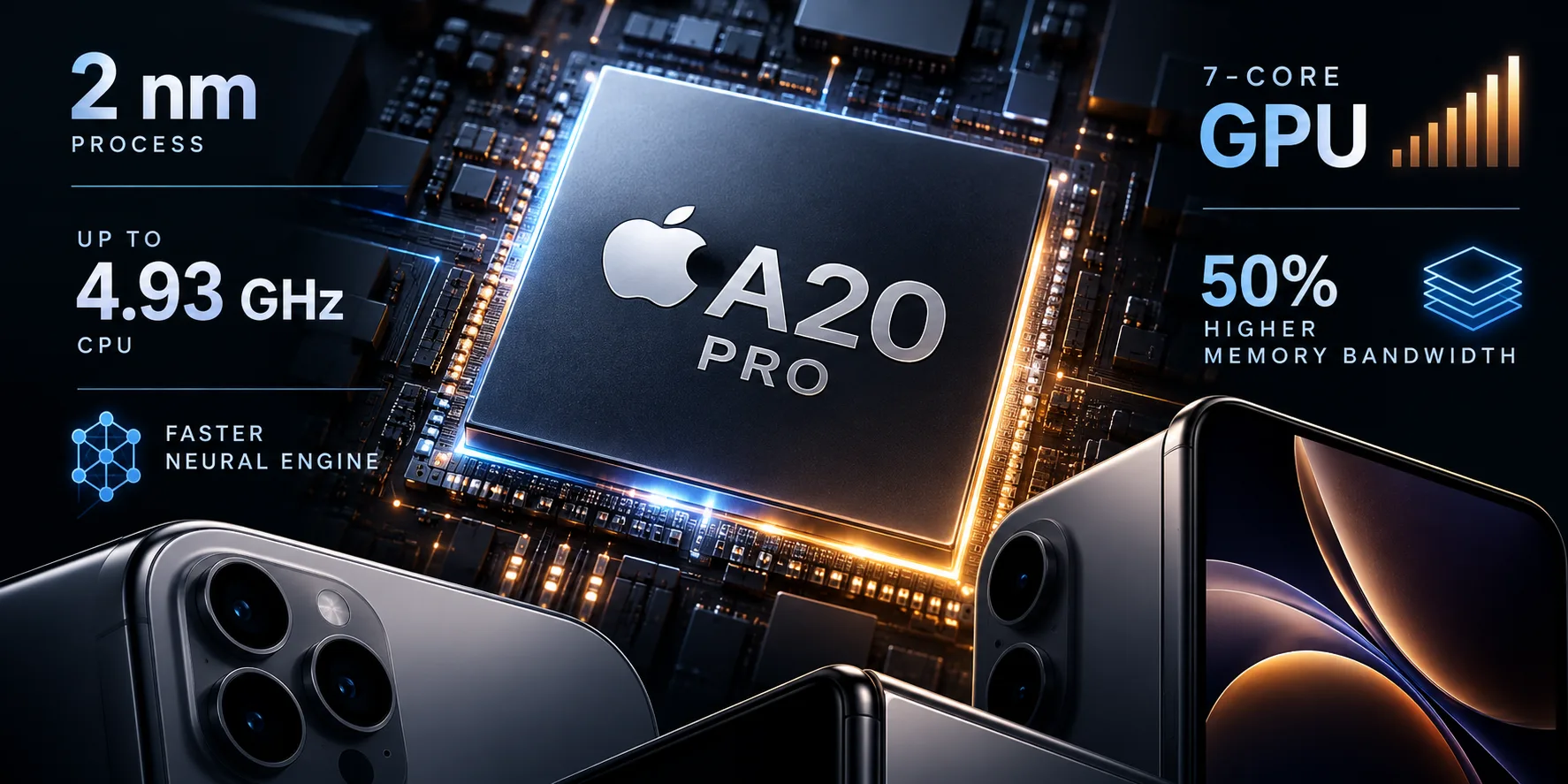
Apple A20 Pro: 2nm Process, Faster CPU, and 7-Core GPU
The Apple A20 Pro has moved to a 2nm process, retaining six CPU cores while gaining higher clock speeds and a 7-core GPU. In the iPhone 18 Pro, the new chip is approximately 25% faster than the A19 Pro in Geekbench 6 Single-Core, 31% faster in Multi-Core, and about one-third faster in 3DMark Solar Bay Unlimited.
The first devices to use the A20 Pro were the iPhone 18 Pro and iPhone 18 Pro Max. The chip is also used in the foldable iPhone Duo.
CPU: Most of the Gain Comes in Multi-Core
The CPU includes two performance cores and four efficiency cores. The performance cores run at up to 4.93 GHz, compared with approximately 4.26 GHz for the A19 Pro.
In Geekbench 6, the iPhone 18 Pro scores approximately 4,733 points in Single-Core and 12,797 in Multi-Core. The iPhone 17 Pro with the A19 Pro scores approximately 3,799 and 9,773 points, respectively. The difference is approximately 25% in the single-threaded test and 31% in the multi-threaded test.
Benchmarks
The table lists results from specific smartphones rather than average chip scores.
| Device | Chip | Geekbench 6 Single | Geekbench 6 Multi | AnTuTu 11 | 3DMark Solar Bay Unlimited | Starting price |
|---|---|---|---|---|---|---|
| iPhone 18 Pro | Apple A20 Pro | 4,733 | 12,797 | 3,592,814 | 16,288 | $1,199 |
| iPhone 18 Pro Max | Apple A20 Pro | 4,741 | 12,789 | - | 17,850 | $1,299 |
| iPhone 17 Pro | Apple A19 Pro | 3,799 | 9,773 | 2,039,555 | 12,208 | $1,099 |
| Samsung Galaxy S26 Ultra | Snapdragon 8 Elite Gen 5 | 3,730 | 11,538 | 3,869,110 | 12,984 | $1,299 |
In Geekbench 6, the A20 Pro has a particularly clear lead over the Snapdragon 8 Elite Gen 5 in Single-Core. The gap is significantly smaller in Multi-Core.
AnTuTu 11 is more difficult to use for a direct comparison between iOS and Android because of differences between the platforms. This test is therefore more useful here for comparing the A20 Pro with the A19 Pro than for a direct comparison with Android chips.
GPU: About 33% Faster Than the A19 Pro in Solar Bay Unlimited
The A20 Pro uses a 7-core GPU, while the A19 Pro in the iPhone 17 Pro has a 6-core GPU.
In 3DMark Solar Bay Unlimited, the iPhone 18 Pro scores 16,288 points versus 12,208 for the iPhone 17 Pro. The gain is approximately 33%.
The iPhone 18 Pro Max scores 17,850 points, exceeding the result of the standard Pro model.
In Wild Life Extreme, the iPhone 18 Pro Max scores approximately 8,344 points, and 2,904 in Solar Bay Extreme.
A Qualcomm engineering platform with the Snapdragon 8 Elite Extreme Gen 6 scores approximately 9,941 points in Wild Life Extreme and 2,262 in Solar Bay Extreme. This is an engineering platform, so its results cannot be directly equated with tests of production smartphones.
In the Wild Life Extreme stress test, the iPhone 18 Pro scores between 4,999 and 6,410 points per cycle. The impact of cooling is more pronounced under sustained graphics workloads than in short tests.
Memory and Cooling
Apple claims that memory bandwidth has increased by approximately 50% compared with the A19 Pro.
The iPhone 18 Pro and iPhone 18 Pro Max feature a new cooling system with a vapor chamber. The iPhone Duo also uses a vapor chamber. The real-world performance of this model should be assessed separately once independent tests become available.
Neural Engine
The A20 Pro features an updated Neural Engine, for which Apple claims a twofold increase in computing power compared with the previous generation. Additional Neural Accelerators are also integrated into the CPU.
Devices Using the A20 Pro
The A20 Pro is used in three Apple models:
- iPhone 18 Pro - from $1,199
- iPhone 18 Pro Max - from $1,299
- iPhone Duo - from $1,999
The iPhone 18 Pro and iPhone 18 Pro Max are already available for purchase. The iPhone Duo will go on sale on October 23, 2026.
In short CPU tests, the difference between the iPhone 18 Pro and iPhone 18 Pro Max is minimal. There are not yet enough independent production-device tests for the iPhone Duo.
Conclusion
Compared with the A19 Pro, the A20 Pro delivers approximately 25% higher performance in Geekbench 6 Single-Core, 31% in Multi-Core, and about 33% in Solar Bay Unlimited on the iPhone 18 Pro. In Geekbench, Apple’s new chip has a larger lead over the Snapdragon 8 Elite Gen 5 in the single-threaded test, while the difference is smaller in Multi-Core.
Under sustained graphics workloads, results also depend on the device’s cooling: the iPhone 18 Pro Max is noticeably faster than the standard Pro in Solar Bay Unlimited.
SOC Comparison
Compare Apple A20 Pro with other SOCs
Basic
GPU Specifications
Connectivity
Memory Specifications
Miscellaneous
Benchmarks
Phones with A20 Pro


Comparison of Devices with A20 Pro
Compared to Other SoC
Related SoC Comparisons




Share in social media
Or Link To Us
<a href="https://cputronic.com/soc/apple-a20-pro" target="_blank">Apple A20 Pro</a>