Xiaomi Xring O3
Xiaomi Xring O3: Benchmarks for the 18 Fold and Pad 9 Pro Max
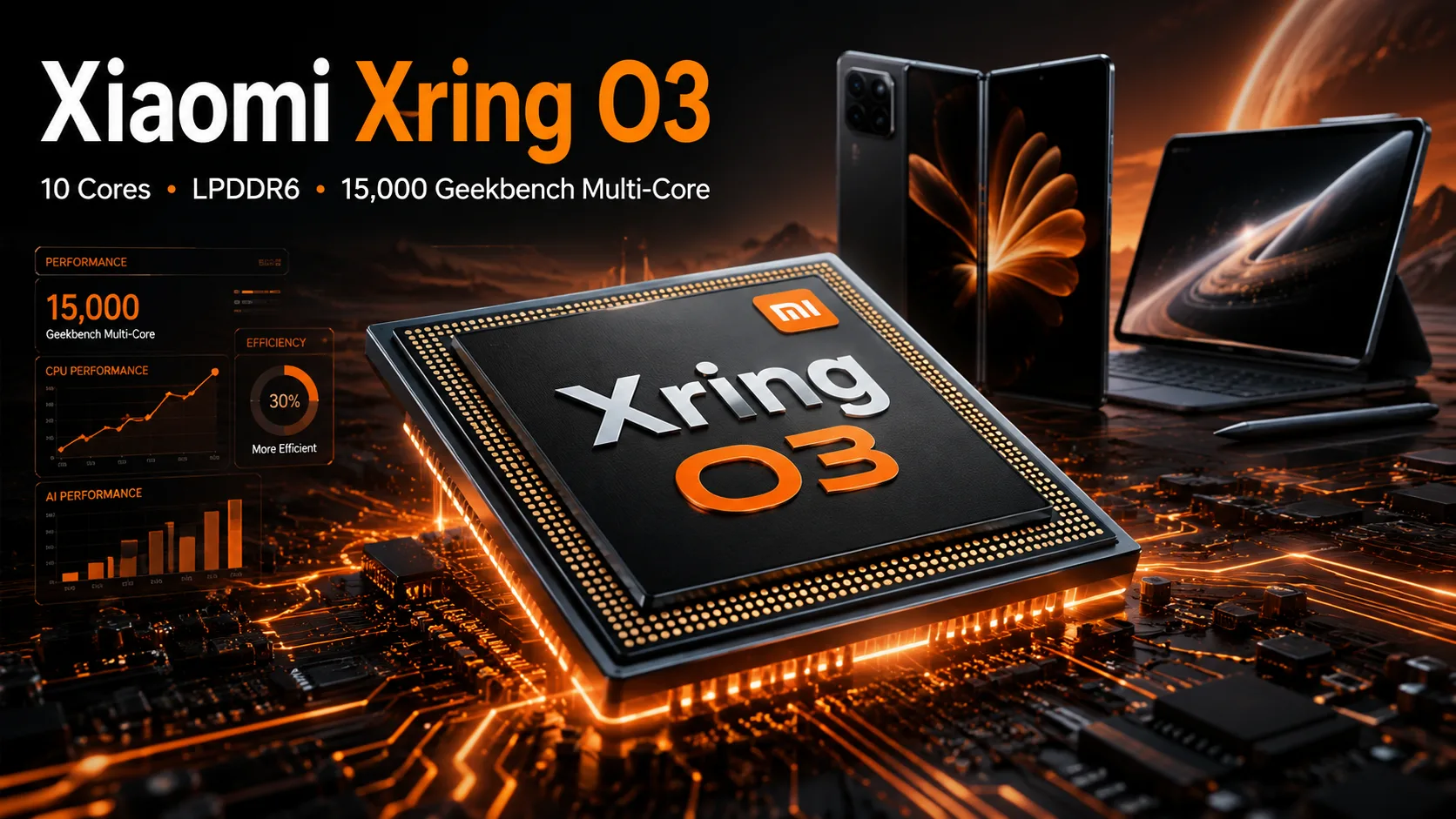
On September 7, 2026, the Xring O3 debuted in two Xiaomi devices at once-the foldable 18 Fold and the Pad 9 Pro Max tablet. In Geekbench, the new SoC scores around 14,000 points in Multi-Core, while Xiaomi lists a score of 5.61 million in AnTuTu for the Pad 9 Pro Max.
10 Cores in a 2 + 4 + 4 Configuration
The 10-core CPU is divided into three clusters. Two C1-Ultra cores run at up to 4.35 GHz, four C1-Premium cores at up to 3.68 GHz, and four C1-Pro cores at up to 3.15 GHz.
There is no separate small-core cluster. This configuration performs particularly well in multithreaded workloads: the Xring O3 clearly outpaces the Xring O1 in Geekbench Multi-Core.
The chip is manufactured using TSMC’s 3nm process.
Xring O3 in the Xiaomi 18 Fold and Pad 9 Pro Max
Geekbench already includes results for the Xiaomi 18 Fold and Pad 9 Pro Max with the Xring O3.
| Device | Processor | RAM | Geekbench 6 Single | Geekbench 6 Multi |
|---|---|---|---|---|
| Xiaomi 18 Fold | Xring O3 | 16 GB | 3643 | 13,633 |
| Xiaomi Pad 9 Pro Max | Xring O3 | 16 GB | 3541 | 14,153 |
| Apple iPhone 17 Pro Max | Apple A19 Pro | - | 3883 | 10,017 |
| Vivo iQOO 15 Ultra | Snapdragon 8 Elite Gen 5 | 16 GB | 3728 | 11,811 |
| Xiaomi 15S Pro | Xring O1 | 16 GB | 2985 | 9250 |
The table shows individual Geekbench 6.7.1 results, so scores may vary between runs.
In Multi-Core, the Xiaomi 18 Fold and Pad 9 Pro Max score around 14,000 points and outperform the A19 Pro- and Snapdragon 8 Elite Gen 5-powered devices listed here.
The difference is much smaller in Single-Core: the Xring O3 delivers results close to those of other flagship SoCs.
The results from the actual devices are below Xiaomi’s initial laboratory figures of 3945 points in Single-Core and 15,221 in Multi-Core.
AnTuTu: Up to 5.61 Million on the Pad 9 Pro Max
At its presentation, Xiaomi announced an AnTuTu score of 5.61 million points for the Pad 9 Pro Max. The result applies specifically to the Pad 9 Pro Max.
The Xring O3 reference platform was previously reported to score around 5.2 million points.
AnTuTu combines the CPU, GPU, memory, and other system components. Therefore, the result characterizes the entire platform rather than just the processor cores.
New G2-Ultra NX Graphics
The Xring O3 uses a 16-core Arm Mali-G2 Ultra NX MC16 GPU. According to Xiaomi and Arm, the GPU is up to 85% faster than the Xring O1’s graphics while consuming less power.
The G2-Ultra NX features eight NX blocks for neural graphics. They are used for image upscaling, frame generation, noise reduction, and ray-tracing effects processing.
The Xiaomi 18 Fold became the first mass-produced smartphone with this graphics architecture. For now, the capabilities of the NX blocks are limited by the number of games and applications that support them.
LPDDR6 with 113.8 GB/s of Bandwidth
The Xring O3 supports LPDDR6 with bandwidth of up to 113.8 GB/s.
The Xiaomi 18 Fold became Xiaomi’s first flagship with LPDDR6 from CXMT.
The Pad 9 Pro Max and Xiaomi 18 Fold are available in configurations with up to 16 GB of memory.
Up to 200 TOPS from the NPU
The Xring O3 features a quad-core NPU for local language and multimodal models. It is rated for up to 200 TOPS of peak performance.
AI workloads are also accelerated by the GPU and the image- and video-processing blocks.
The TOPS figure itself cannot be directly compared across different architectures without considering the compute precision and workload type. In practice, performance will be determined by the specific models and Xiaomi’s software stack.
Xiaomi 18 Fold
The Xiaomi 18 Fold became the first smartphone powered by the Xring O3. Because of its foldable design, it operates under more demanding thermal conditions than the Pad 9 Pro Max.
The smartphone comes with up to 16 GB of LPDDR6 and a 6000 mAh battery. Its starting price in China is 10,999 yuan, while the 16 GB + 1 TB version costs 14,999 yuan.
Xiaomi Pad 9 Pro Max
The Pad 9 Pro Max became the first tablet powered by the Xring O3. Its large chassis allows for more effective cooling during sustained workloads.
The tablet comes with up to 16 GB of memory, a 12,000 mAh battery, and 120 W charging. Pricing starts at 4799 yuan.
In Geekbench 6 Multi-Core, the Pad 9 Pro Max scores more than 14,000 points.
From Xring O1 to O3
The Xring O1, introduced in 2025, was Xiaomi’s first flagship SoC. It was used in the Xiaomi 15S Pro and several tablets.
The next production generation received the O3 designation.
| Generation | Year | Production devices | Geekbench 6 Multi |
|---|---|---|---|
| Xring O1 | 2025 | Xiaomi 15S Pro, Pad 7 Ultra | around 9250 in Xiaomi 15S Pro |
| Xring O3 | 2026 | Xiaomi 18 Fold, Pad 9 Pro Max | up to 14,000+ |
In Geekbench 6 Multi-Core, devices with the Xring O3 score approximately 4,000-5,000 points more than the Xiaomi 15S Pro with the Xring O1.
The O3 designation remains unusual: after the Xring O1, Xiaomi jumped directly to the O3 index.
Conclusion
The Xiaomi 18 Fold and Pad 9 Pro Max score around 14,000 points in Geekbench 6 Multi-Core. This is below the laboratory result of 15,221 points, but significantly higher than the Xring O1’s score.
In terms of CPU performance, the Xring O3 is already comparable to flagship SoCs from Apple, Qualcomm, and MediaTek, and it outperforms some of them in Multi-Core.
The next test for the Xring O3 is sustained load: clock speeds, thermals, and power consumption in the 18 Fold and Pad 9 Pro Max.
SOC Comparison
Compare Xring O3 with other SOCs
Basic
GPU Specifications
Memory Specifications
Miscellaneous
Benchmarks
Compared to Other SoC
Related SoC Comparisons



Share in social media
Or Link To Us
<a href="https://cputronic.com/soc/xiaomi-xring-o3" target="_blank">Xiaomi Xring O3</a>