Qualcomm Snapdragon 8 Elite Gen 6

Qualcomm Snapdragon 8 Elite Gen 6: 2 nm, 5 GHz, and a GPU Boost
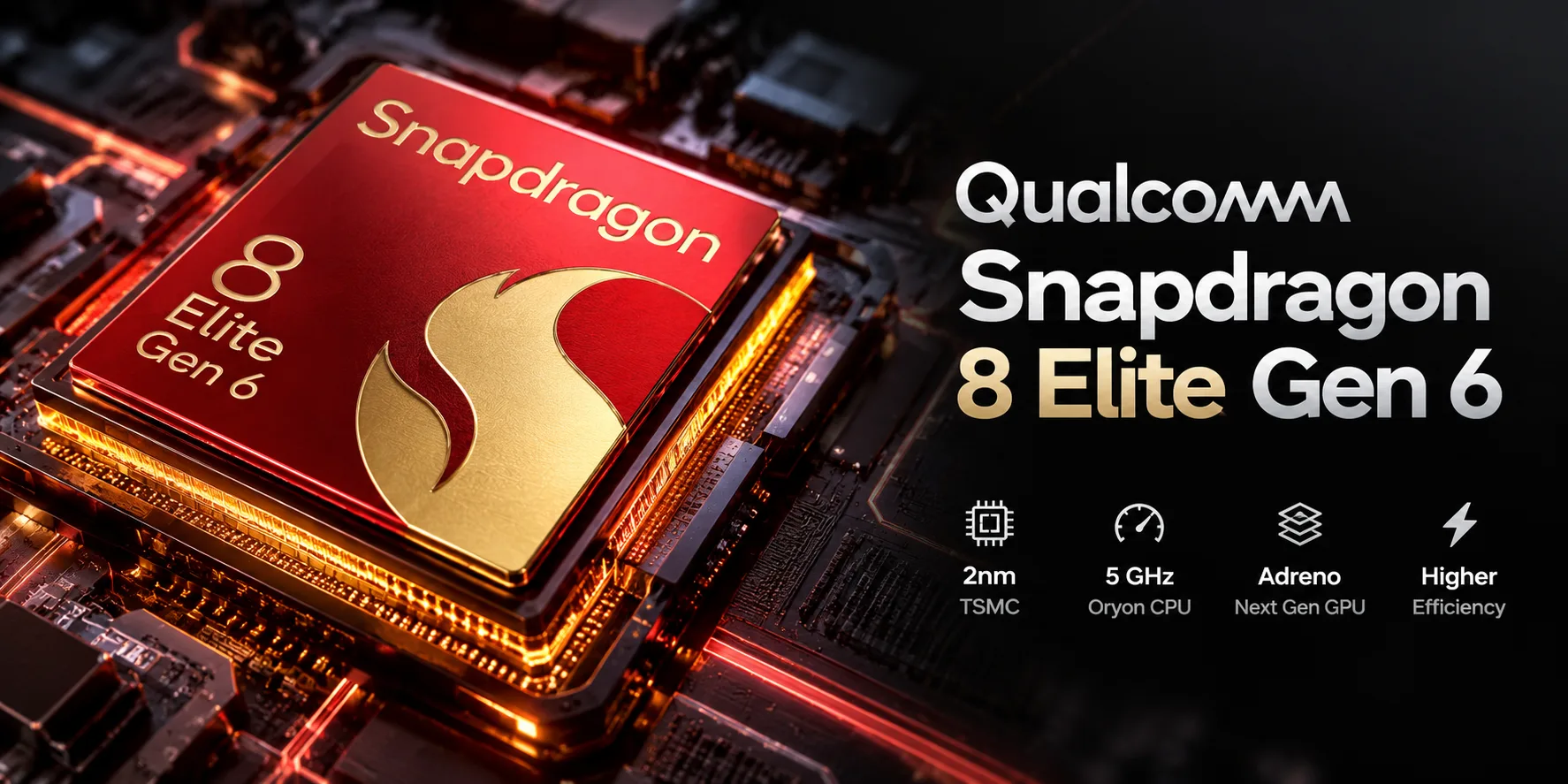
Snapdragon 8 Elite Gen 6 is one of Qualcomm’s two flagship mobile chips for 2026. It is manufactured on TSMC’s 2 nm process, while the clock speed of its prime Oryon cores reaches 5 GHz. Compared with the previous generation, the main changes affect graphics and power efficiency, while the CPU gains in the first tests proved modest.
The chip was unveiled on September 22, 2026. One of the first production smartphones based on Snapdragon 8 Elite Gen 6 was the Xiaomi 18 Pro.
CPU: Oryon clocked at up to 5 GHz
The two prime Oryon cores run at up to 5 GHz, which is higher than in the previous generation.
Snapdragon 8 Elite Gen 6 is manufactured on TSMC’s 2 nm process, replacing the 3 nm process used for Snapdragon 8 Elite Gen 5. According to Qualcomm, the CPU is up to 10% faster and up to 37% more power-efficient.
In the first production smartphones, the difference is smaller than the claimed 10%. The Xiaomi 18 Pro scores around 3866 points in Geekbench 6 Single-Core and 11 140 in Multi-Core. The OnePlus 15 with Snapdragon 8 Elite Gen 5 scores around 3607 and 10 732 points, respectively.
The difference is approximately 7% in the single-threaded test and 4% in the multi-threaded test.
Smartphone benchmarks
The table uses results from specific smartphones rather than average SoC results.
| Smartphone | Processor | Geekbench 6 Single | Geekbench 6 Multi | AnTuTu 11 | Launch price |
|---|---|---|---|---|---|
| Xiaomi 18 Pro | Snapdragon 8 Elite Gen 6 | 3866 | 11 140 | 4 888 150 | around $840 |
| Samsung Galaxy S26 Ultra | Snapdragon 8 Elite Gen 5 | 3624 | 11 049 | 3 939 244 | $1299 |
| OnePlus 15 | Snapdragon 8 Elite Gen 5 | 3607 | 10 732 | 4 008 294 | $899 |
| iPhone 18 Pro | Apple A20 Pro | 4735 | 12 800 | - | $1199 |
In Geekbench, Snapdragon 8 Elite Gen 6 is only slightly faster than Snapdragon 8 Elite Gen 5, while the Apple A20 Pro maintains a significant lead in single-threaded performance.
Therefore, the Xiaomi 18 Pro’s 4.89 million points in AnTuTu cannot be assumed for all devices with this chip.
GPU: the generation’s most significant improvement
The GPU gain is noticeably larger than the CPU gain. Qualcomm claims up to 35% higher GPU performance and up to 40% better power efficiency compared with the previous generation.
The following results were obtained in early 3DMark Steel Nomad Light tests:
| Platform | 3DMark Steel Nomad Light | Power consumption in test |
|---|---|---|
| Apple A20 Pro | 4255 | 14 W |
| MediaTek Dimensity 9600 Pro | 4238 | 16 W |
| Snapdragon 8 Elite Extreme Gen 6 | 3688 | 17 W |
| Snapdragon 8 Elite Gen 6 | 3579 | 14 W |
| Snapdragon 8 Elite Gen 5 | 3015 | 13 W |
The table uses results from early test platforms rather than production smartphones.
In Steel Nomad Light, Snapdragon 8 Elite Gen 6 is approximately 19% ahead of Snapdragon 8 Elite Gen 5.
The Adreno supports hardware-accelerated ray tracing and Vulkan 1.4. Support for Nanite and Lumen is claimed for games running on Unreal Engine.
In a Qualcomm demonstration, a system with Lumen reached up to 60 FPS while consuming less than 5 W.
Heat and throttling
Tests of the Xiaomi 18 Pro show that moving to 2 nm does not eliminate high temperatures in a production smartphone.
In the 30-minute CPU Throttling Test, the Chinese version of the Xiaomi 18 Pro initially maintained around 80% of its maximum performance, after which performance began to drop sharply and briefly. The average result was approximately 67% of the maximum.
During AnTuTu, the test smartphone’s chassis temperature exceeded 50 °C.
How Gen 6 differs from Elite Extreme Gen 6
The two versions are similar in terms of CPU: both are manufactured on a 2 nm process and use Oryon cores clocked at around 5 GHz. The main differences are related to graphics and video processing.
Elite Extreme Gen 6 features Adreno matrix cores, Adreno Neural Fusion, and expanded video-processing capabilities. The additional Extreme blocks are primarily intended for GPU, AI, and multimedia workloads.
NPU and connectivity
For the Hexagon NPU, Qualcomm claims an approximately 14% performance increase and up to 20% better performance per watt.
Snapdragon X105 supports 5G Advanced with download speeds of up to 14.8 Gbps and upload speeds of up to 4.2 Gbps.
FastConnect 8800 supports Wi-Fi 8, channels up to 320 MHz wide, and speeds of up to 11.6 Gbps.
Conclusion
In terms of CPU performance, Snapdragon 8 Elite Gen 6 is only slightly faster than Snapdragon 8 Elite Gen 5: in the first tests, the difference is approximately 7% in Single-Core and 4% in Multi-Core.
The GPU gained more substantially: in the early Steel Nomad Light test, the new Adreno is approximately 19% faster than the previous generation while consuming a similar amount of power.
Elite Extreme Gen 6 remains the higher-end version thanks to its additional GPU and AI capabilities. The standard Gen 6 features a new Adreno, a 2 nm process, and a next-generation connectivity platform, but lacks the additional Extreme GPU and AI blocks.
SOC Comparison
Compare Snapdragon 8 Elite Gen 6 with other SOCs
Basic
GPU Specifications
Connectivity
Memory Specifications
Miscellaneous
Benchmarks
Compared to Other SoC
Related SoC Comparisons





Share in social media
Or Link To Us
<a href="https://cputronic.com/soc/qualcomm-snapdragon-8-elite-gen-6" target="_blank">Qualcomm Snapdragon 8 Elite Gen 6</a>