Qualcomm Snapdragon 8 Elite

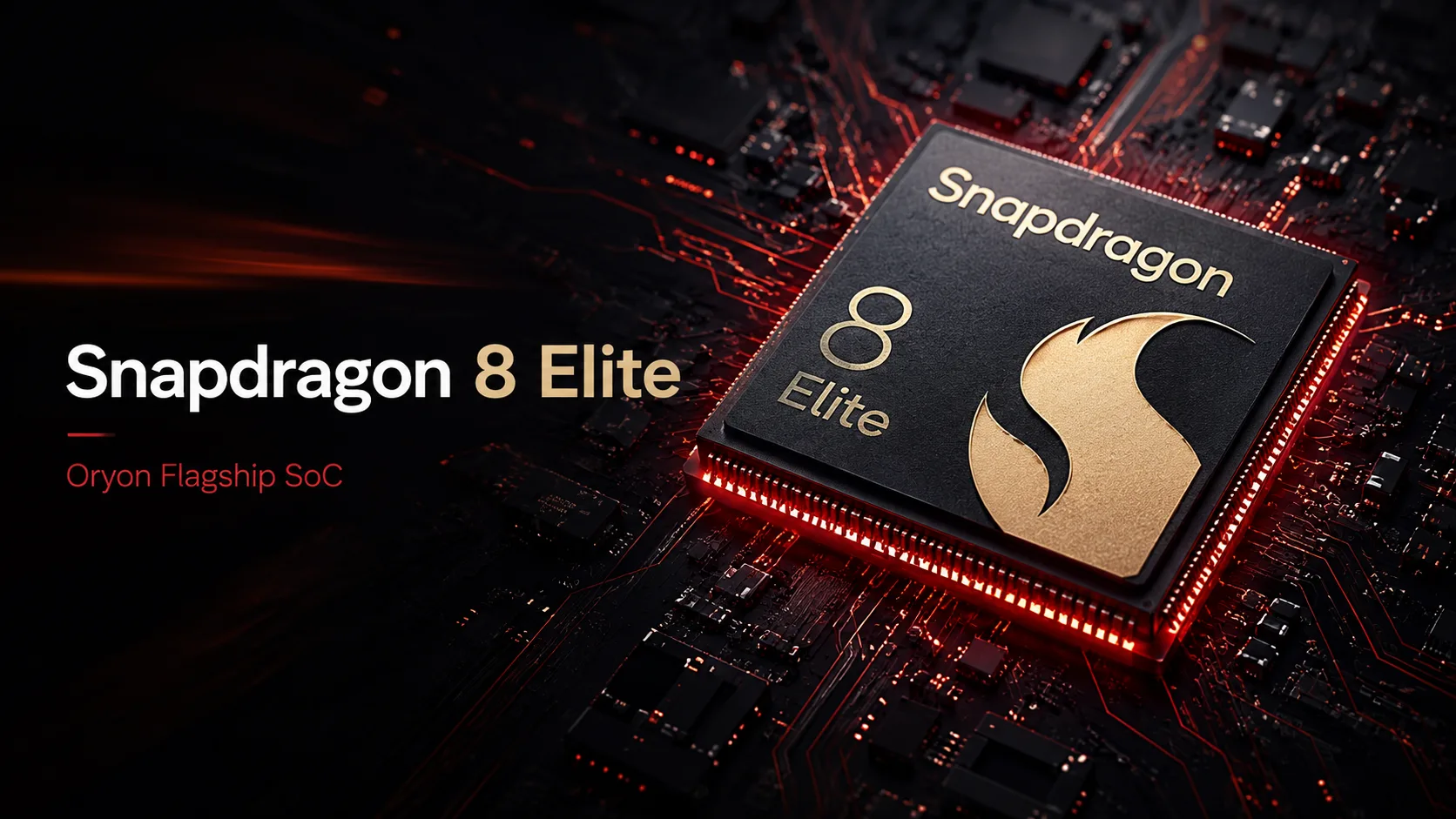
Qualcomm Snapdragon 8 Elite: Not Just a New Flagship, But a Change of Course for Snapdragon
The Snapdragon 8 Elite is noteworthy not just for scoring around 3 million points in AnTuTu. It's hard to impress with that today; every new flagship chip must be fast. Much more important is the fact that Qualcomm has changed the very foundation of its top mobile platform.
While Snapdragon 8 Gen 3 was a powerful but still familiar continuation of the old line, Snapdragon 8 Elite appeared as a reboot. Qualcomm didn’t name it Snapdragon 8 Gen 4, even though many logically expected that. Instead, the company included the word "Elite" in the name to emphasize that this is not a typical annual update, but the first mobile Snapdragon featuring custom Oryon cores.
However, there was a downside to this decision. The name is striking, but not very convenient. To the average reader, Snapdragon 8 Elite might seem like either Snapdragon 8 Gen 4 under a new name, an entirely separate line, or the beginning of a new scheme without generations.
That’s why the story of the name became almost as interesting as the chip itself. In the next generation, Qualcomm retained the word Elite but returned a generation to the name - Snapdragon 8 Elite Gen 5. This way, Elite remained a marker of the highest level, while Gen 5 again clarifies the chip's position in the lineup. It turned out that Snapdragon 8 Elite became not only an architectural transition but also a naming bridge: it started the Oryon phase for mobile Snapdragon but temporarily broke the familiar naming scheme.
What is the Main Idea of Snapdragon 8 Elite
The Snapdragon 8 Elite has an 8-core CPU: 2 Prime cores with a frequency of up to 4.32 GHz and 6 performance cores up to 3.53 GHz. In certain versions, the maximum frequency can be higher, so when comparing smartphones, it’s essential to look at the specifications of the specific model.
The focus here isn’t just on clock speeds. Snapdragon 8 Elite is built around the Oryon CPU architecture - a foundation that Qualcomm promotes not as another minor upgrade, but as a new basis for its top platforms.
For Android flagships, this is a significant moment. For a long time, Snapdragon updates looked predictable: new Cortex cores, higher clock speeds, better efficiency, and slightly improved graphics. Snapdragon 8 Elite breaks this inertia. Qualcomm is trying to play not just in annual upgrades but rather in its own architectural story-similar to how Apple has long done with its A chips.
In practice, this is most noticeable in short and sharp tasks: launching applications, browsing, interface responsiveness, photo processing, switching between heavy applications. In scenarios where a smartphone must instantly respond rather than merely “cope,” the fast Prime cores provide a noticeable advantage.
Why Benchmarks Aren’t the Whole Story Here
In Geekbench 6, Snapdragon 8 Elite scores about 3300 points in single-core and around 9800-9900 in multi-core. In AnTuTu 10, the result may be around 3 million points. These numbers are strong, but they shouldn’t be perceived as absolute guarantees.
The same Snapdragon 8 Elite in two smartphones can behave differently. In a gaming device with a large body and adequate cooling, it can sustain high frequencies longer. In a thin flagship focused on design, manufacturers may limit the power more quickly to prevent overheating.
Therefore, Snapdragon 8 Elite is not a magical label of “always maximum.” It’s a powerful platform, but it only reveals its potential where manufacturers haven’t throttled it with cooling, memory, and power consumption settings.
What to Look for in a Smartphone with Snapdragon 8 Elite
The chip itself is only half the story. For Snapdragon 8 Elite to truly work as a flagship, the entire smartphone surrounding it is essential.
- Cooling. Without proper heat dissipation, high performance quickly turns into throttling.
- Memory and Storage. A flagship SoC loses part of its appeal if the manufacturer skimped on RAM or UFS speed.
- Performance Profiles. Some brands run the chip aggressively, while others throttle it more quickly for temperature and battery life.
- Battery. A powerful processor is only good when the smartphone doesn’t need to be constantly conserved from draining.
- Camera and Processing. Snapdragon 8 Elite provides a strong base, but final photos depend on sensors, optics, and the manufacturer's algorithms.
On paper, different smartphones may have the same Snapdragon 8 Elite. In reality, one may confidently handle workloads, while another quickly drops frequencies.
Adreno 830 - The Second Reason to Look at This Chip
The CPU has received more attention due to Oryon, but the graphics are no less important. Adreno 830 is one of the strongest components of Snapdragon 8 Elite. It’s the GPU that makes this chip particularly interesting for gaming smartphones and high-end Android flagships.
In everyday tasks, the difference between Snapdragon 8 Gen 3 and Snapdragon 8 Elite won’t always be noticeable. Messengers, browsers, videos, and cameras will be fast on both. But in demanding games, emulators, high resolutions, and extended sessions, the GPU’s headroom starts to matter.
Snapdragon 8 Elite is better suited for scenarios where a smartphone isn’t bought “for a year,” but for the long haul: gaming at high settings, future engine updates, heavier graphics, upscaling, and stable FPS under load.
Main Competitor: MediaTek Dimensity 9400
The direct competitor to Snapdragon 8 Elite from MediaTek is the Dimensity 9400. This is also a flagship 3nm chip for expensive Android smartphones, but with a different CPU philosophy.
Qualcomm has opted for its proprietary Oryon cores. MediaTek has taken another route, using an aggressive All Big Core scheme: 1 Cortex-X925, 3 Cortex-X4, and 4 Cortex-A720. There are no small energy-efficient cores in the traditional sense here-all cores are designed for high-performance levels.
That’s why comparing Snapdragon 8 Elite and Dimensity 9400 is more interesting than just a standard battle of “who has more points.” Qualcomm is showing a new stage for Snapdragon with its architecture, while MediaTek is pushing with large Arm cores, strong Immortalis-G925 graphics, and high peak performance.
| What We Compare | Snapdragon 8 Elite | Dimensity 9400 |
|---|---|---|
| CPU Approach | Qualcomm's proprietary Oryon cores | All Big Core on Arm cores |
| CPU Configuration | 2 Prime + 6 Performance | 1 Cortex-X925 + 3 Cortex-X4 + 4 Cortex-A720 |
| GPU | Adreno 830 | Immortalis-G925 |
| Main Idea | A new architectural chapter for Snapdragon | Maximum performance through large Arm cores |
| Where Particularly Interesting | Global Android flagships, gaming models, devices with strong optimization | Chinese flagships, top models from Vivo, Oppo, and other brands |
| What’s Important to Check | Cooling and manufacturer settings | Cooling, battery life, and availability of specific models |
The Dimensity 9400 cannot be dismissed as a “cheaper alternative.” It’s a full flagship competitor. In some smartphones, it can be very close to Snapdragon 8 Elite, and in other cases, it may even be more advantageous in terms of price, battery life, or stability under load.
However, Snapdragon typically has stronger global recognition, wider presence in top Android models, and a robust ecosystem around Adreno graphics. Therefore, the choice between Snapdragon 8 Elite and Dimensity 9400 is not just a benchmarking issue, but a matter of the specific smartphone.
AI and Camera: Not Magic, But a Powerful Base
Snapdragon 8 Elite provides manufacturers with a powerful NPU, a fast ISP, and tools for local photo and video processing. In good implementations, this helps to quickly process shots, more accurately segment scenes, enhance videos, and run AI functions directly on the device.
But the chip alone doesn’t guarantee the best camera. The sensor, optics, and brand algorithms are equally crucial. Snapdragon 8 Elite is a foundation, not ready-made photographic magic.
How Snapdragon 8 Elite Differs from Snapdragon 8 Gen 3
The difference between Snapdragon 8 Elite and Snapdragon 8 Gen 3 isn’t just in percentages. Snapdragon 8 Gen 3 remains a fast chip, and for many users, it will be sufficient. But Snapdragon 8 Elite is more important as an architectural transition.
| What We Compare | Snapdragon 8 Gen 3 | Snapdragon 8 Elite |
|---|---|---|
| CPU | Classic scheme with Cortex cores | Qualcomm's proprietary Oryon cores |
| Performance | Still flagship level | Noticeable leap in CPU and GPU |
| Gaming | High performance | More headroom for heavy graphics |
| AI | Strong block for its generation | More headroom for local AI functions |
| Upgrade Value | Good flagship | New stage for Qualcomm |
If choosing between two smartphones, Snapdragon 8 Elite appears more interesting in terms of potential. But if a model with Snapdragon 8 Gen 3 is significantly cheaper, has good cooling, a strong camera, and decent battery life, it may still be the more reasonable purchase.
Who Really Needs Snapdragon 8 Elite
Snapdragon 8 Elite isn’t necessary for users who use their smartphones for messaging, photography, browsing, and YouTube playback. For such tasks, a simpler flagship or sub-flagship SoC will suffice.
Its value becomes evident in other areas: gaming, emulators, heavy multitasking, video recording, local AI functions, and headroom for several years. In simpler terms, Snapdragon 8 Elite shines best not in any expensive smartphone, but in a well-built flagship with proper cooling, fast memory, a strong battery, and smart performance tuning.
Conclusion
Snapdragon 8 Elite is not a typical annual Snapdragon update. Its main value lies not in the attractive name or record benchmark scores, but in Qualcomm’s shift to Oryon cores in its mobile flagship platform.
Even the name now appears as part of this story. Qualcomm dropped the familiar “Gen 4” to emphasize the leap, but in the next generation, it returned the generation to the name - Snapdragon 8 Elite Gen 5. This way, Elite remained a designation of the top level, while Gen 5 again clarifies the chip’s position in the lineup.
As a result, Snapdragon 8 Elite can be considered a transitional but very important chip. It started a new architectural chapter for Qualcomm, giving Android flagships powerful CPU, strong Adreno 830 graphics, and significant headroom for AI functions. Alongside it emerged a serious competitor - MediaTek Dimensity 9400, which shows a different path: not its own Oryon cores but an aggressive All Big Core scheme on Arm.
This is precisely what makes Snapdragon 8 Elite interesting. It’s not just another fast processor for expensive smartphones, but a platform that shows where top Android flagships are heading next.
SOC Comparison
Compare Snapdragon 8 Elite with other SOCs
Basic
GPU Specifications
Connectivity
Memory Specifications
Miscellaneous
Benchmarks
Phones with Snapdragon 8 Elite











































Tablets with Snapdragon 8 Elite







Comparison of Devices with Snapdragon 8 Elite
Compared to Other SoC
Related SoC Comparisons




Share in social media
Or Link To Us
<a href="https://cputronic.com/soc/qualcomm-snapdragon-8-elite" target="_blank">Qualcomm Snapdragon 8 Elite</a>