Qualcomm Snapdragon 8 Elite
vs
Qualcomm Snapdragon 8 Gen 3

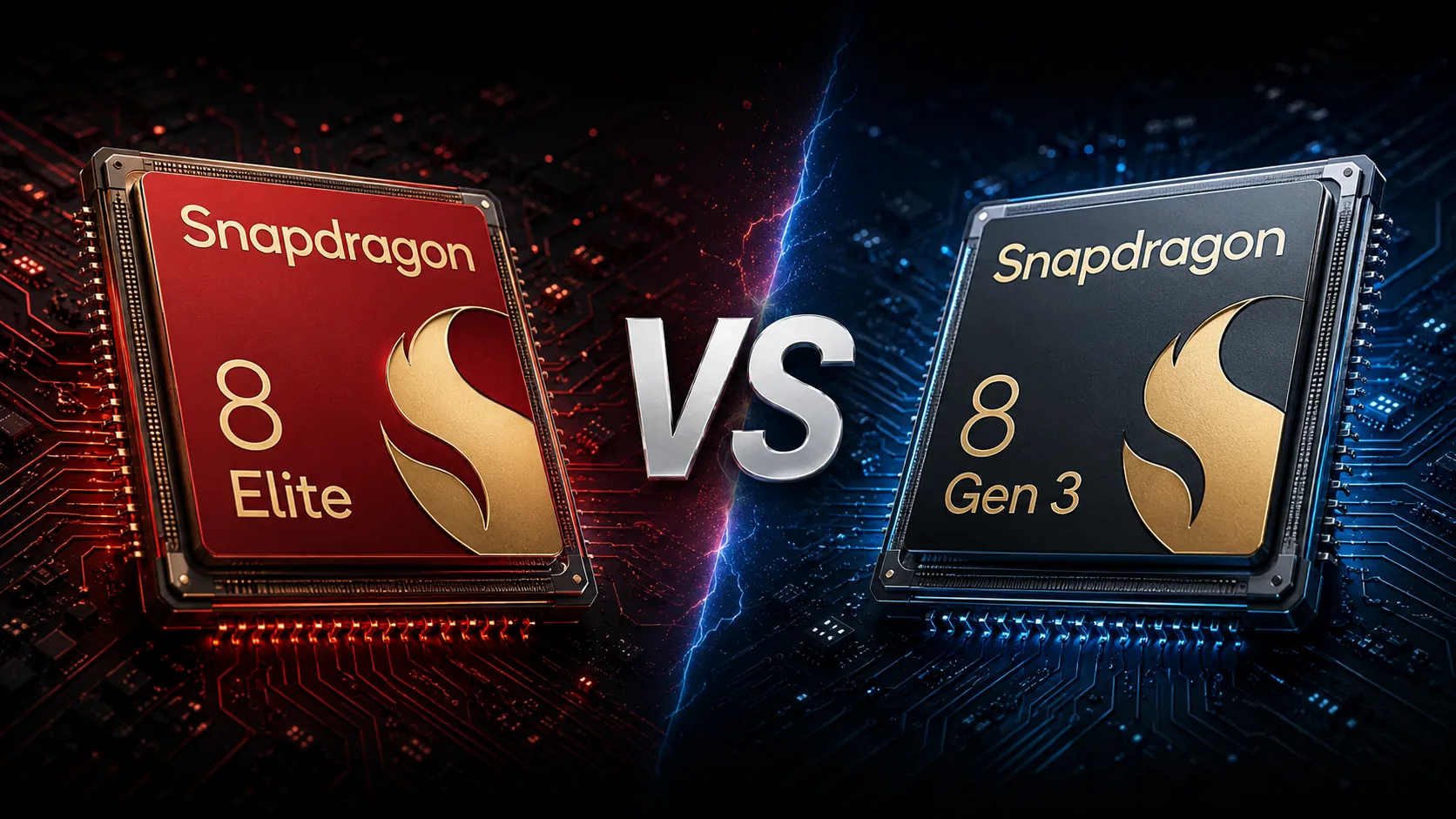
SoC Comparison Result
Snapdragon 8 Elite vs Snapdragon 8 Gen 3 - Which Chip Should You Choose
Snapdragon 8 Elite and Snapdragon 8 Gen 3 are two flagship processors from Qualcomm for powerful Android smartphones. Both are suited for fast devices with good cameras, high gaming performance, and advanced AI features. However, these are not equivalent chips: Snapdragon 8 Elite belongs to a newer generation and is significantly stronger, while Snapdragon 8 Gen 3 remains the flagship of the previous generation that is still appealing at a good price.
It's worth mentioning the naming convention. According to Qualcomm's previous logic, this chip could very well be called Snapdragon 8 Gen 4, as it replaces Snapdragon 8 Gen 3. But the company chose the name Snapdragon 8 Elite, emphasizing that this is not just another annual update but a more significant architectural leap: proprietary Oryon cores, a new manufacturing process, more powerful graphics, and a serious performance boost.
If the price difference is small, it makes more sense to choose Snapdragon 8 Elite. If a smartphone with Snapdragon 8 Gen 3 is significantly cheaper, it can still be a worthwhile purchase.
Key Differences
| Parameter | Snapdragon 8 Elite | Snapdragon 8 Gen 3 |
|---|---|---|
| Class | new flagship | flagship of the previous generation |
| CPU | Qualcomm Oryon | Qualcomm Kryo |
| Graphics | Adreno 830 | Adreno 750 |
| Manufacturing Process | 3 nm | 4 nm |
| Strength | maximum performance, gaming, AI | high speed for lower price |
| Best Scenario | expensive smartphone for several years | discounted flagship |
Snapdragon 8 Elite is significant due to the transition to proprietary Oryon cores. This is not a minor boost of an old platform but a full architectural update. Snapdragon 8 Gen 3 with Kryo CPU is still powerful but already lags behind the new generation in performance and headroom.
CPU Performance
In terms of CPU performance, Snapdragon 8 Elite is noticeably faster. It handles heavy applications, multitasking, photo and video processing, browsers with many tabs, and tasks requiring high single-thread speed better.
In Geekbench 6, the difference between the chips may look something like this:
| Test | Snapdragon 8 Elite | Snapdragon 8 Gen 3 |
|---|---|---|
| Single-Core | around 3000 points | around 2200 points |
| Multi-Core | around 9200 points | around 6400 points |
These are approximate values for specific smartphones and not guaranteed results for any device. But the overall conclusion is clear: Snapdragon 8 Elite is faster by not just a couple of percent but significantly. This is especially important if the smartphone is bought for several years.
In everyday tasks, both chips are fast, but Snapdragon 8 Elite has greater headroom for future versions of Android, heavy applications, and new AI features.
Gaming and Graphics
In gaming, Snapdragon 8 Elite is also ahead. Its Adreno 830 graphics are more powerful than the Adreno 750 in Snapdragon 8 Gen 3. This gives an advantage in demanding games, high FPS, complex effects, upscaling, and ray tracing.
The difference in graphics benchmarks looks like this:
| Test | Snapdragon 8 Elite | Snapdragon 8 Gen 3 |
|---|---|---|
| 3DMark Solar Bay | around 11400 | around 8700 |
| 3DMark Steel Nomad Light | around 2500 | around 1700 |
| 3DMark Wild Life Extreme | around 6000 | around 5000 |
Snapdragon 8 Gen 3 is still excellent for gaming. Most popular titles run smoothly on it, especially if the smartphone has good cooling. But in the most demanding games and during long sessions, Snapdragon 8 Elite provides a greater margin.
That said, a gaming smartphone cannot be judged solely on the chip. A thin body, weak cooling, or aggressive thermal limits can lower the performance even of a newer processor. A well-cooled Snapdragon 8 Gen 3 smartphone may sometimes be more stable than a thin model on Snapdragon 8 Elite.
Camera and Video
Both processors are at a flagship level and suitable for smartphones with advanced cameras. Snapdragon 8 Gen 3 is already powerful enough for HDR, night shooting, portrait algorithms, high-resolution video, and image processing involving AI.
Snapdragon 8 Elite offers more computational headroom. This is beneficial for burst shooting, complex HDR, high-resolution video, noise reduction, real-time image enhancement, and more intensive computational photography algorithms.
However, camera quality is not determined solely by the processor. The sensor, optics, stabilization, manufacturer algorithms, and firmware often matter more than the difference between the two SoCs. Snapdragon 8 Elite opens up more possibilities, but the final photo and video quality depends on the specific smartphone.
AI Features
Snapdragon 8 Elite is better suited for local AI. It handles on-device generative functions, image processing, voice tasks, smart assistants, photo and video enhancement, translation, and other functions that work without constant access to the cloud more quickly.
Snapdragon 8 Gen 3 also supports modern AI capabilities, but its headroom is lower. Today this may not always be noticeable, but in a few years, the difference could become more significant: manufacturers increasingly integrate AI into cameras, galleries, keyboards, system apps, and UIs.
Battery Life and Heating
Snapdragon 8 Elite is manufactured using a more advanced process and is potentially more efficient under load. This does not mean that any smartphone using it will automatically last longer than any model on Snapdragon 8 Gen 3. However, the manufacturer has more options: to maintain high performance, reduce power consumption, or better manage heating.
In practice, battery life depends not only on the processor. The battery, display, brightness, refresh rate, modem, firmware, cooling, and manufacturer settings are crucial. Therefore, comparisons should not only focus on the chips but also on specific smartphones.
It would be more accurate to say: Snapdragon 8 Elite offers better efficiency potential, but actual battery life depends on the entire device.
Smartphone Examples
Snapdragon 8 Gen 3 can be found in models such as the Samsung Galaxy S24 Ultra, OnePlus 12, Xiaomi 14, and other flagship models from the previous generation. These are still very fast smartphones, especially if sold at a good discount.
Snapdragon 8 Elite is used in newer flagships like Xiaomi 15, OnePlus 13, Realme GT 7 Pro, and Samsung Galaxy S25 Ultra with Snapdragon 8 Elite for Galaxy version. These models are usually more expensive but offer greater performance headroom and a more modern platform.
When to Choose Snapdragon 8 Elite
Opt for Snapdragon 8 Elite if you need the most powerful Android smartphone with headroom for several years: for demanding games, active photo and video shooting, local AI features, multitasking, and prolonged loads.
It is particularly logical if the price difference with a Snapdragon 8 Gen 3 smartphone is small. In this case, the savings may be questionable: Elite is noticeably faster, more modern, and better prepared for future scenarios.
When Snapdragon 8 Gen 3 Is Enough
Snapdragon 8 Gen 3 remains an excellent flagship processor. It is sufficient for fast system operation, gaming, cameras, video, navigation, social media, browsers, and most heavy applications.
The main argument in its favor is price. If a Gen 3 smartphone is significantly cheaper than an Elite model, the purchase could be more rational, especially if you do not play the most demanding games every day, do not shoot a lot of video, and do not plan to actively use local AI features.
Conclusion
Snapdragon 8 Elite is a more powerful, modern, and forward-looking processor. It is faster in CPU performance, stronger in graphics, better suited for local AI, demanding games, advanced photo and video processing, and for purchasing a smartphone for several years.
Snapdragon 8 Gen 3 is still a fast and balanced flagship chip. It falls short of Snapdragon 8 Elite but remains an excellent choice, especially if a smartphone with it is offered significantly cheaper.
The conclusion is simple: if the price difference is small, it is better to choose Snapdragon 8 Elite. If a smartphone with Snapdragon 8 Gen 3 costs significantly less, it can still be a very good buy.
However, it’s not worth overpaying just for the chip's name. If a specific model with Snapdragon 8 Gen 3 offers a better price, camera, battery, or cooling, it might be a wiser choice than a more expensive smartphone with Snapdragon 8 Elite.
Advantages
- Higher Technology: 3 nm (3 nm vs 4 nm)
- Higher Frequency: 4320 MHz (4320 MHz vs 3300 MHz)
- Newer Launch Date: October 2024 (October 2024 vs October 2023)
Basic
5x (3x3.2 GHz/2x3.0GHz) – Cortex-A720
2x 2.3 GHz – Cortex-A520
GPU Specifications
Connectivity
Memory Specifications
Miscellaneous
Benchmarks
Comparison of Devices
Related SoC Comparisons







Share in social media
Or Link To Us
<a href="https://cputronic.com/soc/compare/qualcomm-snapdragon-8-elite-vs-qualcomm-snapdragon-8-gen-3" target="_blank">Qualcomm Snapdragon 8 Elite vs Qualcomm Snapdragon 8 Gen 3</a>