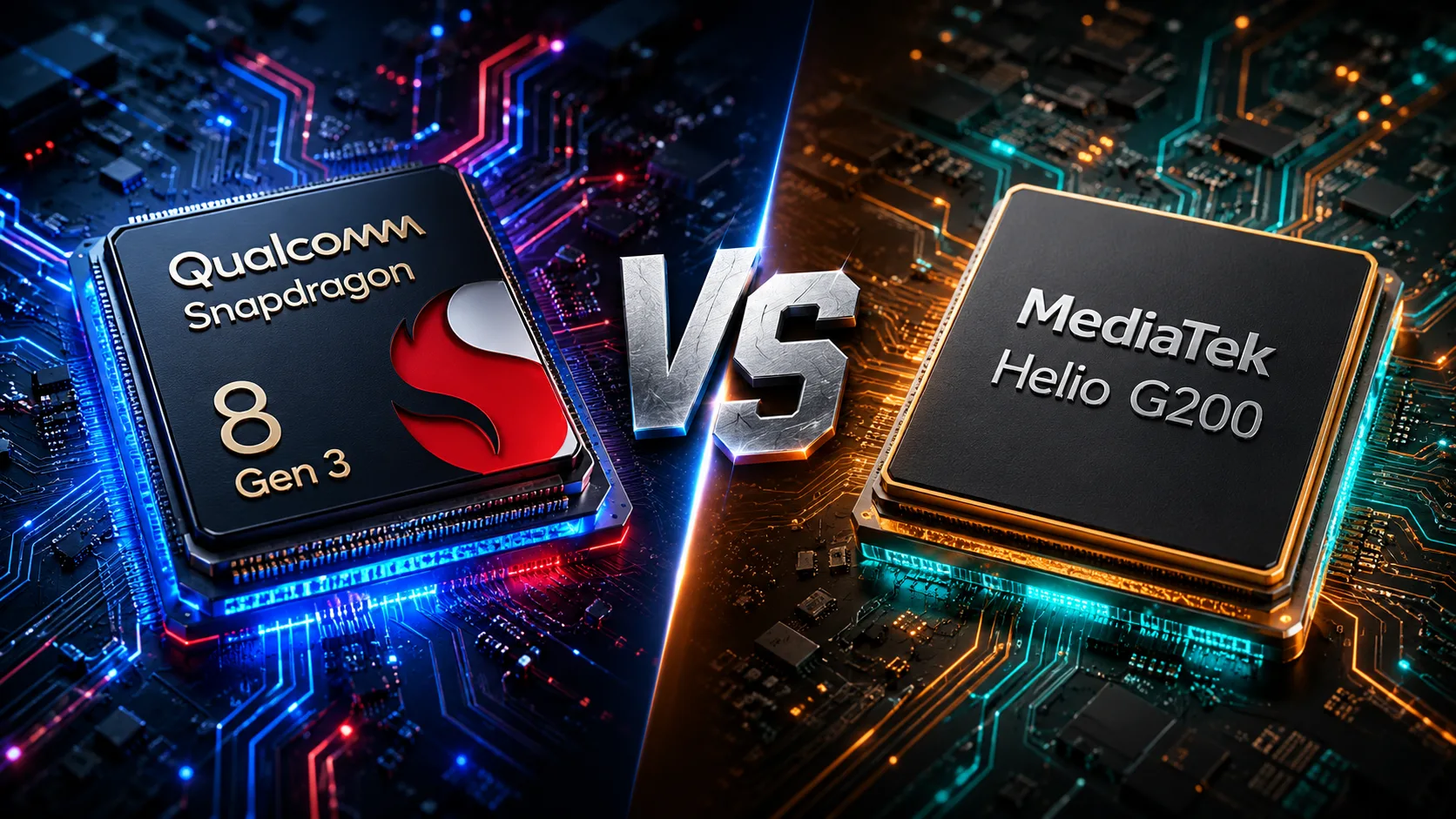
Qualcomm Snapdragon 8 Gen 3
vs
MediaTek Helio G200

SoC Comparison Result
Qualcomm Snapdragon 8 Gen 3 vs MediaTek Helio G200: Flagship Power or Budget-Friendly
On paper, both the Snapdragon 8 Gen 3 and Helio G200 are mobile processors, but in practice, they are solutions from different price realities. The Snapdragon 8 Gen 3 is designed for flagship Android smartphones: it is built for heavy gaming, high-quality photography, 5G, fast memory, advanced image processing, and a significant performance buffer. The Helio G200 is a simpler 4G chip for budget devices, where price, battery life, and stable operation of basic applications are paramount.
Thus, the main question here is not about who is faster. The Snapdragon 8 Gen 3 is clearly more powerful. It is much more useful to understand another: when it is really worth paying extra for a flagship chip, and when the Helio G200 will suffice.
Short Conclusion
The Snapdragon 8 Gen 3 is the better choice for gaming, photography, video, multitasking, and smartphones meant to last for several years. The Helio G200 will be suitable if you need a budget device for messaging, browsing, YouTube, navigation, social media, and light gaming.
| Scenario | Best Choice |
|---|---|
| Heavy gaming | Snapdragon 8 Gen 3 |
| Photography and video | Snapdragon 8 Gen 3 |
| 4K/8K video, HDR, fast photo processing | Snapdragon 8 Gen 3 |
| Smartphone designed to last several years | Snapdragon 8 Gen 3 |
| Everyday tasks without heavy gaming | Helio G200 will suffice |
| Budget smartphone without 5G | Helio G200 |
| Maximum smoothness of interface | Snapdragon 8 Gen 3 |
| Minimum price with decent base speed | Helio G200 |
The Main Difference - Platform Class
The Snapdragon 8 Gen 3 utilizes a modern 8-core architecture with a Prime Cortex-X4 core, powerful Cortex-A720 cores, and energy-efficient Cortex-A520 cores. The maximum frequencies depend on the version of the chip and the specific smartphone, but in any case, this is a flagship platform with a substantial buffer for single-threaded and multi-threaded performance.
The Helio G200 is simpler: it has 2 Cortex-A76 cores up to 2.2 GHz and 6 Cortex-A55 cores up to 2.0 GHz. This configuration fits well for affordable smartphones but significantly lags behind modern flagship cores in speed, efficiency under load, and future-proofing.
| Feature | Snapdragon 8 Gen 3 | Helio G200 |
|---|---|---|
| Class | Flagship | Budget / affordable mid-range |
| Connectivity | 5G | 4G LTE |
| CPU | Cortex-X4 / Cortex-A720 / Cortex-A520 | Cortex-A76 / Cortex-A55 |
| Graphics | Flagship-level Adreno | Mali-G57 MC2 |
| Memory | LPDDR5X | LPDDR4X |
| Storage | UFS 4.0 | UFS 2.2 |
| Wi-Fi | Wi-Fi 7 | Wi-Fi 5 |
| Primary Use Case | Gaming, camera, flagship functions | Basic tasks and budget smartphones |
CPU Performance: The Difference is Noticeable Beyond Tests
For regular tasks, the Helio G200 does not seem weak. It handles messaging apps, browsers, maps, YouTube, banking apps, and simple games well. If the manufacturer has optimized the interface well, a smartphone with this chip can feel smooth enough.
However, the Snapdragon 8 Gen 3 operates at a different level. It opens heavy apps faster, maintains multitasking more confidently, processes photos quicker, handles demanding websites better, and retains comfortable speed longer after Android and app updates.
The advantage of Snapdragon is especially evident in tasks such as:
- Launching heavy applications;
- Processing photos after shooting;
- Camera operation and HDR;
- Heavy web pages;
- Gaming and emulators.
In synthetic tests, the Snapdragon 8 Gen 3 usually shows a significant advantage over the Helio G200. But what’s more important than the numbers is the real-world feeling: the flagship chip provides more headroom, fewer interface pauses, and a higher chance that the smartphone will remain fast over the years.
Graphics and Gaming: The Largest Gap
In graphics performance, the difference between the processors is especially noticeable. The Snapdragon 8 Gen 3 is equipped with powerful flagship-level Adreno graphics. It is designed for heavy 3D games, high frame rates, advanced effects, and long-lasting gaming relevance.
The Helio G200 uses Mali-G57 MC2. This is sufficient for light and moderately demanding games, but don't expect to run modern heavy titles on high settings.
| Gaming Scenario | Snapdragon 8 Gen 3 | Helio G200 |
|---|---|---|
| PUBG Mobile / Free Fire / Mobile Legends | High settings, good buffer | Medium or low settings, depends on the smartphone |
| Genshin Impact | Comfortable play with good cooling | Low settings and possible frame drops |
| Honkai: Star Rail / Wuthering Waves | Performs significantly better | Heavy scenario for the chip |
| Emulators | Much higher chances of comfort | Limited capabilities |
| Long gaming sessions | Depends on cooling, but with a large buffer | Possible frame drops |
Cooling is also important. Even the Snapdragon 8 Gen 3 might throttle in a thin body. However, its initial headroom is so much higher that, even after throttling, it usually remains significantly faster than the Helio G200.
Camera and Video: Megapixels Do Not Make Chips Equal
Both processors can be used in smartphones with high-resolution cameras, but comparing them solely by megapixels is incorrect. The quality of photos and videos depends not only on the sensor but also on the ISP - the image processing block inside the chip.
The Snapdragon 8 Gen 3 is designed for flagship mobile photography: fast HDR processing, night algorithms, support for multiple cameras, high video quality, and quick frame processing. In good smartphones, this helps achieve more stable results at night, better video quality, and reduced latency during shooting.
The Helio G200 also looks decent for its class. It supports cameras up to 200 MP, electronic stabilization, noise reduction, and video recording up to 2K at 30 FPS or Full HD at 60 FPS. However, this is still at the level of affordable devices, where the final quality relies more on the sensor, lens, and algorithms of the particular manufacturer.
The practical takeaway is straightforward: for typical daytime photos, the Helio G200 may be sufficient, but for nighttime shooting, HDR, high-quality video, and fast processing, the Snapdragon 8 Gen 3 is significantly stronger.
Memory, Storage, and Connectivity
The Snapdragon 8 Gen 3 supports more modern standards of memory, storage, and wireless connectivity. LPDDR5X and UFS 4.0 help in launching apps faster, loading games, installing updates, and dealing with large files. 5G and Wi-Fi 7 make the platform more relevant for expensive smartphones, which are not purchased for just one year.
The Helio G200 is limited to LPDDR4X, UFS 2.2, Wi-Fi 5, and 4G LTE. This is normal for a budget smartphone, but the headroom is lower. If the user often plays, records a lot of video, stores large files, or uses multitasking intensively, the difference will be noticeable.
Battery Life: It All Depends on the Smartphone
The Helio G200 can exhibit good battery life in budget devices. Typically, these smartphones are equipped with a Full HD+ screen, a large battery, and a not-too-power-hungry setup. For calls, messaging, videos, music, and browsing, that’s usually sufficient.
The Snapdragon 8 Gen 3 can also be efficient in light tasks: it quickly performs work and reduces power consumption. However, in gaming, video recording, and heavy applications, it can consume more because it delivers a significantly higher level of performance.
Therefore, battery life cannot be judged solely by the processor. The battery, display, firmware, cooling, and manufacturer’s settings are all crucial.
Who Should Choose the Snapdragon 8 Gen 3
The Snapdragon 8 Gen 3 should be chosen if you need a smartphone with a great power reserve. This is suitable for those who game, frequently take photos and videos, use navigation, video editing, heavy applications, emulators, or simply want the fastest Android smartphone.
It is especially good if the following are important:
- High performance in gaming;
- Fast and smooth interface;
- Good camera and video capabilities;
- Modern standards of connectivity, memory, and storage;
- Headroom for future Android versions and applications.
Who Should Consider the Helio G200
The Helio G200 is worth considering in budget smartphones where the primary criterion is price. It is neither a gaming nor a flagship chip, but it can be an acceptable choice for basic tasks.
It will suffice if the smartphone is needed for:
- Calls and messaging;
- YouTube and music;
- Browsing;
- Social media;
- Maps and navigation;
- Banking apps;
- Light games;
- Everyday use without high demands for camera and graphics.
The main point is not to expect flagship-level performance from the Helio G200. It is a practical 4G chip for the affordable segment, not a competitor to the Snapdragon 8 Gen 3.
Conclusion
The Snapdragon 8 Gen 3 is undeniably a stronger platform. It is faster in CPU performance, significantly more powerful in graphics, better suited for camera functions, video, gaming, AI tasks, faster memory, 5G, and longevity. This is the choice for those looking for a flagship smartphone without serious compromises in performance.
MediaTek Helio G200 plays a different role. It does not attempt to replace flagship chips but meets basic needs in more affordable smartphones. For messaging, browsing, video, navigation, and simple games, its capabilities may be sufficient.
If you need a smartphone for gaming, a good camera, long-term relevance, and maximum speed - the Snapdragon 8 Gen 3 is far better. If you need a budget device for everyday tasks and do not require 5G - the Helio G200 can be a sensible budget option.
Advantages
- Higher Technology: 4 nm (4 nm vs 6 nm)
- Higher Frequency: 3300 MHz (3300 MHz vs 2200 MHz)
- Newer Launch Date: May 2025 (October 2023 vs May 2025)
Basic
5x (3x3.2 GHz/2x3.0GHz) – Cortex-A720
2x 2.3 GHz – Cortex-A520
GPU Specifications
Connectivity
Memory Specifications
Miscellaneous
- AIFF
- CAF
- MP3
- MP4
- WAV
- H.265
- VP9
Benchmarks
Comparison of Devices
Related SoC Comparisons



Share in social media
Or Link To Us
<a href="https://cputronic.com/soc/compare/qualcomm-snapdragon-8-gen-3-vs-mediatek-helio-g200" target="_blank">Qualcomm Snapdragon 8 Gen 3 vs MediaTek Helio G200</a>