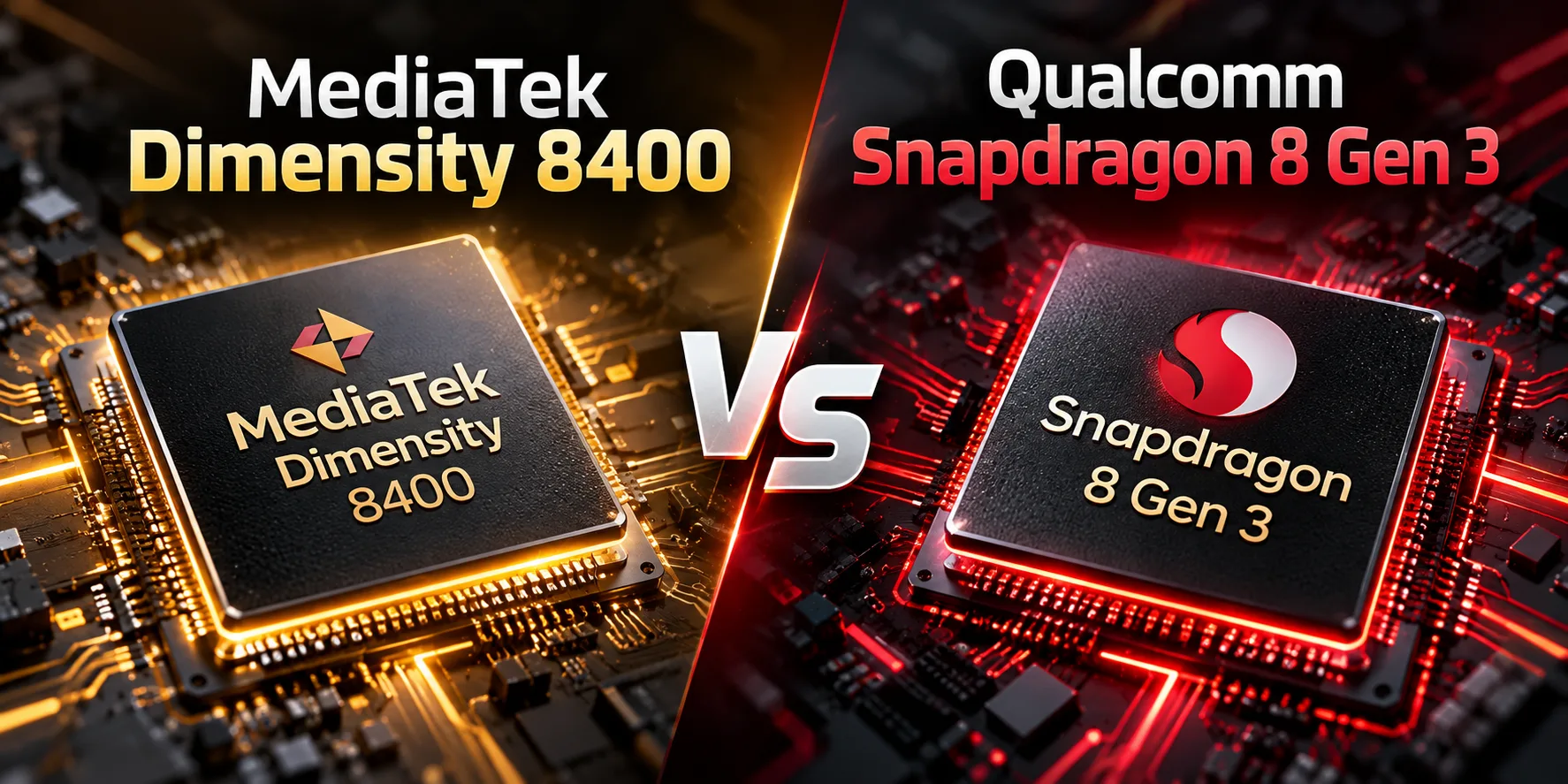
MediaTek Dimensity 8400
vs
Qualcomm Snapdragon 8 Gen 3

SoC Comparison Result
MediaTek Dimensity 8400 vs Qualcomm Snapdragon 8 Gen 3
The MediaTek Dimensity 8400 uses the newer Cortex-A725 CPU architecture, but the Snapdragon 8 Gen 3 remains faster in single-threaded tasks and is noticeably stronger in graphics. The difference is much smaller in multi-core workloads: the Dimensity 8400’s eight Cortex-A725 cores allow it to come close to the Snapdragon 8 Gen 3.
Key Differences
| Feature | Dimensity 8400 | Snapdragon 8 Gen 3 |
|---|---|---|
| Process technology | 4 nm TSMC | 4 nm TSMC |
| CPU | 1x Cortex-A725 3.25 GHz + 3x A725 3.0 GHz + 4x A725 2.1 GHz | 1x Cortex-X4 3.3 GHz + 5x Cortex-A720 + 2x Cortex-A520 |
| GPU | Mali-G720 MC7 | Adreno 750 |
| Memory | LPDDR5X | LPDDR5X |
| Storage | UFS 4.0 | UFS 4.0 |
| Wi-Fi | Wi-Fi 6E | Wi-Fi 7 |
| Maximum video recording | 4K 60 FPS | 8K 30 FPS, 4K 120 FPS |
The Dimensity 8400 uses eight high-performance Cortex-A725 cores without a separate efficiency-core cluster. The Snapdragon 8 Gen 3 combines a powerful Cortex-X4 with Cortex-A720 cores and two Cortex-A520 cores.
The Cortex-X4 gives the Snapdragon a significant advantage in Single-Core performance, while the gap narrows in Multi-Core performance.
CPU Performance
In Geekbench 6, the chips achieve average scores of around 1684 / 6970 points for the Dimensity 8400 and 2192 / 7085 for the Snapdragon 8 Gen 3.
The Snapdragon is approximately 30% faster in Single-Core, while the difference in Multi-Core is around 2%. The eight Cortex-A725 cores allow the Dimensity 8400 to deliver strong results in workloads capable of fully utilizing all CPU cores.
Results for specific smartphones depend more heavily on cooling, firmware, and power limits.
| Smartphone | Chip | Geekbench 6 SC | Geekbench 6 MC | AnTuTu 11 | Launch price |
|---|---|---|---|---|---|
| Poco X7 Pro | Dimensity 8400 Ultra | 1573 | 6102 | 1 930 851 | from ~$299 |
| Realme GT 7T | Dimensity 8400 Max | 1613 | 6238 | 2 079 848 | around ~$700* |
| Xiaomi 14 | Snapdragon 8 Gen 3 | 2206 | 6701 | 2 363 726 | around ~$1080* |
| OnePlus 12 | Snapdragon 8 Gen 3 | 2182 | 6465 | 2 401 788 | from $799 |
- The price was converted from the regional launch price and is provided as a reference.
The Dimensity 8400 Ultra and Dimensity 8400 Max are versions of the same platform with similar specifications, so their results can be used as a reference for the Dimensity 8400 in production smartphones.
In this selection, Snapdragon-powered devices are approximately 38% faster in Geekbench 6 Single-Core and 7% faster in Multi-Core. In AnTuTu 11, the average lead is around 19%.
The Snapdragon’s advantage is more noticeable in short single-threaded tasks, while the difference is substantially smaller under a full load across all cores.
Graphics and Gaming
The Snapdragon’s advantage is more pronounced in graphics. The Adreno 750 outperforms the Mali-G720 MC7 in demanding 3DMark tests.
Results depend on the cooling and power limits of each device, so the table shows the performance of real-world models rather than results from a reference platform.
| Device | Chip | Solar Bay | Steel Nomad Light |
|---|---|---|---|
| Poco X7 Pro | Dimensity 8400 Ultra | 5931 | 1285 |
| Realme GT 7T | Dimensity 8400 Max | 6474 | 1417 |
| Xiaomi 14 | Snapdragon 8 Gen 3 | 7582 | 1511 |
| OnePlus 12 | Snapdragon 8 Gen 3 | 8360 | 1676 |
Based on the average results of these devices, the Snapdragon leads the Dimensity by approximately 29% in Solar Bay and 18% in Steel Nomad Light.
The difference is especially noticeable in Solar Bay, which evaluates ray-tracing performance.
The final result also depends on cooling: smartphones with higher power limits can sustain maximum clock speeds for longer.
Platform Features
Both chips support LPDDR5X and UFS 4.0.
The Snapdragon 8 Gen 3 additionally supports Wi-Fi 7 and video recording at up to 8K 30 FPS and 4K 120 FPS. The Dimensity 8400 is limited to Wi-Fi 6E and recording at up to 4K 60 FPS.
Which Is Faster
The Snapdragon 8 Gen 3 wins primarily thanks to its Single-Core and GPU performance. Based on the chips’ average results, its advantage in Geekbench 6 Single-Core is around 30%, while in the specific smartphones from our selection it reaches approximately 35-40%.
The situation is much closer in Multi-Core performance. The Dimensity 8400 can come close to the Snapdragon 8 Gen 3 under a full load across all cores.
In the selection shown above, the Snapdragon is approximately 18-29% faster in graphics tests.
If gaming, emulation, and maximum GPU performance are the priorities, the Snapdragon 8 Gen 3 is noticeably stronger. The Dimensity 8400 stands out for its high multi-core CPU performance in smartphones from a lower price segment.
Conclusion
The Qualcomm Snapdragon 8 Gen 3 remains the faster chip. It is approximately 30% ahead of the Dimensity 8400 in Single-Core performance and around 18-29% faster in the graphics tests shown above.
The Dimensity 8400’s main strength is Multi-Core performance. Its eight Cortex-A725 cores allow it to come close to the Snapdragon 8 Gen 3 in multi-threaded workloads despite its lower positioning.
The Dimensity 8400 is close to the Snapdragon 8 Gen 3 in multi-core CPU performance, but falls behind in single-core performance and especially in graphics.
Advantages
- Newer Launch Date: December 2024 (December 2024 vs October 2023)
- Higher Frequency: 3300 MHz (3250 MHz vs 3300 MHz)
Basic
3x 3.0 GHz – Cortex-A725
4x 2.1 GHz – Cortex-A725
5x (3x3.2 GHz/2x3.0GHz) – Cortex-A720
2x 2.3 GHz – Cortex-A520
GPU Specifications
Connectivity
Memory Specifications
Miscellaneous
Benchmarks
Comparison of Devices
Related SoC Comparisons


Share in social media
Or Link To Us
<a href="https://cputronic.com/soc/compare/mediatek-dimensity-8400-vs-qualcomm-snapdragon-8-gen-3" target="_blank">MediaTek Dimensity 8400 vs Qualcomm Snapdragon 8 Gen 3</a>