Qualcomm Snapdragon 8s Gen 4
vs
Qualcomm Snapdragon 8 Gen 3

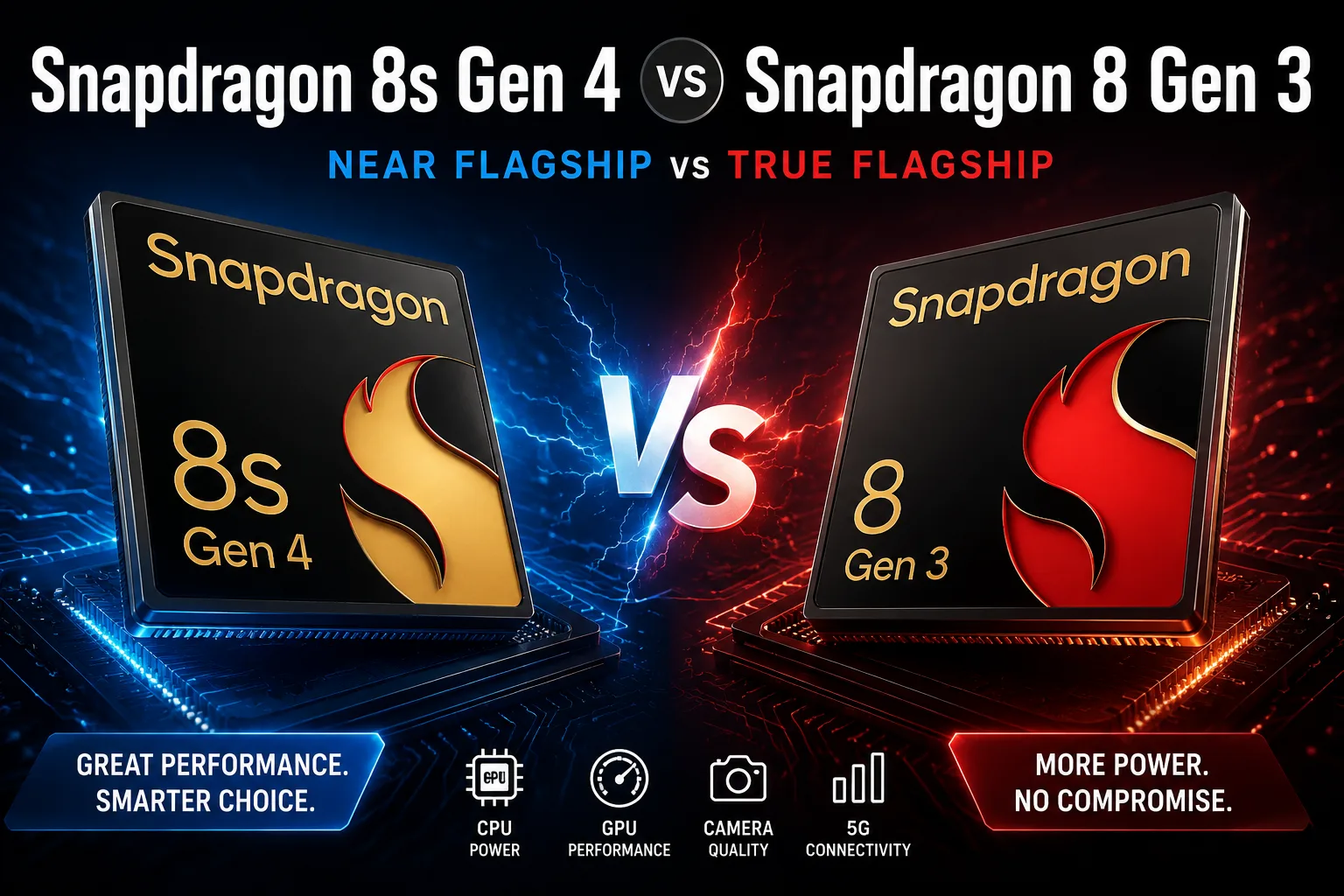
SoC Comparison Result
Qualcomm Snapdragon 8s Gen 4 vs Snapdragon 8 Gen 3: Almost-Flagship vs True-Flagship
The Snapdragon 8s Gen 4 and Snapdragon 8 Gen 3 have similar names, but they are not processors of the same class. The Snapdragon 8 Gen 3 is a full-fledged flagship chip used in expensive Android smartphones. The Snapdragon 8s Gen 4 is a newer and more affordable platform for nearly flagship-level smartphones.
The significance of the Snapdragon 8s Gen 4 lies not merely in its "newness." The main point is that the new sub-flagship has nearly caught up to the former flagship in processing performance. In Geekbench and regular tasks, the gap is already small, so in the interface, web browsing, and applications, both chips feel very fast. However, graphics remain the main limitation of the Snapdragon 8s Gen 4: in heavy games and GPU benchmarks, the Snapdragon 8 Gen 3 is still noticeably ahead. Therefore, the 8s Gen 4 can be considered an almost-flagship in terms of CPU, but not a complete replacement for the 8 Gen 3 in gaming.
Key Differences
| Characteristic | Snapdragon 8s Gen 4 | Snapdragon 8 Gen 3 |
|---|---|---|
| Class | affordable premium | flagship |
| CPU | 1x Cortex-X4 + 7x Cortex-A720 | 1x Cortex-X4 + 5x Cortex-A720 + 2x Cortex-A520 |
| Max Frequency | up to 3.2 GHz | up to 3.4 GHz, depending on the version |
| GPU | Adreno 825* | Adreno 750* |
| Video | 4K HDR up to 60 FPS | 8K HDR up to 30 FPS, 4K up to 120 FPS |
| 5G Modem | up to 4.2 Gbps | Snapdragon X75, up to 10 Gbps |
| mmWave | not in base specifications | available, depends on version and smartphone |
| Bluetooth | Bluetooth 6.0 | Bluetooth 5.4 |
- GPU numbers are often used in specification databases; Qualcomm usually just mentions Adreno in public specifications.
Points that are the same, like the 4nm process, LPDDR5X, and UFS 4.0, should not be considered advantages for one side. The difference here is not in memory or storage, but in the level of execution: the Snapdragon 8s Gen 4 offers nearly flagship speed at a lower price, while the Snapdragon 8 Gen 3 remains a more complete platform.
CPU Performance
In terms of CPU, the Snapdragon 8s Gen 4 looks very respectable. It has one powerful Cortex-X4 core and seven Cortex-A720 cores without small Cortex-A520 cores. This configuration helps it stay close to the Snapdragon 8 Gen 3 in Geekbench and other CPU tests.
The Snapdragon 8 Gen 3 is arranged differently: one Cortex-X4, five Cortex-A720, and two Cortex-A520. Its maximum frequency is higher, and the platform is more frequently found in smartphones with more robust cooling. In devices that are equally well-cooled, the Snapdragon 8 Gen 3 generally retains a slight CPU performance lead and a significantly greater GPU headroom.
For the average user, both chips will feel very fast. The advantage of the Snapdragon 8 Gen 3 is not that it is suddenly faster in the interface, but in its greater reserve for heavy scenarios.
Benchmarks and Games
| Test | Snapdragon 8s Gen 4 | Snapdragon 8 Gen 3 |
|---|---|---|
| AnTuTu 10/11 | approximately 2.1-2.3 million | approximately 2.1-2.35 million |
| Geekbench 6 Single-Core | around 2000-2100 | around 2150-2250 |
| Geekbench 6 Multi-Core | around 6300-6800 | around 6600-6900 |
| 3DMark Wild Life Extreme | approximately 3700-4500 | approximately 4700-5200 |
The overall AnTuTu score can be very close, so it is not advisable to choose based solely on that. It is more important to look at graphical tests and stability under load. The Snapdragon 8s Gen 4 is already powerful enough for heavy games, but the Snapdragon 8 Gen 3 often provides more GPU headroom.
For popular games, the Snapdragon 8s Gen 4 is more than sufficient: high settings, 60 FPS, and smooth performance are not an issue in capable smartphones. The Snapdragon 8 Gen 3 is more interesting for maximum graphics, emulators, high refresh rates, and extended gaming sessions.
The specific smartphone still matters a lot. A model with Snapdragon 8 Gen 3 that has poor cooling may quickly reduce its frequencies, while a well-designed device with Snapdragon 8s Gen 4 may maintain stability. However, when comparing the platforms overall, Snapdragon 8 Gen 3 remains the more reliable choice for heavy gaming and prolonged loads.
Camera, Video, and Connectivity
In terms of camera capabilities, the Snapdragon 8s Gen 4 does not seem reduced to a mid-range offering either. It supports 18-bit Triple ISP, photos up to 320 MP, 4K HDR video up to 60 FPS, HDR10+, Dolby Vision, and advanced image processing. For most smartphones, this is sufficient.
However, the Snapdragon 8 Gen 3 is a higher class. Its significant advantage is support for 8K HDR up to 30 FPS and 4K up to 120 FPS. Not every manufacturer uses these modes to their full extent, but for a flagship camera, the reserve in the 8 Gen 3 is wider.
The gap in connectivity is even clearer. The Snapdragon 8 Gen 3 uses the X75 modem with peak speeds up to 10 Gbps and mmWave support. The Snapdragon 8s Gen 4 has a simpler modem: up to 4.2 Gbps and Sub-6. In a real-world network, this may not always be noticeable, but in terms of platform level, the Snapdragon 8 Gen 3 is stronger. However, the Snapdragon 8s Gen 4 has the more modern Bluetooth 6.0.
What to Choose
The Snapdragon 8s Gen 4 is worth choosing if the smartphone is significantly cheaper. It is a fast chip of nearly flagship level: suitable for gaming, heavy applications, camera use, and everyday tasks with a good reserve.
The Snapdragon 8 Gen 3 is better if the prices are close. It is stronger as a complete flagship platform: superior graphics, better modem, a higher ceiling for video, and generally higher class smartphones in which it is installed.
The conclusion is simple: Snapdragon 8s Gen 4 is an attractive almost-flagship, while Snapdragon 8 Gen 3 is still a true flagship. If the price difference is large, the 8s Gen 4 looks sensible. If the prices are similar, the Snapdragon 8 Gen 3 remains the stronger and more versatile option.
Advantages
- Newer Launch Date: April 2025 (April 2025 vs October 2023)
- Higher Frequency: 3300 MHz (3200 MHz vs 3300 MHz)
Basic
3x 3 GHz – Cortex-A720
2x 2.8 GHz – Cortex-A720
2x 2.02 GHz – Cortex-A720
5x (3x3.2 GHz/2x3.0GHz) – Cortex-A720
2x 2.3 GHz – Cortex-A520
GPU Specifications
Connectivity
Memory Specifications
Miscellaneous
- AIFF
- CAF
- MP3
- MP4
- WAV
- H.265
- AV1
- VP9
Benchmarks
Comparison of Devices
Related SoC Comparisons



Share in social media
Or Link To Us
<a href="https://cputronic.com/soc/compare/qualcomm-snapdragon-8s-gen-4-vs-qualcomm-snapdragon-8-gen-3" target="_blank">Qualcomm Snapdragon 8s Gen 4 vs Qualcomm Snapdragon 8 Gen 3</a>