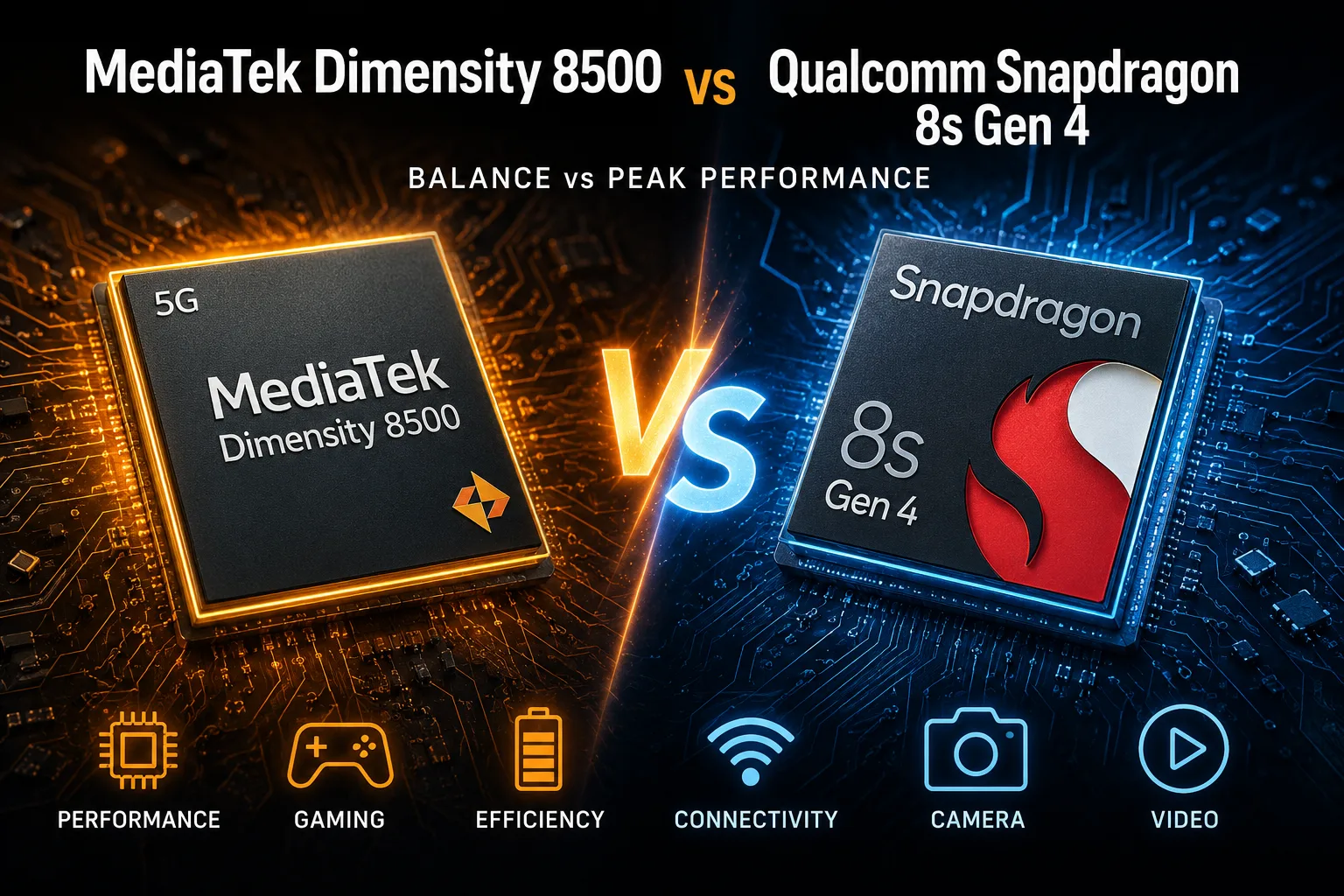
MediaTek Dimensity 8500
vs
Qualcomm Snapdragon 8s Gen 4

SoC Comparison Result
MediaTek Dimensity 8500 vs Qualcomm Snapdragon 8s Gen 4: Balance vs Peak Power
MediaTek Dimensity 8500 and Qualcomm Snapdragon 8s Gen 4 play in roughly the same field: they are not absolute flagships, but they are fast chips for mid-range and upper mid-range smartphones. Both are designed for users who desire high performance without the price tag of top models.
However, their approach is different. The Snapdragon 8s Gen 4 bets on a powerful Cortex-X4 core, strong Adreno graphics, Wi-Fi 7, and a more advanced multimedia block. The Dimensity 8500 was released later and tries to take a different route: with a fresh Cortex-A725 configuration, emphasis on energy efficiency, and more consistent performance under prolonged loads.
This is a case where one cannot simply look at the overall AnTuTu score and pick a winner. For gaming, heating, connectivity, and camera, the picture turns out to be different.
Key Differences
| Parameter | Dimensity 8500 | Snapdragon 8s Gen 4 | What Matters More |
|---|---|---|---|
| CPU | 8 Cortex-A725 cores | Cortex-X4 + Cortex-A720 | Snapdragon is stronger in peak tasks |
| GPU | Mali-G720 MC8 | Adreno 825 | Snapdragon is stronger in heavy 3D games |
| Connectivity | Wi-Fi 6E, Bluetooth 5.4 | Wi-Fi 7, Bluetooth 6.0 | Snapdragon is more modern |
| Video | 4K60 | 4K HDR capture, 8K HDR playback | 8K on Snapdragon - playback, not recording |
| Character | consistent load, energy efficiency | high peak power | depends on the task and smartphone |
Processor: Cortex-X4 vs Eight Cortex-A725
Snapdragon 8s Gen 4 uses a more classic Qualcomm scheme: one powerful Cortex-X4 core and a set of performant Cortex-A720 cores. This yields good results in single-threaded tasks: launching applications, interface responsiveness, specific gaming episodes, browsing, and handling short heavy operations.
Dimensity 8500 is structured differently. Here all eight cores belong to the Cortex-A725 family: one core runs up to 3.4 GHz, three up to 3.2 GHz, and four up to 2.2 GHz. There is no separate "super core" at the Cortex-X4 level, but the architecture is fresher, and the load distribution appears more uniform.
In practice, Snapdragon should be faster where immediate reaction from a strong single core is essential. Dimensity 8500 is more interesting in scenarios where the load is prolonged and distributed across several cores. Therefore, in typical daily use, the difference between them may be less noticeable than it seems from the specifications.
Graphics and Gaming: Advantage to Snapdragon, but with a Caveat
The main argument for the Snapdragon 8s Gen 4 is the Adreno 825 graphics. Qualcomm claims up to a 49% increase in GPU performance compared to the Snapdragon 8s Gen 3, and the architecture is closer to the higher-end solutions in the Snapdragon 8 series. This is an important plus for gaming: Adreno traditionally performs well in heavy 3D scenes, emulators, and GPU-intensive projects.
The Dimensity 8500 is equipped with the Mali-G720 MC8. This is not weak graphics, especially for the mid-range, but it struggles against the Adreno 825. In regular games, both chips will provide a high level of comfort, but when it comes to Genshin Impact, Wuthering Waves, Zenless Zone Zero, and other demanding projects at high settings, Snapdragon appears more promising.
However, the high performance of Snapdragon almost always requires good cooling. If a manufacturer cuts costs on the case, thermal module, or power settings, some of Adreno's advantage might be lost due to throttling.
Heating: Much Depends on the Specific Smartphone
Snapdragon 8s Gen 4 cannot be evaluated separately from the smartphone it is installed in. In a well-designed model with a large vapor chamber, it can maintain high frame rates for extended periods. In a thinner body or with aggressive performance settings, it can get noticeably hot.
The Dimensity 8500 appears potentially calmer in terms of heat. Its configuration without Cortex-X4 and emphasis on energy efficiency should help during prolonged loads. However, it is too early to draw a final conclusion: for a fair comparison, tests of several smartphones with Dimensity 8500 in identical conditions are needed.
For now, it is more accurate to say: Snapdragon 8s Gen 4 has been better tested in real devices but relies more on cooling. Dimensity 8500 looks promising, though it still needs to gather a database of independent gaming and stress tests.
Benchmarks: Why One Test Doesn't Solve Everything
| Test | Dimensity 8500 | Snapdragon 8s Gen 4 | Comment |
|---|---|---|---|
| Geekbench 6 Single | around 1700 | around 2100 | Snapdragon is noticeably stronger in single-threaded |
| Geekbench 6 Multi | around 6800 | around 7000 | The difference is minimal |
| AnTuTu | around 2.3-2.4 million | around 2.0-2.3 million | Dimensity may score higher overall |
Geekbench provides a good indication of CPU characteristics. In single-core, Snapdragon leads due to the Cortex-X4. In multi-core, the gap is much smaller: Dimensity 8500 narrows it down with eight performant Cortex-A725 cores and a more uniform load distribution.
AnTuTu needs to be read carefully. The overall score is composed of CPU, GPU, memory, and UX, so it doesn't always directly answer the question of "which chip is faster in games." Dimensity 8500 may look quite strong in the overall result, but for gaming, individual GPU tests, FPS stability, and temperature management are more important.
That is why it is more reasonable to look not at a single impressive number but at the combination: Geekbench, AnTuTu, 3DMark, gaming tests, and throttling.
Connectivity: Qualcomm is More Modern
In terms of wireless interfaces, Snapdragon 8s Gen 4 is ahead. It supports Wi-Fi 7 and Bluetooth 6.0. This doesn’t mean that every user will immediately feel the difference, but for a smartphone that will last 3-4 years, this is beneficial.
Dimensity 8500 uses Wi-Fi 6E and Bluetooth 5.4. For most situations, this is sufficient: home internet, headphones, watches, navigation, and regular data transfer do not hit these standards. But when comparing the platform level, Qualcomm is stronger here.
Camera and Video: Snapdragon Has Stronger Multimedia Block
Both chips support cameras up to 320 MP and video recording at 4K at 60 FPS. Therefore, in regular shooting, not just the processor will determine the outcome, but the specific smartphone: sensor, optics, stabilization, processing algorithms, and camera firmware.
The Snapdragon 8s Gen 4 has a stronger side - an 18-bit Triple ISP, scene and object processing in the frame, and support for 8K HDR video playback. But it’s important not to confuse: this is playback of 8K HDR, not recording 8K. Video recording on Snapdragon 8s Gen 4 is up to 4K HDR at 60 FPS.
Dimensity 8500 also looks decent: 4K60, support for AV1 playback, modern AI image processing features. But if choosing a platform specifically for the camera and video, Qualcomm has more leverage in terms of ISP and multimedia capabilities.
Conclusion
Snapdragon 8s Gen 4 appears stronger for gaming, graphics, wireless interfaces, and multimedia capabilities. Its main advantage is the Adreno 825, along with Wi-Fi 7, Bluetooth 6.0, and a more advanced ISP. However, this chip is demanding on cooling: in a well-engineered smartphone, it performs well, but in a weaker case, it can heat up and lose some advantages.
The Dimensity 8500 bets on a different approach. It has a fresh CPU configuration based on Cortex-A725, strong multi-core performance, and good prospects for stable operation under prolonged loads. It is not necessarily faster than Snapdragon in all tasks, but it looks like a very strong option for mid-range and upper mid-range smartphones.
The most practical takeaway is this: at the same price and with good cooling, Snapdragon 8s Gen 4 is more interesting for gaming. If a model with Dimensity 8500 is cheaper, maintains frequencies better, offers a large battery, and has a good camera, then paying extra for Snapdragon may not always make sense.
Advantages
- Higher Frequency: 3400 MHz (3400 MHz vs 3200 MHz)
- Newer Launch Date: January 2026 (January 2026 vs April 2025)
Basic
3x 3 GHz – Cortex-A720
2x 2.8 GHz – Cortex-A720
2x 2.02 GHz – Cortex-A720
GPU Specifications
Connectivity
Memory Specifications
Miscellaneous
- AIFF
- CAF
- MP3
- MP4
- WAV
- H.265
- AV1
- VP9
Benchmarks
Comparison of Devices
Related SoC Comparisons


Share in social media
Or Link To Us
<a href="https://cputronic.com/soc/compare/mediatek-dimensity-8500-vs-qualcomm-snapdragon-8s-gen-4" target="_blank">MediaTek Dimensity 8500 vs Qualcomm Snapdragon 8s Gen 4</a>