Qualcomm Snapdragon 8 Gen 3
vs
HiSilicon Kirin 9030 Pro


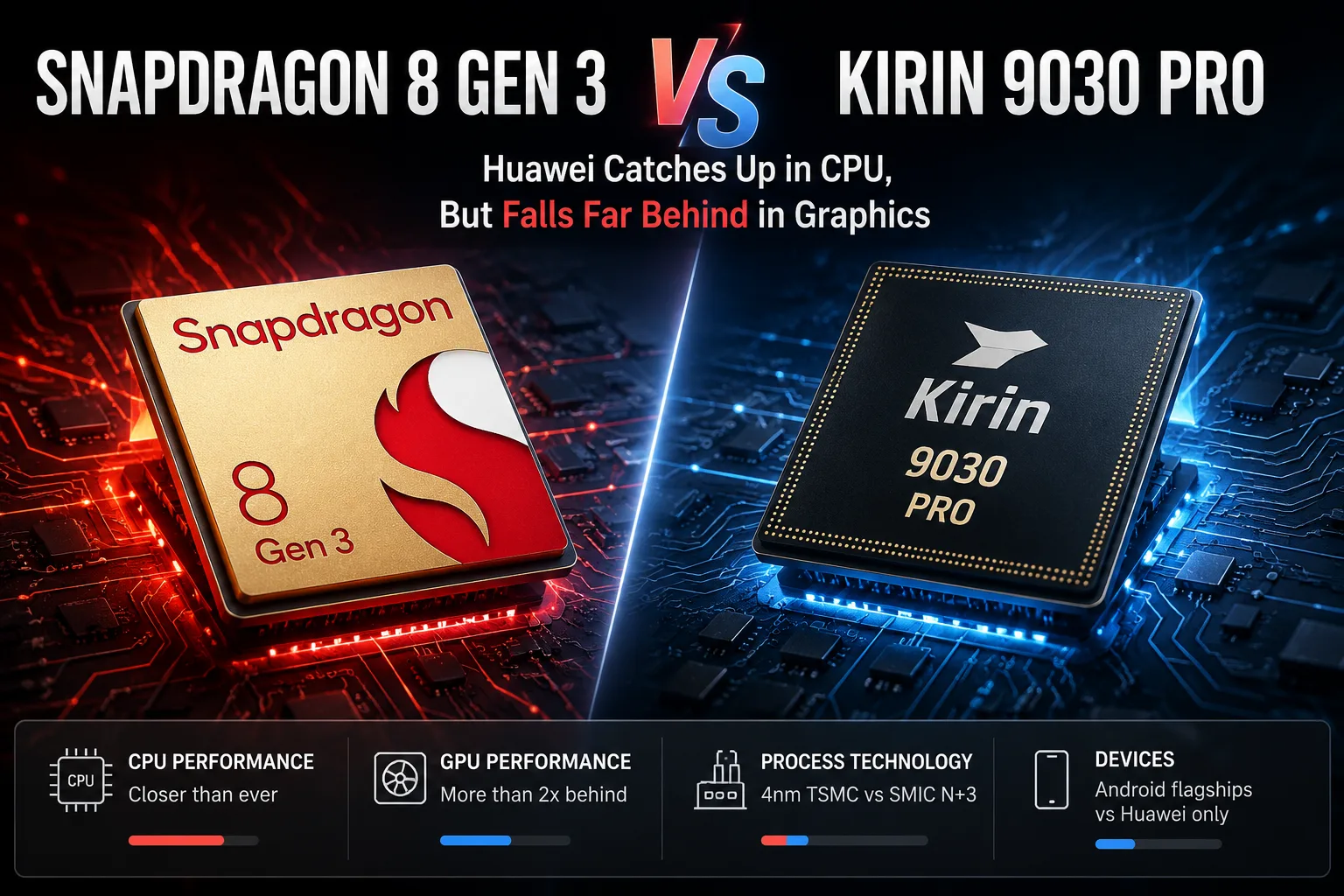
SoC Comparison Result
Snapdragon 6 Gen 3 vs Dimensity 7400: Similar Cores, Different Gaming Performance
Qualcomm Snapdragon 6 Gen 3 and MediaTek Dimensity 7400 are built on the same processor architecture: four Cortex-A78 and four Cortex-A55 cores. MediaTek has increased the clock speeds of both clusters and has included faster graphics. Consequently, in web browsing, messaging, and interface operations, the difference is minimal, while in gaming and under prolonged load, the Dimensity 7400 often comes out ahead.
It is important to note that these processors are not from different classes. The Snapdragon 6 Gen 3 provides sufficient speed for an everyday smartphone, and the performance gap with the Dimensity 7400 is usually measured in tens of percentage points rather than an order of magnitude. The choice between them particularly depends on price and the specific implementation of the device.
Key Differences
| Feature | Snapdragon 6 Gen 3 | Dimensity 7400 |
|---|---|---|
| CPU Frequencies | 4 × Cortex-A78 up to 2.4 GHz and 4 × Cortex-A55 up to 1.8 GHz | 4 × Cortex-A78 up to 2.6 GHz and 4 × Cortex-A55 up to 2.0 GHz |
| Graphics | Adreno 710 | Mali-G615 MC2 |
| Maximum Screen Refresh Rate | FHD+ at 120 Hz | FHD+ at 144 Hz or WFHD+ at 120 Hz |
| Peak 5G Speed | Up to 2.9 Gbps | Up to 3.27 Gbps |
| Bluetooth | 5.2 | 5.4 |
The table only includes distinguishing characteristics. Both processors are manufactured using a 4nm process, support LPDDR4X and LPDDR5, UFS 3.1 storage, Wi-Fi 6E, cameras up to 200 MP, and 4K HDR recording at 30 frames per second. There is little sense in listing these parameters as advantages for either side.
Smartphone Benchmark Results
| Smartphone | Processor | RAM | Geekbench 6, Single Core | Geekbench 6, Multi-Core | AnTuTu 10 |
|---|---|---|---|---|---|
| Samsung Galaxy A36 5G | Snapdragon 6 Gen 3 | 8 GB | 1,023 | 2,690 | 655,225 |
| Motorola Moto G75 | Snapdragon 6 Gen 3 | 8 GB | 1,011 | 2,887 | 620,511 |
| Realme Narzo 80 Pro | Dimensity 7400 | 12 GB | 1,045 | 2,928 | 711,323 |
| Infinix GT 30 | Dimensity 7400 | 8 GB | 1,073 | 3,221 | 727,195 |
The results are taken from tests of finished smartphones. They cannot be regarded as a stand-alone comparison of the two chips: firmware, cooling, memory size, and storage speed all affect the scores. For example, Infinix GT 30 significantly outperforms Realme Narzo 80 Pro with the same Dimensity 7400 chip, while the Galaxy A36 lags behind the Moto G75 in multi-core testing.
Nonetheless, a general trend is evident. In single-core Geekbench, the difference is not significant: the best devices with Dimensity 7400 surpass Snapdragon 6 Gen 3 by about 2-6%. In the multi-core test, the MediaTek advantage depends on the smartphone settings and ranges from a few percent to 10-20%. In AnTuTu, models with Dimensity 7400 score roughly 9-17% higher.
Processor Performance
Both chips use older, yet still adequate Cortex-A78 and Cortex-A55 cores for the mid-range. There is no architectural breakthrough here. The advantage of Dimensity 7400 is due to higher clock speeds: up to 2.6 GHz for the performance cluster and up to 2.0 GHz for the efficiency cores.
This does not mean that a smartphone with MediaTek will be noticeably faster with each touch of the screen. Launching messengers, scrolling through websites, playing videos, and switching between common applications do not create a heavy enough load for the difference to be consistently noticeable.
The advantage of Dimensity 7400 becomes apparent in photo processing, file unpacking, app installation, and prolonged multitasking. However, even here, much depends on cooling. Infinix GT 30 scores 3,221 points in multi-core Geekbench, while Realme Narzo 80 Pro with the same chip scores 2,928.
Snapdragon 6 Gen 3, on the other hand, is an evolution of Snapdragon 6 Gen 1 and not a completely new architecture. Qualcomm claimed a CPU boost of up to 10% and graphics performance increase of over 30% compared to the previous platform. Therefore, the Gen 3 index looks more impressive than the actual scope of changes.
Gaming and Graphics
Mali-G615 MC2 in Dimensity 7400 is faster than Adreno 710, but the gap does not elevate MediaTek into a different class of gaming platform. In 3DMark Wild Life Extreme, Samsung Galaxy A36 scores around 914 points, while Infinix GT 30 scores 1,048 points. The difference is about 15%. AnTuTu GPU results present a similar picture: 154,588 points for Galaxy A36 against 182,825 for Infinix.
This level of advantage is enough to increase settings one notch in some games or achieve a more stable frame rate. Dimensity 7400 is better suited for Genshin Impact, Wuthering Waves, and other demanding titles, especially in a smartphone with developed cooling.
Snapdragon 6 Gen 3 performs adequately in Call of Duty: Mobile, PUBG Mobile, World of Tanks Blitz, and less demanding games. In heavy projects, lower or medium settings will often need to be selected. However, Moto G75 shows near-perfect stability in the stress test of 3DMark, so weaker peak graphics do not necessarily mean strong throttling.
Support for 144Hz screens in Dimensity 7400 is beneficial for interface and less demanding competitive games. However, one should not expect stable 144 frames per second in demanding titles: the Mali-G615 MC2 does not have enough power for this.
Cameras, Connectivity, and Battery Life
There is no camera advantage between the platforms that can be generalized across all smartphones. Both support sensors up to 200 MP and 4K HDR recording at 30 frames per second. The actual quality depends more on the sensor, optics, stabilization, and manufacturer's algorithms than on the name of the processor.
Dimensity 7400 offers a slightly faster 5G modem and Bluetooth 5.4 instead of 5.2. The difference in peak mobile network speed in normal conditions is hardly felt, as real-world indicators are limited by the carrier, coverage, and plan. Bluetooth 5.4 also does not guarantee better sound: the codecs and capabilities of wireless headphones depend on the specific smartphone.
It is hard to pre-select a winner in terms of battery life. Both chips are manufactured according to 4nm standards, but the final power consumption is determined by the display, battery, modem settings, and firmware. Comparing battery life should be done using tests of specific models.
Which Processor is Better
Dimensity 7400 wins in pure performance. It is slightly faster in short processor tasks, noticeably outperforms Snapdragon under full core load, and is about 10-20% stronger in graphics tests. At a similar price, a smartphone with MediaTek is more advantageous for gaming and heavy applications.
Snapdragon 6 Gen 3 is justified if the device is cheaper or better in other characteristics. Cameras, display quality, casing protection, update lifespan, and battery life may prove to be more important than additional points in AnTuTu.
A practical guideline for choosing:
- at the same price, prefer Dimensity 7400;
- for gaming, MediaTek’s advantage is noticeable but not radical;
- for browsing, video, navigation, and messaging, both processors are sufficient;
- choose a smartphone with Snapdragon if it wins on price, cameras, or support.
Dimensity 7400 is a faster and more versatile chip. Snapdragon 6 Gen 3 remains a workable mid-range solution, but its graphical power is less, and its notable name conceals a rather cautious update of an old platform.
Advantages
- Higher Technology: 4 nm (4 nm vs 7 nm)
- Higher Frequency: 3300 MHz (3300 MHz vs 2750 MHz)
- Newer Launch Date: November 2025 (October 2023 vs November 2025)
Basic
5x (3x3.2 GHz/2x3.0GHz) – Cortex-A720
2x 2.3 GHz – Cortex-A520
3x 1.72 GHz
4x 2.27 GHz
GPU Specifications
Connectivity
Memory Specifications
Miscellaneous
- AIFF
- CAF
- MP3
- MP4
- WAV
- H.265
- VP9
Benchmarks
Related SoC Comparisons




Share in social media
Or Link To Us
<a href="https://cputronic.com/soc/compare/qualcomm-snapdragon-8-gen-3-vs-hisilicon-kirin-9030-pro" target="_blank">Qualcomm Snapdragon 8 Gen 3 vs HiSilicon Kirin 9030 Pro</a>