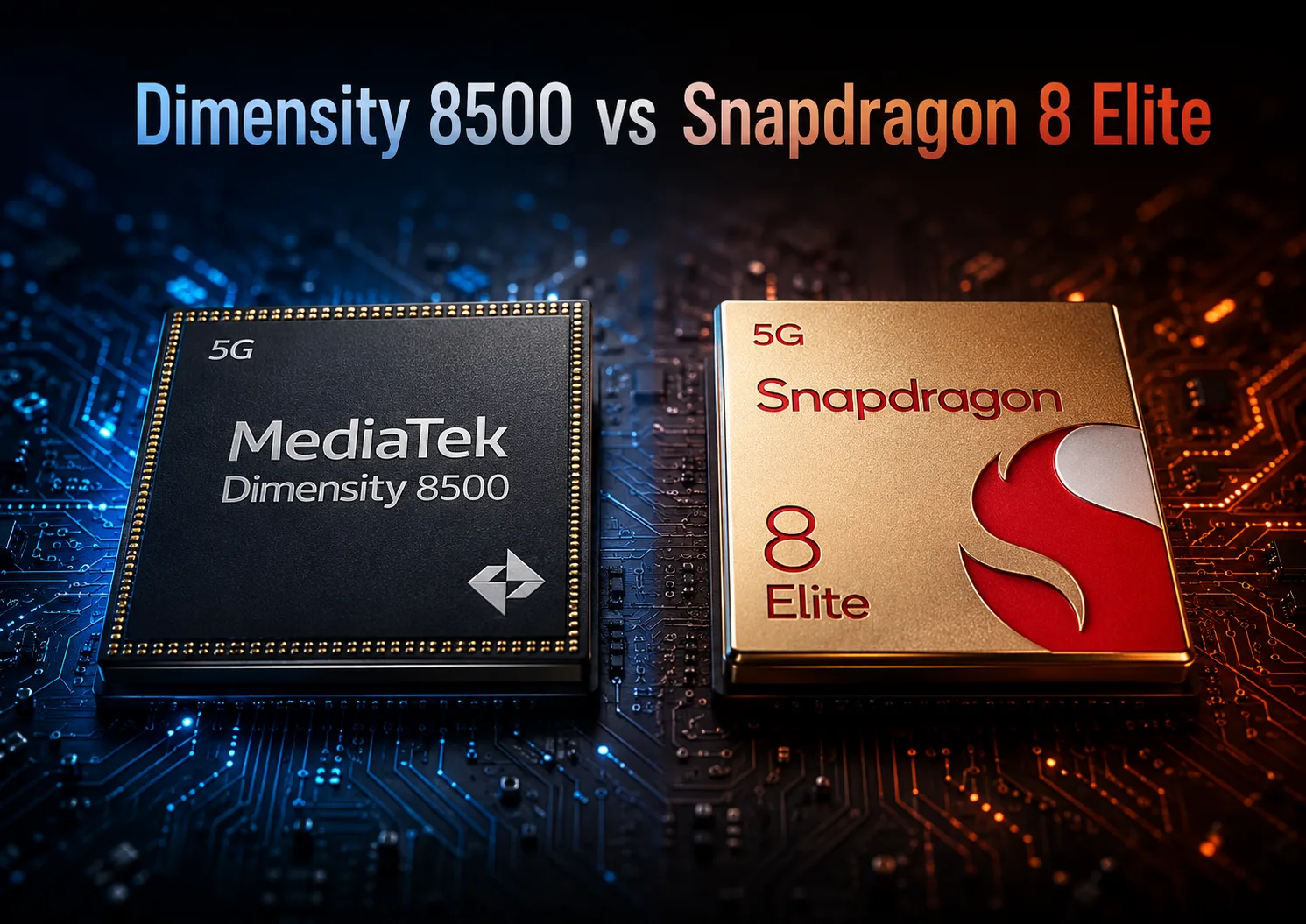
MediaTek Dimensity 8500
vs
Qualcomm Snapdragon 8 Elite

SoC Comparison Result
MediaTek Dimensity 8500 vs Qualcomm Snapdragon 8 Elite: Strong Sub-Flagship vs True Flagship
MediaTek Dimensity 8500 and Qualcomm Snapdragon 8 Elite are not direct competitors. Snapdragon 8 Elite is a full-fledged flagship chip with custom Oryon cores, powerful Adreno 830 graphics, and a more expensive platform. Dimensity 8500 is positioned lower: it aims to provide high speed and some flagship feel in more affordable smartphones.
The main question here isn't which chip is faster. Snapdragon 8 Elite is faster almost everywhere. The real question is how good Dimensity 8500 is for the money.
Key Differences
| Parameter | MediaTek Dimensity 8500 | Qualcomm Snapdragon 8 Elite | What it Means |
|---|---|---|---|
| Class | Sub-Flagship | Flagship | Qualcomm is positioned higher |
| Process Node | 4nm TSMC | 3nm TSMC | Snapdragon is built on a newer node |
| CPU | 8x Cortex-A725 | 2x Oryon + 6x Oryon | Snapdragon is stronger in single-threaded tasks |
| CPU Frequency | Up to 3.4 GHz | Up to 4.32-4.47 GHz | Qualcomm has a higher frequency ceiling |
| GPU | Mali-G720 MC8 | Adreno 830 | Snapdragon is significantly stronger in gaming |
| Memory | LPDDR5X, up to 76.8 GB/s | LPDDR5X, up to 84.8 GB/s | There is a difference, but it's not key |
| Connectivity | 5G-A, Wi-Fi 6E | X80 5G, Wi-Fi 7 | Snapdragon is richer as a platform |
| Video | Up to 4K60 | Up to 4K120 / 8K | Qualcomm has a higher multimedia ceiling |
Dimensity 8500 employs an All Big Core scheme: one Cortex-A725 core up to 3.4 GHz, three cores up to 3.2 GHz, and four cores up to 2.2 GHz. There are no small Cortex-A5xx cores, so the chip performs well in multi-threaded tasks. However, Snapdragon 8 Elite is built on custom Oryon cores and operates at higher frequencies, giving it a significantly higher ceiling.
CPU Performance
In regular use, both chips will be fast. The interface, browser, messaging apps, camera, and the majority of applications won't cause problems for either. The difference emerges in heavy scenarios: photo processing, complex websites, emulation, video editing, and prolonged loads.
According to early Geekbench 6 data, Dimensity 8500 scores about 1720 points in single-core and 6700 points in multi-core. Snapdragon 8 Elite shows around 3040 and 9400 points. The final figures depend on the specific smartphone, cooling, and firmware, but the overall situation is clear: Snapdragon is noticeably faster, especially in single-threaded tasks.
Dimensity 8500 can't be called weak. For its class, it's a strong chip. But Snapdragon 8 Elite is not just symbolically faster; it has a significant lead.
Gaming and Graphics
The Mali-G720 MC8 in Dimensity 8500 provides good graphics for a sub-flagship smartphone. It is suitable for popular games, high settings, and increased frame rates in optimized titles. However, in heavy games and emulators, Snapdragon 8 Elite will be more stable.
Adreno 830 is considerably more powerful, better suited for long gaming sessions and modern graphical effects. Qualcomm also offers a stronger set of gaming technologies: hardware ray tracing, Snapdragon Game Super Resolution, Adreno Frame Motion Engine, and support for current gaming technologies.
In AnTuTu 11, the gap is large: Dimensity 8500 scores about 2.15 million points, while Snapdragon 8 Elite scores around 3.34 million. The difference in the GPU section is even more pronounced: approximately 686k vs. 1.19 million points. These results may also vary from model to model, but the divide between a strong sub-flagship and a top-tier chip is clearly visible.
Camera and Video
Both chips support cameras up to 320 MP, but in terms of video capabilities, Snapdragon 8 Elite is class above. Dimensity 8500 features the modern ISP Imagiq 1080, supports three cameras of 32 MP, AI Zero Shutter Lag, and can record video up to 4K60. This is sufficient for mid-range and upper mid-range smartphones: you can install a good main sensor, a decent triple camera, and shoot 4K without obvious shortcomings.
Snapdragon 8 Elite offers more possibilities for expensive camera phones. It features a stronger ISP + Hexagon NPU combo, with a higher video ceiling - up to 4K120, slow motion 1080p at 480 FPS, support for 10-bit HDR video, Dolby Vision, HDR10+, HLG, and more advanced scene processing. This doesn't mean that any smartphone with Snapdragon automatically takes better photos, but for flagship cameras, the platform's capabilities are significantly greater.
Connectivity and Platform
Dimensity 8500 supports 5G-Advanced Sub-6, Wi-Fi 6E, Bluetooth 5.4, LPDDR5X 9600 Mbps, and UFS 4 + MCQ. This is a modern set without clear shortcomings.
Snapdragon 8 Elite is richer: X80 5G, Wi-Fi 7, FastConnect 7900, UWB, and a higher class wireless platform. Not every user will notice this every day, but for an expensive flagship, such details are important.
What to Choose
Dimensity 8500 makes sense if the smartphone is significantly cheaper. It will provide a fast interface, good CPU, strong class-leading graphics, modern memory, and decent camera capabilities. Its goal is not to outperform Snapdragon 8 Elite but to offer a high standard without the flagship price.
Snapdragon 8 Elite is better if you need the maximum: gaming, emulation, heavy camera use, video, fast AI, Wi-Fi 7, and maximum performance for several years. Especially if the smartphone itself is expensive and doesn’t skimp on display, cooling, memory, and cameras.
Conclusion
Snapdragon 8 Elite is objectively stronger: CPU, GPU, camera, video, connectivity, and overall platform level are all higher. It is a true flagship chip.
Dimensity 8500 is interesting for its balance. If a smartphone using it costs significantly less, it can be a very good purchase. But with a similar price to models on Snapdragon 8 Elite, Qualcomm’s advantage is too large: in such a comparison, Dimensity only wins in price, not in absolute power.
Advantages
- Newer Launch Date: January 2026 (January 2026 vs October 2024)
- Higher Technology: 3 nm (4 nm vs 3 nm)
- Higher Frequency: 4320 MHz (3400 MHz vs 4320 MHz)
Basic
GPU Specifications
Connectivity
Memory Specifications
Miscellaneous
Benchmarks
Comparison of Devices
Related SoC Comparisons



Share in social media
Or Link To Us
<a href="https://cputronic.com/soc/compare/mediatek-dimensity-8500-vs-qualcomm-snapdragon-8-elite" target="_blank">MediaTek Dimensity 8500 vs Qualcomm Snapdragon 8 Elite</a>