MediaTek Dimensity 8300 Ultra
vs
MediaTek Dimensity 8500
SoC Comparison Result
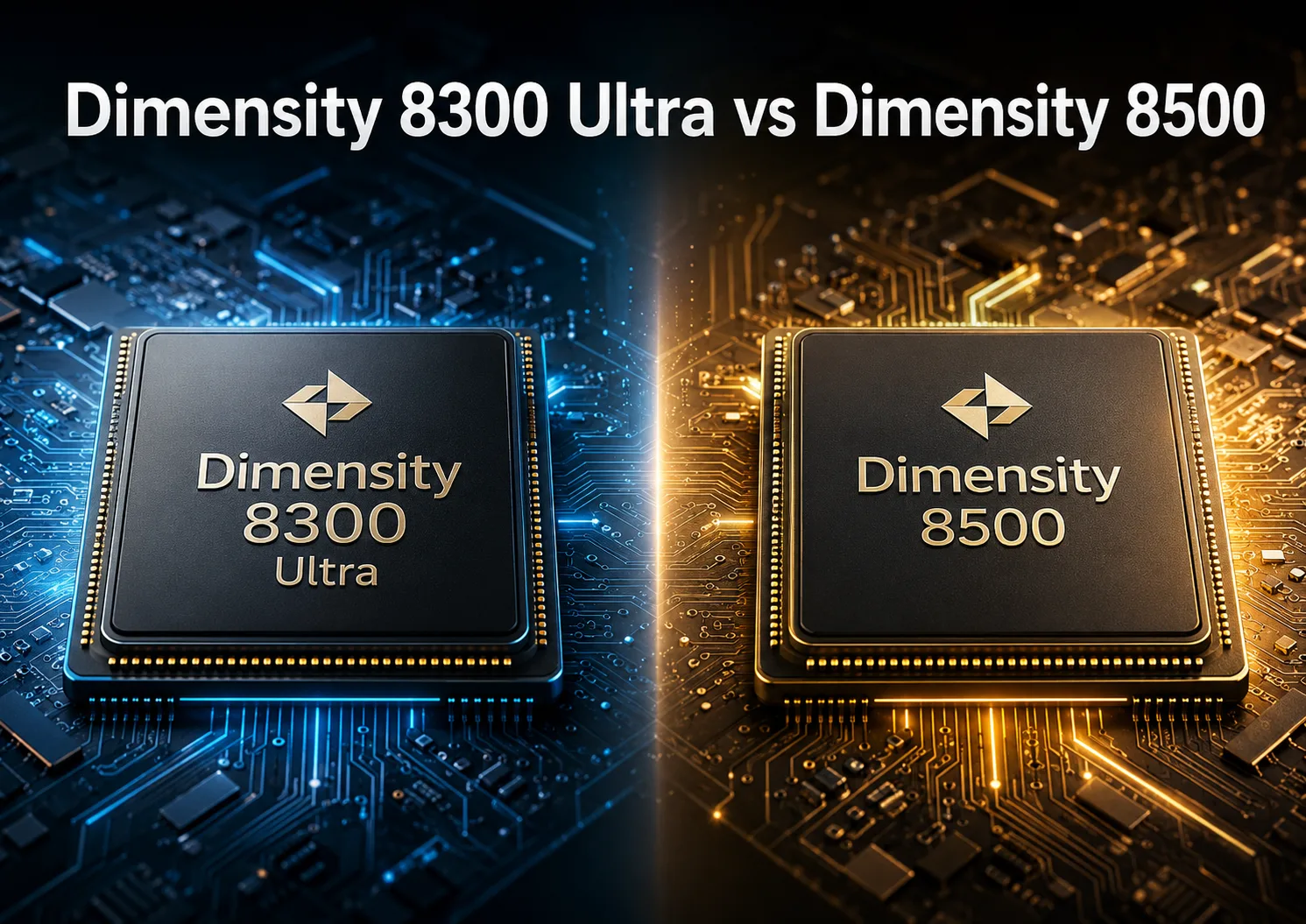
MediaTek Dimensity 8300 Ultra vs MediaTek Dimensity 8500: Old Hit vs. New Generation
The MediaTek Dimensity 8300 Ultra was one of the most successful chips in its class. It was featured in smartphones like the POCO X6 Pro and brought almost flagship performance to a more affordable segment.
The Dimensity 8500 is a more modern platform. The main difference is not just a slight increase in frequency but in the new CPU based on Cortex-A725, the Mali-G720 MC8 graphics, faster memory, and NPU 880. The Dimensity 8300 Ultra is still good, but compared to the 8500, it looks like a chip from the previous generation.
Key Differences
| Specification | Dimensity 8300 Ultra | Dimensity 8500 |
|---|---|---|
| CPU | 4x Cortex-A715 + 4x Cortex-A510 | 8x Cortex-A725 |
| CPU Architecture | big.LITTLE | all-big-core |
| L3 Cache | 4 MB | 6 MB |
| GPU | Mali-G615 MC6 | Mali-G720 MC8 |
| NPU | NPU 780 | NPU 880 |
| Memory | LPDDR5X up to 8533 Mbps | LPDDR5X up to 9600 Mbps |
| Display | WQHD+ up to 120 Hz / FHD+ up to 180 Hz | WQHD+ up to 144 Hz |
From the table, it is clear that the Dimensity 8500 is stronger not in just one separate part but almost across the entire platform. It has a more modern CPU, a wider graphics block, faster memory, larger L3 cache, and higher support for WQHD+ frequency. The NPU 880 is also important, but more as a basis for local AI features than as a main selling point for smartphones today.
CPU Section
The Dimensity 8300 Ultra uses a 4+4 architecture: four powerful Cortex-A715 and four energy-efficient Cortex-A510. At its time, this was a very successful configuration. The chip quickly opens apps, manages multitasking well, and does not appear weak even against newer mid-range solutions.
The Dimensity 8500 shifts to a different philosophy - eight Cortex-A725 cores without the smaller Cortex-A510. This all-big-core scheme means that even the smaller cores remain powerful, simply operating at lower frequencies. In heavy tasks, this approach provides more headroom: rendering, unpacking, photo processing, running multiple apps, and CPU-intensive gaming should run more reliably.
In practice, the Dimensity 8300 Ultra is still fast, but the Dimensity 8500 is better suited for prolonged loads, especially when talking about more than just social networks and browsers, but also heavy gaming, camera work, and constant multitasking.
Graphics and Gaming
The difference in graphics is no longer superficial. The Dimensity 8300 Ultra uses the Mali-G615 MC6, while the Dimensity 8500 uses the Mali-G720 MC8. This is not just a matter of having more cores; it marks a transition to a newer generation of GPUs from ARM.
The Mali-G615 MC6 is capable graphics for a strong mid-range. It is based on the fourth generation of Valhall architecture and supports Variable Rate Shading. This helped the Dimensity 8300 Ultra establish a good gaming reputation: the chip handles heavy projects noticeably better than many standard mid-range SoCs while remaining quite economical.
The Mali-G720 MC8 in the Dimensity 8500 is already a step further. This is a fifth-generation GPU, featuring a configuration with 8 cores compared to 6 in the Mali-G615 MC6. The Mali-G720 also includes Deferred Vertex Shading - a new geometry processing scheme that helps achieve better visuals within the same power budget. For gaming, this is more important than just the peak FPS numbers in the first minutes; stability after heating up matters too.
Simply put, the Dimensity 8300 Ultra is still good for gaming, but the Dimensity 8500 offers more headroom for high settings, 120/144 Hz, and heavier projects. In synthetic benchmarks, the gap in GPU performance often appears significant: in AnTuTu, the graphic score for the Dimensity 8500 can be approximately 45-50% higher. In real games, the outcome will depend on the smartphone cooling, but the GPU itself in the 8500 is noticeably more modern and powerful.
Benchmarks
| Test | Dimensity 8300 Ultra / 8300 | Dimensity 8500 | Approximate Difference |
|---|---|---|---|
| AnTuTu 11 Overall | ~1.6 million | ~2.15 million | +30-35% |
| AnTuTu 11 CPU | ~466 thousand | ~623 thousand | +30-35% |
| AnTuTu 11 GPU | ~465 thousand | ~687 thousand | +45-50% |
| Geekbench 6 Single-Core | ~1375 | ~1720 | +25% |
| Geekbench 6 Multi-Core | ~4215 | ~6715 | +55-60% |
| Geekbench 6 GPU Compute | ~9370 | ~13460 | +40-45% |
These figures are best viewed as a reference. The same chip might show different results in different smartphones: cooling, firmware, power limits, RAM, and the case all play a role.
The main significance of benchmarks isn’t in single-core performance, where the difference is moderate, but in multi-core and GPU performance. The Dimensity 8500 is noticeably stronger exactly where the load is prolonged and heavy: gaming, photo and video processing, multitasking, unpacking, rendering, and computational tasks.
Final Choice
The Dimensity 8300 Ultra cannot be considered weak. It's a successful chip that has well-survived the generational shift and still competes better than many mid-range competitors. If a smartphone with this chip is significantly cheaper, it can be a solid choice for gaming, daily tasks, photography, videography, and heavy applications.
The Dimensity 8500 seems like the better option at a similar price point. This is not a minor upgrade from the Dimensity 8300 Ultra, but a full step forward: all-big-core CPU, Mali-G720 MC8, NPU 880, 6 MB L3, and LPDDR5X 9600. It is faster in multithreading, significantly stronger in graphics, and better suited for heavy gaming and prolonged loads.
The main takeaway is simple: The Dimensity 8300 Ultra makes sense if it is significantly cheaper. If the price difference is small, it is better to choose the Dimensity 8500.
Advantages
- Higher Frequency: 3400 MHz (3350 MHz vs 3400 MHz)
- Newer Launch Date: January 2026 (November 2023 vs January 2026)
Basic
GPU Specifications
Connectivity
Memory Specifications
Miscellaneous
Benchmarks
Comparison of Devices
Related SoC Comparisons



Share in social media
Or Link To Us
<a href="https://cputronic.com/soc/compare/mediatek-dimensity-8300-ultra-vs-mediatek-dimensity-8500" target="_blank">MediaTek Dimensity 8300 Ultra vs MediaTek Dimensity 8500</a>