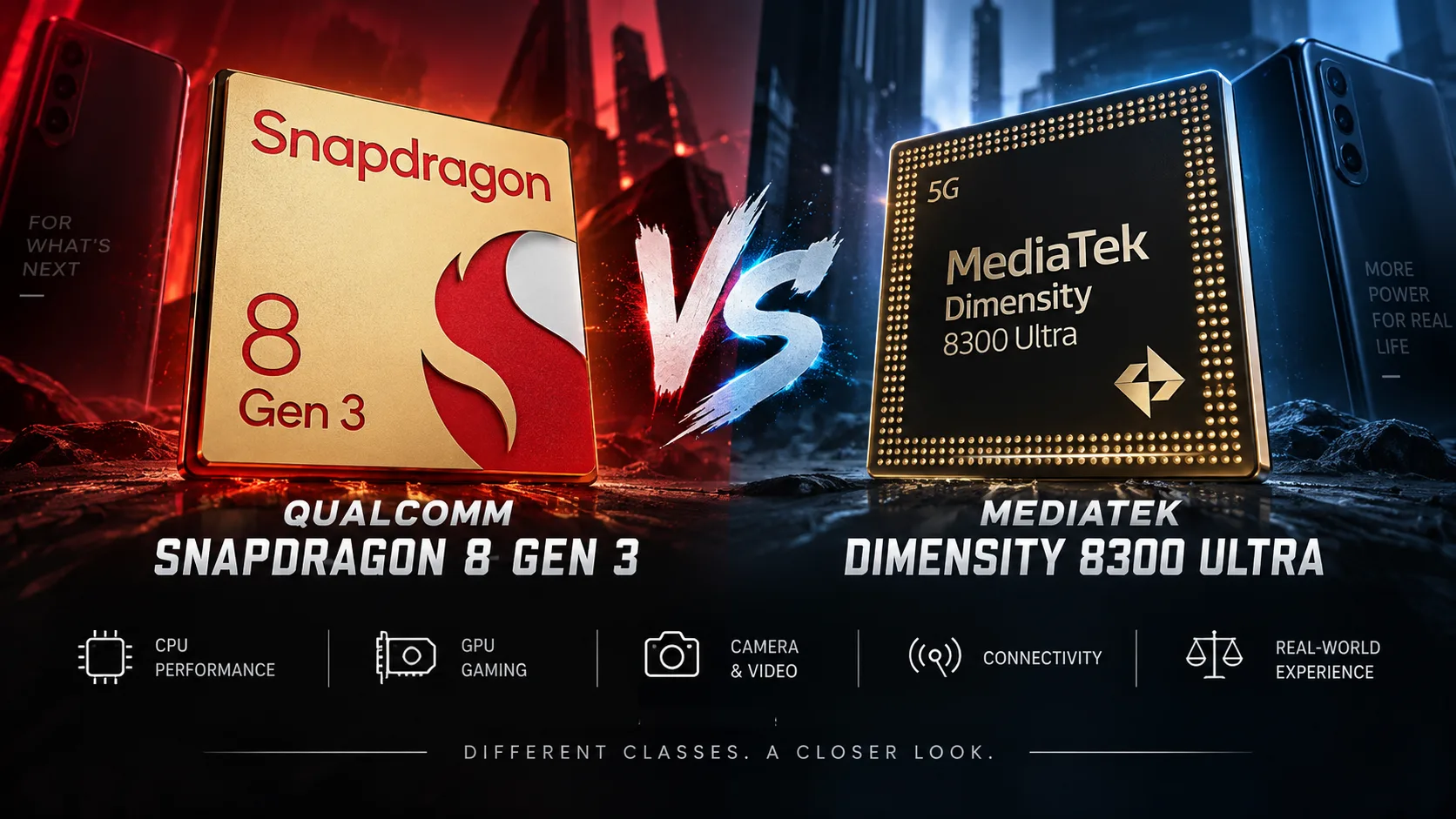
Qualcomm Snapdragon 8 Gen 3
vs
MediaTek Dimensity 8300 Ultra

vs

SoC Comparison Result

Qualcomm Snapdragon 8 Gen 3 vs MediaTek Dimensity 8300-Ultra - flagship or fast sub-flagship without overpayment

Snapdragon 8 Gen 3 - the top platform for expensive Android flagships.
Dimensity 8300-Ultra - a powerful sub-flagship chip that is more commonly found in more affordable Xiaomi and POCO smartphones.

It's important to understand: the Ultra designation does not turn the Dimensity 8300-Ultra into a full-fledged competitor to the Snapdragon 8 Gen 3. This is a version of Dimensity 8300 for Xiaomi, POCO, and Redmi devices with a proprietary platform configuration, but it still belongs to the upper mid-range class.

The main question here is not which processor is more powerful. Snapdragon 8 Gen 3 is more powerful. It is more important to understand whether it is worth paying extra for flagship reserve if the Dimensity 8300-Ultra already covers most real scenarios.

Quick Summary

Snapdragon 8 Gen 3 is the choice if heavy games, high FPS, a strong camera, advanced modem, Wi-Fi 7, fast on-device AI, and performance reserve for several years are important.

Dimensity 8300-Ultra is more cost-effective if you need a very fast smartphone for applications, gaming, photo, video, and everyday use, but without overpaying for a true flagship.

In simple terms: Snapdragon 8 Gen 3 - maximum capabilities, Dimensity 8300-Ultra - almost flagship speed for more reasonable money.

Main Differences

Parameter Snapdragon 8 Gen 3 Dimensity 8300-Ultra What it means
Class Flagship Sub-flagship Snapdragon is more often found in more expensive devices
CPU Cortex-X4 + Cortex-A720 + Cortex-A520 1x Cortex-A715 up to 3.35 GHz + 3x Cortex-A715 up to 3.2 GHz + 4x Cortex-A510 up to 2.2 GHz Snapdragon is faster in peaks and heavy tasks
GPU Adreno 750 Mali-G615 MC6 Snapdragon performs better in heavy games and emulators
Connectivity Snapdragon X75, Wi-Fi 7 5G, Wi-Fi 6E Snapdragon has a more robust modem and wireless network capabilities
Camera 18-bit ISP 14-bit HDR-ISP Snapdragon's advantages are often noticeable in smartphones with expensive sensors and advanced processing
AI / NPU More powerful AI block MediaTek APU/NPU 780 Snapdragon is better suited for heavy local AI scenarios
Benchmarks AnTuTu 10: ≈ 1.9-2.1 million; Geekbench 6: ≈ 2100-2300 / 6600-7300 AnTuTu 10: ≈ 1.4-1.55 million; Geekbench 6: ≈ 1450-1550 / 4500-5000 Snapdragon is usually faster by about 30-45%, especially in heavy CPU/GPU tasks
Smartphone Prices Higher Lower Dimensity 8300-Ultra generally offers better price/performance

Performance

Snapdragon 8 Gen 3 is faster in almost everything. It features a powerful main Cortex-X4 core, a strong cluster of performance cores, and a high reserve for heavy tasks: gaming, photo processing, video editing, emulators, AI functions, and multitasking.

Dimensity 8300-Ultra is weaker, but it is by no means a slow chip. In regular use, the difference is often imperceptible: the interface, browser, social media, messengers, camera, and most applications work quickly. For most users, its performance is more than adequate.

The difference becomes more pronounced under prolonged load. Snapdragon 8 Gen 3 is better suited for scenarios that require maintaining high speed for extended periods: heavy gaming, video recording, processing large files, emulators, and active multitasking. Dimensity 8300-Ultra is also fast, but it often depends more on cooling and the specific smartphone settings.

Gaming and Graphics

In gaming, the advantage of Snapdragon 8 Gen 3 is more noticeable than in regular tasks. The Adreno 750 graphics are more powerful than the Mali-G615 MC6, making it better suited for high settings, stable FPS, and heavy gaming projects.

In demanding games like Genshin Impact, Honkai: Star Rail, and Wuthering Waves, Snapdragon 8 Gen 3 often allows for playing at higher settings and maintaining stable frame rates for longer. This is especially apparent in gaming smartphones or flagships with good cooling systems.

Dimensity 8300-Ultra is also suitable for gaming. The POCO X6 Pro demonstrates that this chip can deliver very good performance for its price: it handles modern games, opens applications quickly, and feels significantly more powerful than typical mid-range platforms. However, it is not on the level of gaming flagships: in the heaviest projects, settings may sometimes need to be lowered, and FPS stability will rely more on the casing and cooling system.

A separate advantage of Snapdragon is the Adreno graphics drivers. They often perform better in emulators and some games with Vulkan, where optimization for Qualcomm can provide a noticeable advantage.

Energy Efficiency and Heat

Both chips are manufactured on a modern 4nm process technology, but the final performance depends not only on the processor. Factors like the casing, cooling system, battery, display, and manufacturer settings are crucial.

Scenario Snapdragon 8 Gen 3 Dimensity 8300-Ultra
Everyday Tasks Fast and smooth, consumption depends on firmware Very good balance of speed and battery life
Mid-Heavy Games High FPS, good reserve Comfortable performance without a high premium
Heavy Games and Benchmarks Higher peak, but more demanding on cooling Lower peak, but often more moderate heating
Extended Load Better in smartphones with good cooling More dependent on the casing and thermal package

For prolonged heavy gaming, it is better to choose a smartphone with Snapdragon 8 Gen 3 and a good cooling system. For everyday use, social media, browsing, video, and occasional gaming, Dimensity 8300-Ultra appears very rational.

Camera and Video

Snapdragon 8 Gen 3 excels in camera and video capabilities. Its 18-bit ISP is designed for flagship scenarios: complex HDR processing, multi-camera systems, high video quality, and advanced image processing algorithms.

However, it’s important not to overestimate the chip itself. The camera is influenced not only by the chip but by the entire smartphone: sensor, optics, stabilization, processing algorithms, and manufacturer settings. Snapdragon 8 Gen 3 is often found in more expensive models, so users typically also receive a stronger camera module with it.

Dimensity 8300-Ultra also supports good camera and video capabilities. For example, the Xiaomi 14T on this chip puts greater emphasis on the camera, display, and overall user experience compared to the POCO X6 Pro. Nevertheless, on average, smartphones with Dimensity 8300-Ultra still tend to belong to the "almost flagship" class rather than true camera phones.

The verdict is simple: if superior video recording, complex HDR processing, and flagship-level cameras are important, Snapdragon 8 Gen 3 is preferred. If decent everyday shooting is sufficient, Dimensity 8300-Ultra will do just fine.

Connectivity and Wireless Capabilities

Snapdragon 8 Gen 3 is stronger in communications. The Snapdragon X75 modem, support for Wi-Fi 7, and greater reserve in networking capabilities make it better for expensive smartphones that are purchased for several years.

Dimensity 8300-Ultra offers modern 5G, Wi-Fi 6E, and Bluetooth 5.4 depending on the specific device. For most users, this is adequate: messengers, video, gaming, navigation, and mobile internet will work quickly.

The difference is more important for those who want maximum future-proofing, Wi-Fi 7, a more advanced modem, and better connectivity in a premium smartphone.

Artificial Intelligence and NPU

Snapdragon 8 Gen 3 is better prepared for heavy on-device AI scenarios: generative features, image processing, local language models, and advanced AI tools in the camera.

Dimensity 8300-Ultra with MediaTek APU/NPU 780 is also designed for modern AI tasks, including generative functions, photo enhancement, scene recognition, noise reduction, and voice capabilities. However, in terms of capacity for heavy local AI, Snapdragon 8 Gen 3 appears stronger.

At the same time, comparing NPUs directly by TOPS is not always correct: manufacturers use different metrics, types of computations, and testing scenarios. For users, the important aspect is not just a dry number but what AI functions are actually available in the specific smartphone.

Examples of Smartphones

Smartphones with Snapdragon 8 Gen 3

Samsung Galaxy S24 Ultra - one of the most well-known flagships with Snapdragon 8 Gen 3. This is a device where the powerful chip is complemented by a strong camera, quality display, S Pen, good battery life, and long-term support.

OnePlus 12 - a good option for those who need flagship performance without the maximum overpayment. It fully reveals Snapdragon 8 Gen 3's capabilities in gaming, multitasking, and everyday speed.

ASUS ROG Phone 8 Pro - a gaming example. Here, Snapdragon 8 Gen 3 is particularly suitable: powerful graphics, high FPS, advanced cooling, and a display with a high refresh rate.

Smartphones with Dimensity 8300-Ultra

POCO X6 Pro - the most recognizable smartphone with Dimensity 8300-Ultra. Its main idea is maximum performance for the money. It demonstrates the strengths of this chip well: a lot of speed without flagship prices.

Xiaomi 14T - a more balanced option with Dimensity 8300-Ultra. It emphasizes not only performance but also display, camera, design, and overall user experience.

Redmi K70E - an important model for the Chinese market. It demonstrates that Dimensity 8300-Ultra is well-suited for smartphones with aggressive price, performance, display, and battery ratios.

What Real Devices Show

The differences in positioning are clearly visible across smartphones.

Snapdragon 8 Gen 3 is more often found in expensive flagships. You pay not only for the chip but also for a better display, camera, materials, cooling, connectivity, and longer support.

Dimensity 8300-Ultra is more commonly used in models where price and speed are the main considerations. Such smartphones are very fast, but usually fall short of flagships in camera, materials, cooling, haptic feedback, wireless capabilities, or additional features.

Which Processor to Choose

Choose Snapdragon 8 Gen 3 if:

  • you need a smartphone for 3-4 years;
  • you play heavy games and want maximum FPS;
  • camera, video, connectivity, and Wi-Fi 7 are important;
  • you are interested in next-generation on-device AI features;
  • you want a flagship level device overall;
  • the price difference is not critical.

Choose Dimensity 8300-Ultra if:

  • you need a fast smartphone cheaper than a flagship;
  • gaming is important, but not necessarily at maximum settings;
  • you want a good balance of speed, autonomy, and price;
  • you are considering POCO X6 Pro, Xiaomi 14T, or similar models;
  • you are not chasing after 8K video, Wi-Fi 7, and a top camera;
  • overpaying for Snapdragon 8 Gen 3 seems unjustified.

Conclusion

Snapdragon 8 Gen 3 is suitable for those who need maximum reserves: heavy gaming, strong camera, advanced connectivity, local AI functions, and overall flagship smartphone level.

Dimensity 8300-Ultra looks better for those who want very fast everyday performance, good energy efficiency, and a favorable price-performance ratio.

If you need the maximum - go for Snapdragon 8 Gen 3. If you need high speed for less money - Dimensity 8300-Ultra.

Advantages

  • Higher Frequency: 3350 MHz (3300 MHz vs 3350 MHz)
  • Newer Launch Date: November 2023 (October 2023 vs November 2023)

Basic

Qualcomm
Label Name
MediaTek
October 2023
Launch Date
November 2023
SmartPhone Flagship
Platform
SmartPhone Flagship
TSMC
Manufacturing
TSMC
SM8650-AB
Model Name
Dimensity 8300 ultra
1x 3.3 GHz – Cortex-X4
5x (3x3.2 GHz/2x3.0GHz) – Cortex-A720
2x 2.3 GHz – Cortex-A520
Architecture
1x 3.35 GHz – Cortex-A715, 3x 3.2 GHz – Cortex-A715, 4x 2.2 GHz – Cortex-A510
8
Cores
8
4 nm
Technology
4 nm
3300 MHz
Frequency
3350 MHz

GPU Specifications

Adreno 750
GPU name
Mali-G615 MP6
770 MHz
GPU frequency
1400 MHz
3.0 FP
OpenCL version
2.0
-
Vulkan version
1.3
4K @ 60 Hz, QHD+ @ 144 Hz
Max display resolution
2960 x 1440

Connectivity

LTE Cat. 24
4G support
Yes
Yes
5G support
Yes
5.4
Bluetooth
5.4
7
Wi-Fi
6
GPS, GLONASS, Beidou, Galileo, QZSS, NAVIC
Navigation
GPS, GLONASS, Beidou, Galileo, QZSS, NAVIC

Memory Specifications

LPDDR5X
Memory type
LPDDR5X
4800 MHz
Memory frequency
4266 MHz
4x 16 Bit
Memory Bus
4x 16 Bit

Miscellaneous

Hexagon
Neural processor (NPU)
MediaTek APU 780
AAC, AIFF, CAF, MP3, MP4, WAV
Audio codecs
AAC LC, MP3, HE-AACv1, HE-AACv2, FLAC
1x 200MP
Max camera resolution
1x 320MP
UFS 4.0
Storage type
UFS 4.0
8K at 30FPS, 4K at 120FPS
Video capture
4K at 60FPS
H.264, H.265, AV1, VP8, VP9
Video codecs
H.264, H.265, AV1, VP9
8K at 30FPS, 4K at 120FPS
Video playback
4K at 60FPS
ARMv9
Instruction set
-

Benchmarks

Geekbench 6 Single Core
Snapdragon 8 Gen 3
2192 +46%
Dimensity 8300 Ultra
1506
Geekbench 6 Multi Core
Snapdragon 8 Gen 3
7085 +46%
Dimensity 8300 Ultra
4844
AnTuTu 10
Snapdragon 8 Gen 3
1933536 +27%
Dimensity 8300 Ultra
1518170
AiTuTu 3
Snapdragon 8 Gen 3
1571677 +698%
Dimensity 8300 Ultra
197065

Comparison of Devices

3DMark Sling Shot Extreme Unlimited
ZTE Nubia Red Magic 9 Pro
Qualcomm Snapdragon 8 Gen 3
19778
Xiaomi Redmi K70E
MediaTek Dimensity 8300 Ultra
10420
3DMark Sling Shot Unlimited
ZTE Nubia Red Magic 9 Pro
Qualcomm Snapdragon 8 Gen 3
22529
Xiaomi Poco X6 Pro
MediaTek Dimensity 8300 Ultra
9580
3DMark Solar Bay
Redmagic Gaming Pad Pro
Qualcomm Snapdragon 8 Gen 3
9124
Xiaomi Redmi K70E
MediaTek Dimensity 8300 Ultra
4609
3DMark Solar Bay Extreme
Redmagic Gaming Pad Pro
Qualcomm Snapdragon 8 Gen 3
955
Xiaomi Redmi K70E
MediaTek Dimensity 8300 Ultra
509
3DMark Solar Bay Unlimited
Redmagic Gaming Pad Pro
Qualcomm Snapdragon 8 Gen 3
9078
Xiaomi Redmi K70E
MediaTek Dimensity 8300 Ultra
4869
3DMark Steel Nomad Light
Redmagic 9S Pro+
Qualcomm Snapdragon 8 Gen 3
1840
Xiaomi Redmi K70E
MediaTek Dimensity 8300 Ultra
1182
3DMark Steel Nomad Light Unlimited
ZTE Nubia Red Magic 9 Pro
Qualcomm Snapdragon 8 Gen 3
1806
Xiaomi Redmi K70E
MediaTek Dimensity 8300 Ultra
1162
3DMark Wild Life
Asus ROG Phone 8 / 8 Pro
Qualcomm Snapdragon 8 Gen 3
18450
Xiaomi Redmi K70E
MediaTek Dimensity 8300 Ultra
9801
3DMark Wild Life Extreme
Asus ROG Phone 8 / 8 Pro
Qualcomm Snapdragon 8 Gen 3
5205
Xiaomi Redmi K70E
MediaTek Dimensity 8300 Ultra
2773
3DMark Wild Life Unlimited
ZTE Nubia Red Magic 9 Pro
Qualcomm Snapdragon 8 Gen 3
21026
Xiaomi Redmi K70E
MediaTek Dimensity 8300 Ultra
11135
PCMark for Android Storage 2.0
Asus ZenFone 11 Ultra
Qualcomm Snapdragon 8 Gen 3
62240
Xiaomi Poco X6 Pro
MediaTek Dimensity 8300 Ultra
41915
PCMark for Android Work 3.0
Lenovo Legion Y700 (2025)
Qualcomm Snapdragon 8 Gen 3
25201
Xiaomi Poco X6 Pro
MediaTek Dimensity 8300 Ultra
13978