MediaTek Dimensity 8500
vs
Apple A16 Bionic

SoC Comparison Result
MediaTek Dimensity 8500 vs Apple A16 Bionic: New MediaTek Against A16 After Three Years
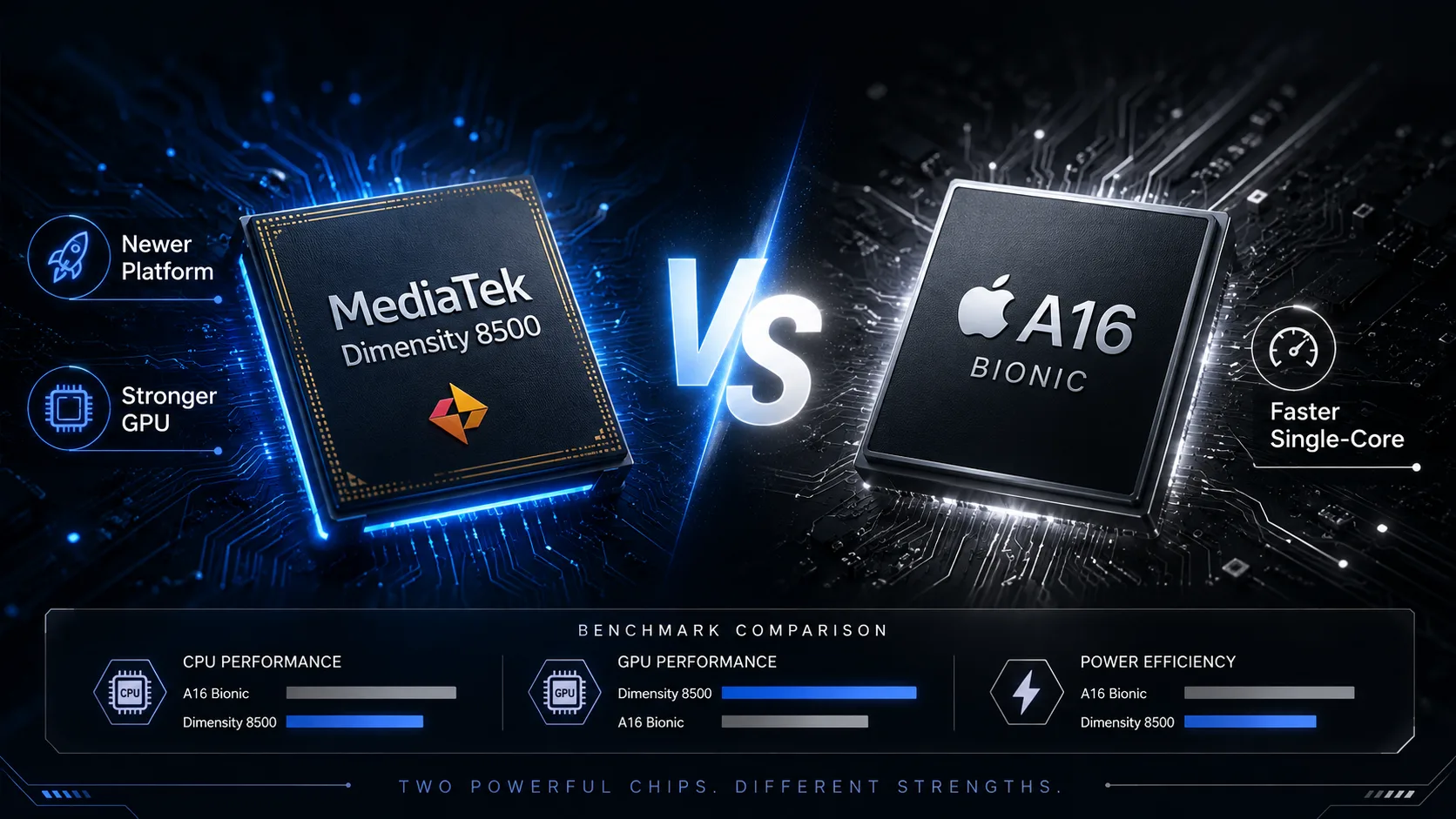
The A16 Bionic launched more than three years before the Dimensity 8500, yet it remains noticeably faster in single-core performance. The new MediaTek narrows the gap with its eight Cortex-A725 cores: in Geekbench 6 Multi-Core scores, they are already comparable, and in 3DMark Wild Life Extreme, smartphones featuring the Dimensity 8500 score higher.
| Specification | MediaTek Dimensity 8500 | Apple A16 Bionic |
|---|---|---|
| Year of Release | 2026 | 2022 |
| CPU | 8× Cortex-A725 | 2 performance + 4 efficiency cores |
| Maximum Frequency | 3.4 GHz | 3.46 GHz |
| GPU | Mali-G720 MC8 | Apple GPU, 5 cores |
| AI Block | NPU 880 | 16-core Neural Engine |
| Typical Devices | Xiaomi 17T, POCO X8 Pro, Redmi Turbo 5 | iPhone 14 Pro/Pro Max, iPhone 15/15 Plus |
In Xiaomi smartphones, a version identified as Dimensity 8500-Ultra is used. The CPU configuration is the same: one Cortex-A725 up to 3.4 GHz, three up to 3.2 GHz, and four up to 2.2 GHz.
CPU Performance
The main advantage of the A16 Bionic is its single-core speed. In Geekbench 6, smartphones with the A16 score around 2240-2380 points in Single-Core compared to 1700-1750 for the Dimensity 8500.
In Geekbench 6 Multi-Core, the difference nearly disappears. Eight Cortex-A725 cores allow the Dimensity 8500 to catch up to the A16, and in some smartphones, to slightly surpass it.
| Device | Processor | Geekbench 6 Single-Core | Geekbench 6 Multi-Core |
|---|---|---|---|
| Xiaomi 17T | Dimensity 8500-Ultra | 1744 | 6569 |
| POCO X8 Pro | Dimensity 8500-Ultra | 1712 | 6541 |
| Redmi Turbo 5 | Dimensity 8500-Ultra | 1698 | 6527 |
| iPhone 14 Pro | Apple A16 Bionic | 2378 | 6434 |
| iPhone 14 Pro Max | Apple A16 Bionic | 2358 | 6389 |
| iPhone 15 | Apple A16 Bionic | 2237 | 5953 |
The difference of a few dozen points between models is insignificant. OS version, cooling, and the specific version of Geekbench 6.x impact the results; thus, the table displays a range of performance rather than an absolute ranking.
A16 confidently leads in Single-Core performance, while in Multi-Core, the difference is minimal. For applications sensitive to one or two core performance, Apple has the advantage; well-parallelizable tasks make better use of the eight cores of the Dimensity 8500.
Graphics: Dimensity 8500 Ahead in 3DMark
For GPU comparison, the cross-platform 3DMark Wild Life Extreme is used, available on Android and iOS.
| Device | Processor | 3DMark Wild Life Extreme |
|---|---|---|
| Xiaomi 17T | Dimensity 8500-Ultra | 4087 |
| POCO X8 Pro | Dimensity 8500-Ultra | 4058 |
| Redmi Turbo 5 | Dimensity 8500-Ultra | 3980 |
| iPhone 14 Pro | Apple A16 Bionic | 3383 |
| iPhone 14 Pro Max | Apple A16 Bionic | 3335 |
Smartphones featuring the Dimensity 8500 exhibit approximately 18-23% higher scores in this test compared to the iPhone 14 Pro and 14 Pro Max with the A16. In Wild Life Extreme, the advantage already belongs to the Mali-G720 MC8.
A single run result does not indicate how well a smartphone maintains performance under prolonged load. In a stress test, the Xiaomi 17T loses about 40% of its initial performance during the worst cycle. Thus, for gaming, not only the SoC itself is important but also the cooling system of the specific smartphone.
The actual gaming performance of the Dimensity 8500 depends on the power limits and cooling of the particular model.
Memory and Platform
The Dimensity 8500 supports LPDDR5X up to 9600 Mbps and UFS 4 storage with MCQ. For A16, the separate memory characteristics are less indicative since Apple designs the SoC, memory, storage, and iOS as a unified system.
NPU and Local AI Features
The Dimensity 8500 is equipped with an NPU 880 supporting INT4, Diffusion Transformer, and local LLM execution.
The A16 includes a 16-core Neural Engine, which is used for processing images, video, and other ML tasks. However, iPhones with the A16 do not support Apple Intelligence; these features are available on models with A17 Pro and newer processors.
Which Smartphones Use These SoCs
The Dimensity 8500/8500-Ultra is found in the Xiaomi 17T, POCO X8 Pro, and Redmi Turbo 5. The A16 Bionic is installed in the iPhone 14 Pro, iPhone 14 Pro Max, iPhone 15, and iPhone 15 Plus.
In practice, the choice between them primarily boils down to a choice between a specific Android smartphone and an iPhone. In a real purchase, the processor cannot be separated from the device itself: with it, the OS, display, cameras, battery, and cooling also change.
Conclusion
The A16 Bionic is significantly faster in Geekbench 6 Single-Core. In Multi-Core, the Dimensity 8500 already shows comparable results, and in 3DMark Wild Life Extreme, smartphones with the new MediaTek come out ahead.
However, benchmark comparisons do not answer the question of which smartphone is better to buy. The A16 is found in iPhones while the Dimensity 8500 powers modern Android models, meaning that with the processor, the OS, cameras, display, battery, and other characteristics also change.
When purchasing a specific device, price, battery life, and cooling quality may prove more important than the differences between these SoCs in isolated tests.
Advantages
- Newer Launch Date: January 2026 (January 2026 vs September 2022)
- Higher Frequency: 3460 MHz (3400 MHz vs 3460 MHz)
Basic
4x 2.02 GHz – Sawtooth
GPU Specifications
Connectivity
Memory Specifications
Miscellaneous
Benchmarks
Related SoC Comparisons




Share in social media
Or Link To Us
<a href="https://cputronic.com/soc/compare/mediatek-dimensity-8500-vs-apple-a16-bionic" target="_blank">MediaTek Dimensity 8500 vs Apple A16 Bionic</a>