MediaTek Dimensity 6500
MediaTek Dimensity 6500: Enhanced CPU Without Upgrading Category
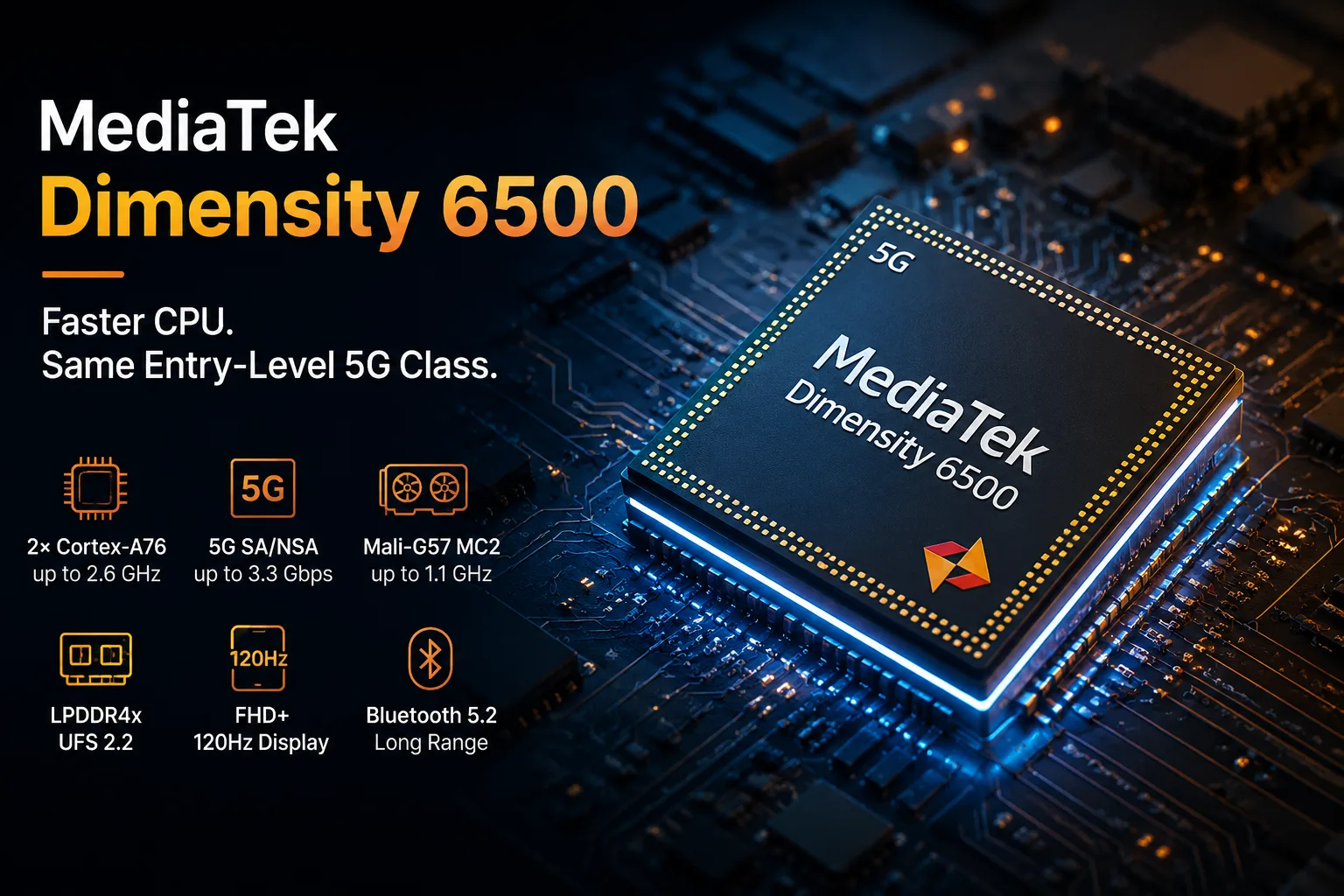
The MediaTek Dimensity 6500 formally joins the Dimensity 6000 series but remains closely related to the Dimensity 6400 and Dimensity 6300 in terms of specifications. The main change is that the frequency of the two Cortex-A76 cores has increased to 2.6 GHz. The rest of the specifications are familiar: Mali-G57 MC2, LPDDR4x, UFS 2.2, and Full HD+ displays up to 120 Hz.
In terms of classification, the Dimensity 6500 remains below the Dimensity 7000 and is aimed at budget 5G smartphones. The main differences are the CPU frequency of up to 2.6 GHz and Bluetooth 5.2 Long Range. For the other key parameters, the chip is close to the Dimensity 6400.
Changes Compared to Dimensity 6400 and Dimensity 6300
The Dimensity 6500 is better viewed alongside the Dimensity 6400 and Dimensity 6300. The picture is straightforward: the base configuration is the same, with only the frequency of the larger cores being higher.
| Parameter | Dimensity 6500 | Dimensity 6400 | Dimensity 6300 |
|---|---|---|---|
| Large CPU Cores | 2× Cortex-A76 up to 2.6 GHz | 2× Cortex-A76 up to 2.5 GHz | 2× Cortex-A76 up to 2.4 GHz |
| Small CPU Cores | 6× Cortex-A55 up to 2.0 GHz | same | same |
| GPU | Mali-G57 MC2 up to 1.1 GHz | Mali-G57 MC2 | Mali-G57 MC2 |
| Memory and Storage | LPDDR4x / UFS 2.2 | same | same |
| Display | up to 2520 × 1080, 120 Hz | same | same |
| 5G | up to 3.3 Gbps | up to 3.3 Gbps | up to 3.3 Gbps |
| Bluetooth | 5.2 Long Range | 5.2 | 5.2 |
In most characteristics, the Dimensity 6500 repeats the Dimensity 6400 and 6300. Thanks to the 2.6 GHz frequency, it may offer a slight advantage in short CPU loads, but in memory, storage, display, camera, and 5G modem, it remains close to previous models. In a real smartphone, differences may be mitigated by cooling, the UI layer, RAM volume, and storage speed.
CPU: Cortex-A76 Overclocked Again
The CPU part consists of eight cores: two Cortex-A76 cores up to 2.6 GHz and six Cortex-A55 cores up to 2.0 GHz. This is a typical architecture for entry-level 5G chips from MediaTek. For browsers, messaging apps, video, navigation, and ordinary multitasking, this configuration is sufficient.
It is unnecessary to call this architecture modern. Cortex-A76 and Cortex-A55 are no longer fresh cores, but this combination is still often found in the budget segment. The advantage of this scheme lies not in speed, but in price and moderate energy consumption.
In single-core tasks, the Dimensity 6500 may be slightly faster than the Dimensity 6400 and 6300. In multi-core load, the gain will be more modest: the small cores remain the same, and there are still only two large cores.
GPU: Mali-G57 MC2 Remains the Main Limitation
The graphical component remains the main limitation of the Dimensity 6500. The chip uses the Mali-G57 MC2 with a frequency of up to 1.1 GHz. For interfaces, video, simple games, and light online projects, the Mali-G57 MC2 is sufficient. In heavy games, it will be necessary to reduce graphics settings and not expect stable high FPS.
The CPU has become slightly faster, but the GPU remains entry-level. Thus, comparing the Dimensity 6500 to the Dimensity 7300, Dimensity 7400, or other more expensive platforms is inappropriate: not only are the frequencies higher there, but also the overall class of graphics.
Memory, Display, and Camera
LPDDR4x and UFS 2.2 keep the Dimensity 6500 in the entry-level 5G segment. This is sufficient for a budget smartphone, but there are no speeds at the level of LPDDR5 and UFS 3.x here.
The display supports a resolution of up to 2520 × 1080 and a refresh rate of up to 120 Hz. For budget smartphones, a 120 Hz refresh rate is more important than a small increase in synthetic benchmarks: smooth scrolling and responsive interfaces are noticeable every day.
For the camera, support is claimed for sensors up to 108 MP or a combination of 16 + 16 MP. However, simply supporting 108 MP does not guarantee high-quality photos. The quality will be determined by the sensor, optics, and processing in a specific smartphone.
Connectivity: The Main Difference Is Bluetooth 5.2 Long Range
In terms of 5G, the Dimensity 6500 is close to the Dimensity 6400 and 6300: it features 5G SA/NSA, 5G Carrier Aggregation, Dual 5G SIM support, VoNR, and peak download speeds of up to 3.3 Gbps. The main difference is the Bluetooth 5.2 Long Range.
It also supports Wi-Fi 5 and GNSS with multiple satellite systems. This does not elevate the chip to a higher class. The goal of the Dimensity 6500 is different: providing a budget 5G smartphone with dual SIM support, a 120 Hz display, and moderate energy consumption.
Expected Performance
The expected gain over the Dimensity 6400 and 6300 will be minimal. The advantage will be more noticeable in short tasks tied to the frequency of the large cores: launching applications, switching between programs, and browsing.
In gaming, the difference will be lesser. The Mali-G57 MC2 remains entry-level graphics, so the Dimensity 6500 should not be viewed as a gaming platform. Simple games and light online projects are designed for moderate settings. In heavy projects, graphics will need to be lowered.
When choosing, it is important to consider not only the SoC but also the specific implementation of the smartphone: RAM volume, type of storage, display quality, battery capacity, cooling, and manufacturer’s UI. Two devices on the same chip can differ significantly in speed and stability.
Who is the Smartphone on Dimensity 6500 Suitable For
A smartphone featuring the Dimensity 6500 makes sense for:
- Affordable 5G models;
- Messaging, browsing, video, and social media use;
- Everyday photography without claims to flagship quality;
- Light gaming and mild online projects;
- Smartphones with Full HD+ displays at 120 Hz;
- Scenarios where connectivity, autonomy, and price are more important than heavy gaming.
A smartphone with the Dimensity 6500 should not be purchased if you need a substantial graphics reserve, heavy gaming at high settings, or performance level of the Dimensity 7000. That already belongs to the upper platform segment.
Conclusion
The MediaTek Dimensity 6500 does not elevate the lower tier of MediaTek to a new class. It slightly speeds up the CPU but retains previous limitations: older cores, simple graphics, LPDDR4x, and UFS 2.2.
Compared to the Dimensity 6400 and Dimensity 6300, the gain is expected to be moderate. The main distinction is a slightly higher CPU frequency and Bluetooth 5.2 Long Range. This is a typical platform for mass-market 5G smartphones: the emphasis is on price, connectivity, battery life, and a 120 Hz display rather than gaming. It is not worth overpaying for a smartphone solely due to the Dimensity 6500; a model with the Dimensity 6400 can offer almost the same specifications for less.
SOC Comparison
Compare Dimensity 6500 with other SOCs
Basic
GPU Specifications
Connectivity
Memory Specifications
Miscellaneous
Benchmarks
Compared to Other SoC


Share in social media
Or Link To Us
<a href="https://cputronic.com/soc/mediatek-dimensity-6500" target="_blank">MediaTek Dimensity 6500</a>