MediaTek Helio G81
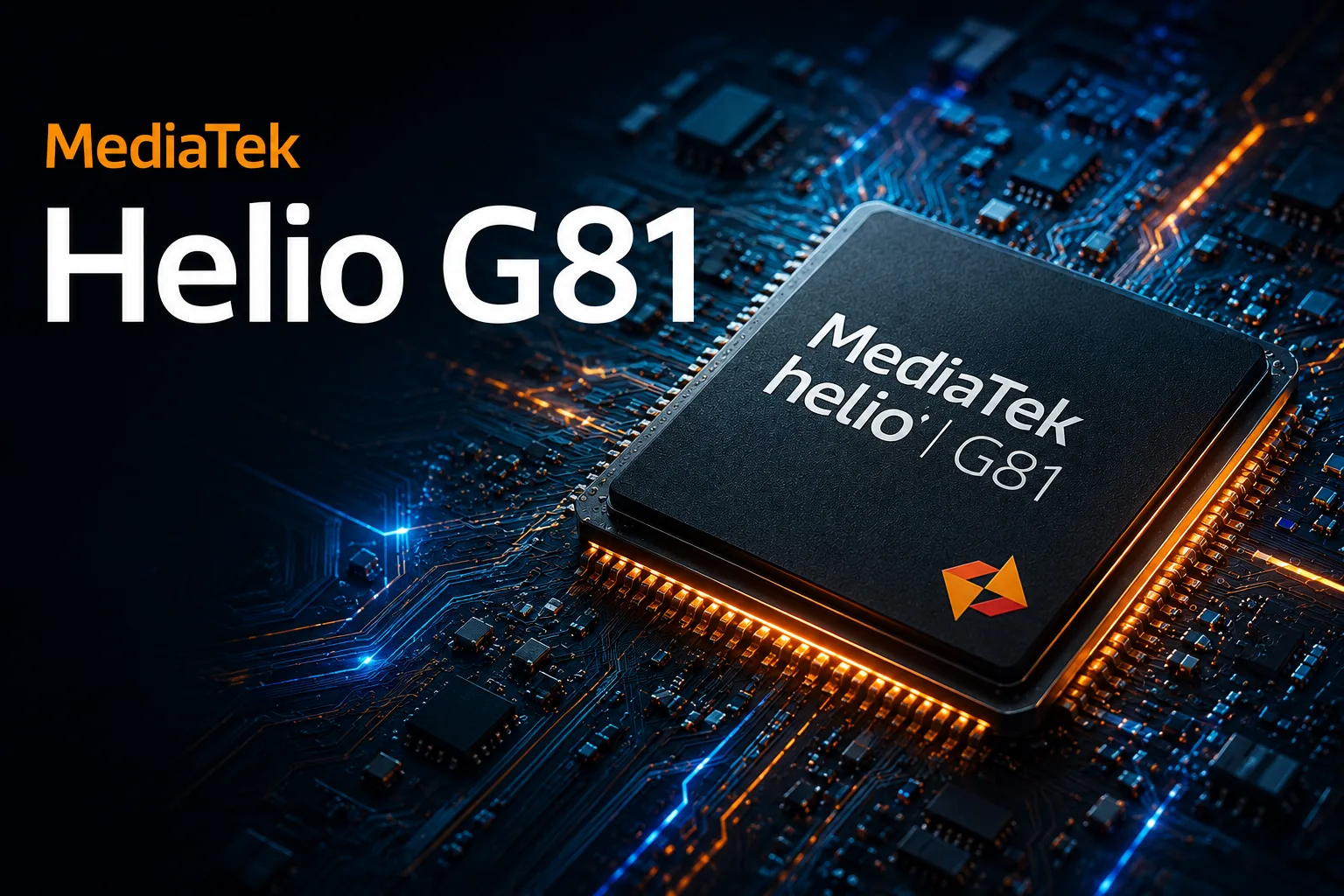
MediaTek Helio G81: Budget 4G Chip for Affordable Smartphones
MediaTek Helio G81 is a mobile platform designed for budget Android smartphones. In terms of positioning, it competes with basic 4G chips like the MediaTek Helio G80/G85/G88, Helio G91, Snapdragon 680/685, and affordable Unisoc series solutions like T606/T616/T620.
The main advantage of the Helio G81 is sufficient speed for basic tasks: calls, messaging apps, browsing, YouTube, navigation, social media, and light gaming. Major limitations include the lack of 5G support, eMMC 5.1 storage, and the older combination of Cortex-A75/Cortex-A55 cores.
In essence, it’s not sensible to compare the Helio G81 with Dimensity 6100+, Dimensity 6300, or Snapdragon 6 Gen 1 as equals. These platforms are significantly more modern and typically offer higher performance reserves, faster memory, and better connectivity. The Helio G81 is designed for the lower budget 4G class, where price, battery life, and basic everyday tasks are prioritized.
In Which Smartphones is the Helio G81 Used
The Helio G81 can be found in affordable 4G smartphones released in 2025-2026. Depending on the brand, the chip may be referred to as Helio G81, Helio G81-Ultra, Helio G81 Extreme, or Helio G81 Ultimate. In most cases, these are similar-class versions of a single budget platform.
Examples of smartphones featuring the Helio G81 and its versions:
| Smartphone | Chip Version | Important Information |
|---|---|---|
| POCO C85 | Helio G81-Ultra | Budget 4G smartphone with a large display, eMMC 5.1, and a 6000 mAh battery |
| Redmi 15C | Helio G81-Ultra | Affordable Xiaomi model with HyperOS, large screen, and 6000 mAh battery |
| Motorola Moto G05 | Helio G81 Extreme | Basic Moto G model with 4G, LPDDR4X, and a focus on battery life |
| Motorola Moto G06 Power | Helio G81 Extreme | Budget Moto with an exceptionally large battery |
| Infinix Hot 60i | Helio G81 Ultimate | Affordable smartphone with a 120 Hz display, fast charging, and eMMC storage |
Important: The chip version name from the manufacturer should not be the main argument for purchase. In this class, RAM size, storage type, display, battery, and user interface optimization are more influential factors.
Performance
The Helio G81 features an 8-core CPU: 2 performance cores Cortex-A75 up to 2.0 GHz and 6 energy-efficient Cortex-A55 cores. This is an older, but still suitable architecture for basic tasks.
In everyday use, a smartphone with the Helio G81 is adequate for Telegram, WhatsApp, Chrome, YouTube, maps, banking apps, and simple work tasks. Latency may occur on heavy websites, with many apps open, and during active camera use.
The benchmark target for Geekbench 6 is about 390-420 points in single-core performance and approximately 1300-1400 in multi-core. This is within the budget class, not comparable to modern mid-range 5G platforms.
Graphics and Gaming
The graphics are handled by a Mali-G52 MC2. This is sufficient for casual games, 2D projects, Minecraft, Mobile Legends, and PUBG Mobile at low or medium settings.
Heavy games like Genshin Impact are best run on minimal settings. Expecting consistent smoothness is unrealistic, especially in smartphones with low RAM and inadequate cooling solutions.
Memory and Storage
The Helio G81 supports LPDDR4X and eMMC 5.1. It is the eMMC 5.1 that most significantly limits the perception of speed: apps open more slowly, updates take longer, and virtual RAM expansion is less effective than real RAM.
For a smartphone with the Helio G81, it’s advisable to choose a version with at least 4GB RAM and 128GB storage. Models with 3/64GB quickly reach their limits, particularly with heavy user interfaces and multiple background apps.
Cameras and Video
The platform supports cameras up to 48 MP or dual modules of up to 16 + 16 MP. Video recording can go up to 2K at 30 frames per second or Full HD at 60 frames per second.
In practice, shooting quality depends on the specific smartphone: its sensor, optics, and manufacturer processing. The Helio G81 is suitable for regular daytime photos but not for strong night shots, advanced HDR, or stable video at a level comparable to more expensive models.
Connectivity and Battery Life
The Helio G81 supports 4G, Dual 4G VoLTE, Wi-Fi 5, Bluetooth, and basic navigation systems. There is no 5G support here.
Battery life is generally decent because the chip is installed in smartphones with 5000-6000 mAh batteries, and the platform itself is not designed for high performance. The final usage time depends on the display, battery, user interface, and optimization of the specific model.
Who is the Helio G81 Suitable For
A smartphone with the Helio G81 is worth considering if you need an affordable device for communication, video, social media, navigation, simple gaming, and light workloads.
Do not choose the Helio G81 for heavy gaming, active multitasking, long-term use over several years, 5G, fast UFS memory, or high-quality night photography. In such cases, it’s better to look at the Dimensity 6100+/6300, Snapdragon 6 Gen 1/6 Gen 3, or other more recent platforms.
Conclusion
The MediaTek Helio G81 is a simple budget 4G processor. Its advantages include adequate speed for basic tasks, decent battery life, and low-cost smartphones. Its drawbacks are limited gaming performance, eMMC 5.1, absence of 5G, and the older combination of Cortex-A75/Cortex-A55.
Buying a smartphone with the Helio G81 makes sense only at a good price and preferably in a version with 4-6GB RAM and 128GB storage. The chip itself should not be a reason for overpayment: in this segment, the device's price, display, battery, memory size, and user interface quality are more important.
SOC Comparison
Compare Helio G81 with other SOCs
Basic
6x 1.8 GHz – Cortex-A55
GPU Specifications
Connectivity
Memory Specifications
Miscellaneous
Benchmarks
Phones with Helio G81

Comparison of Devices with Helio G81
Compared to Other SoC
Related SoC Comparisons


Share in social media
Or Link To Us
<a href="https://cputronic.com/soc/mediatek-helio-g81" target="_blank">MediaTek Helio G81</a>