Qualcomm Snapdragon 685

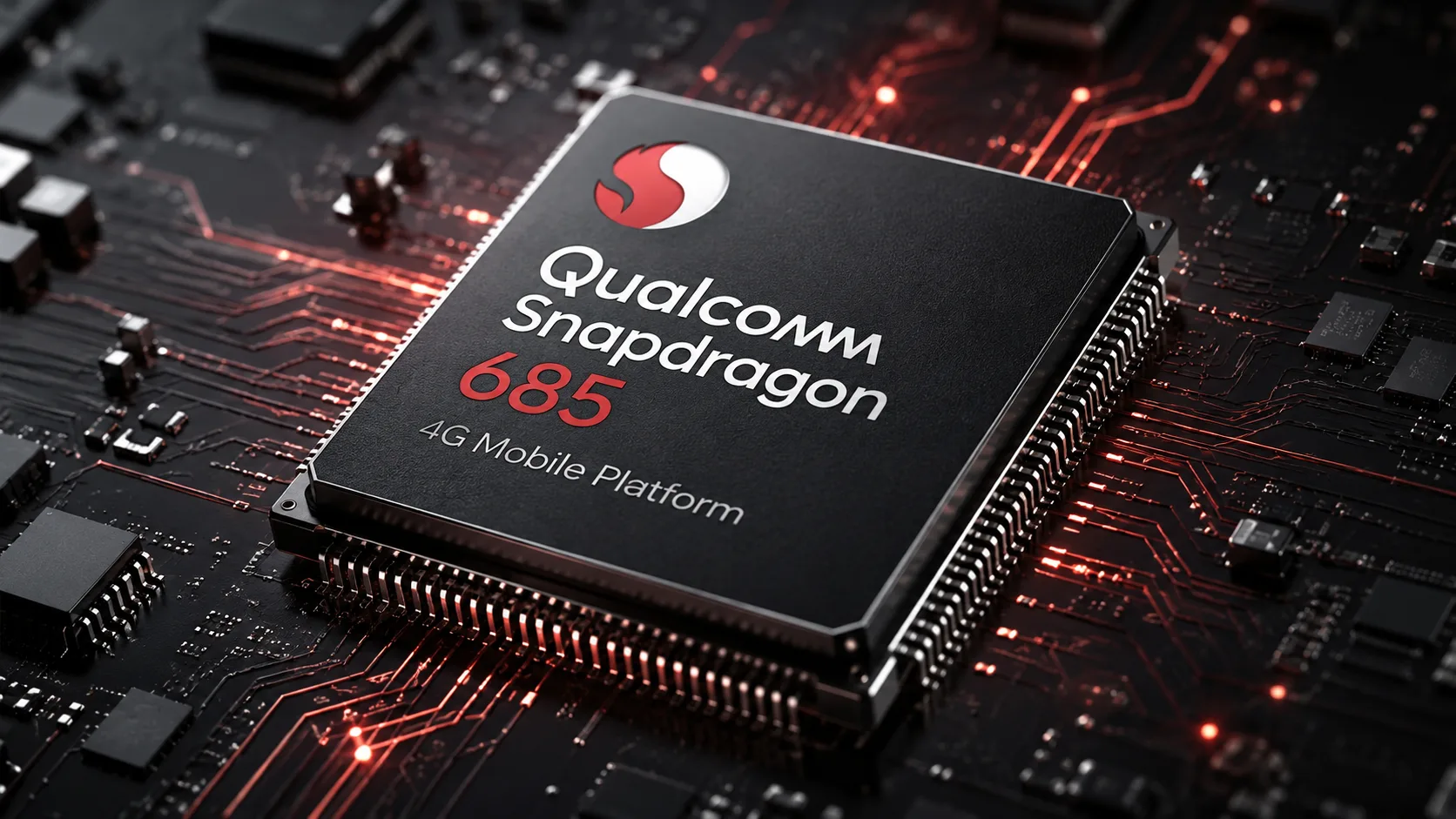
Qualcomm Snapdragon 685: The Overclocked Snapdragon 680 Without 5G
The Snapdragon 685 looks modern in terms of specifications: 6 nm, FHD+ 120 Hz display, camera up to 108 MP, and CPU frequency up to 2.8 GHz. However, it is an evolution of the Snapdragon 680 with elevated frequencies while retaining the old CPU architecture and Adreno 610 graphics.
The Snapdragon 685 is designed not for high performance, but for affordable 4G smartphones with decent battery life. It's sufficient for browsing, messaging, video, navigation, and banking applications. However, for gaming, heavy multitasking, and purchasing a device to last several years, it falls short.
What Has Changed Compared to Snapdragon 680
The Snapdragon 685 is closest to the Snapdragon 680, with increased frequencies. Qualcomm has raised the clock speed of the performance cores to 2.8 GHz, boosted the graphics unit, and added support for FHD+ displays with refresh rates up to 120 Hz.
The base remains unchanged: Cortex-A73, Cortex-A53, and Adreno 610. There is a noticeable improvement over the Snapdragon 680, but the class of the platform hasn't changed. A smartphone with Snapdragon 685 is generally faster than a model with Snapdragon 680 but remains in the same budget 4G segment.
Where's the Catch
The main limitation of the Snapdragon 685 is the gap between its strong specifications and the old computational base. The specifications boast 6 nm, 120 Hz, and a camera up to 108 MP, but the CPU and GPU remain at the level of a basic 4G chip.
120 Hz makes the interface visually smoother, but it doesn’t add power. Support for cameras up to 108 MP looks good on paper but does not guarantee photo quality. The final image quality depends on the sensor, optics, stabilization, and the manufacturer's processing.
A frequency of 2.8 GHz also does not compensate for the age of the architecture. Overclocking doesn't make Cortex-A73 comparable to more recent Cortex-A76 or Cortex-A78 architectures. Therefore, a smartphone with Snapdragon 685 may look modern in terms of the display, design, and megapixel count, but it quickly hits limitations in demanding applications, gaming, and multitasking.
Performance and Benchmarks
The Snapdragon 685 is sufficient for basic tasks but without much headroom. Benchmarks confirm its budget-level performance: in Geekbench 6, smartphones with this chip typically score around 450-480 points in Single-Core and 1350-1600 points in Multi-Core. In AnTuTu, results often hover around 450-470 thousand points, depending on the version of the test, memory, cooling, and specific smartphone model.
| Benchmark | Snapdragon 685 |
|---|---|
| Geekbench 6 Single-Core | approximately 450-480 |
| Geekbench 6 Multi-Core | approximately 1350-1600 |
| AnTuTu | approximately 450-470 k |
| 3DMark Sling Shot Extreme Physics | around 2700 |
In everyday scenarios-calling, browsing, video, maps-the performance is adequate. However, a heavy UI, slow memory, or limited RAM can quickly reveal the chip's constraints. In this respect, models with Helio G99, Dimensity 6100+, or Snapdragon 695 generally provide a greater buffer.
Gaming and Graphics
The main limitation in gaming is the Adreno 610. Simple games and less demanding online projects run without serious issues, but heavier games quickly hit the limits of the Adreno 610's capabilities.
PUBG Mobile, Mobile Legends, Roblox, and similar games are playable, but with no headroom on settings and FPS. In heavy games, you will have to lower settings, and dips in performance will be normal. For Genshin Impact, Honkai: Star Rail, and similar projects, it's better to look for faster chips right away.
For gaming, it makes more sense to choose Helio G99, Dimensity 6080/6100+, Snapdragon 695, or more recent solutions. At a similar price point, they typically offer a more noticeable buffer in CPU or graphics performance.
Display, Camera, and Connectivity
FHD+ 120 Hz is the most notable practical advantage of Snapdragon 685. It allows manufacturers to equip affordable smartphones with smooth displays. In the interface and scrolling experience, this is more noticeable than the slight CPU increase.
The same principle applies to cameras. Support for sensors up to 108 MP improves the specifications on paper but does not replace a good sensor, optics, stabilization, and processing. Snapdragon 685 provides a basic platform rather than transforming a smartphone into a camera phone.
In terms of connectivity, Snapdragon 685 remains a 4G platform with no 5G support. If 5G is not essential, this limitation is not critical. However, when purchasing for several years, the absence of 5G reduces the relevance lifespan, especially when there are models on Dimensity 6100+ or Snapdragon 695 available at a similar price.
Snapdragon 685 vs. Helio G99
Snapdragon 685 is often compared to MediaTek Helio G99 because both chips are found in affordable 4G smartphones. However, in terms of performance, Helio G99 usually comes out on top.
Helio G99 uses more recent performance cores, Cortex-A76, making it faster in CPU tasks, gaming, and interface responsiveness. Snapdragon 685 leads more in terms of battery life and the specific implementation of the smartphone rather than in raw performance.
At the same price point, Helio G99 is generally the more preferable option. Snapdragon 685 is justified if the smartphone is cheaper or noticeably better in display, battery, camera, or build quality.
Should You Buy a Smartphone with Snapdragon 685?
A smartphone with Snapdragon 685 is worth considering if you need:
- calls, messaging, and social media;
- browsing, YouTube, maps, and banking applications;
- battery life is more important than gaming performance;
- 5G is not needed;
- a specific model is significantly cheaper than the competition.
It's not worth overpaying for Snapdragon 685. If there is a smartphone on Helio G99, Dimensity 6100+, or Snapdragon 695 available at a similar price, that model should be ranked higher on your list. These chips offer more room for gaming, multitasking, and when planning to buy a smartphone for several years.
Conclusion
The Snapdragon 685 should be chosen not for its power, but for the specific smartphone it powers. If the model is inexpensive, with a good display, battery, camera, or build quality, the chip can handle basic tasks.
However, at the price point of devices on Helio G99, Dimensity 6100+, or Snapdragon 695, its advantage quickly diminishes. In such comparisons, Snapdragon 685 is justified only by a lower price or specific strengths of the device.
SOC Comparison
Compare Snapdragon 685 with other SOCs
Basic
GPU Specifications
Connectivity
Memory Specifications
Miscellaneous
Benchmarks
Compared to Other SoC
Related SoC Comparisons






Share in social media
Or Link To Us
<a href="https://cputronic.com/soc/qualcomm-snapdragon-685" target="_blank">Qualcomm Snapdragon 685</a>