Qualcomm Snapdragon 4 Gen 5

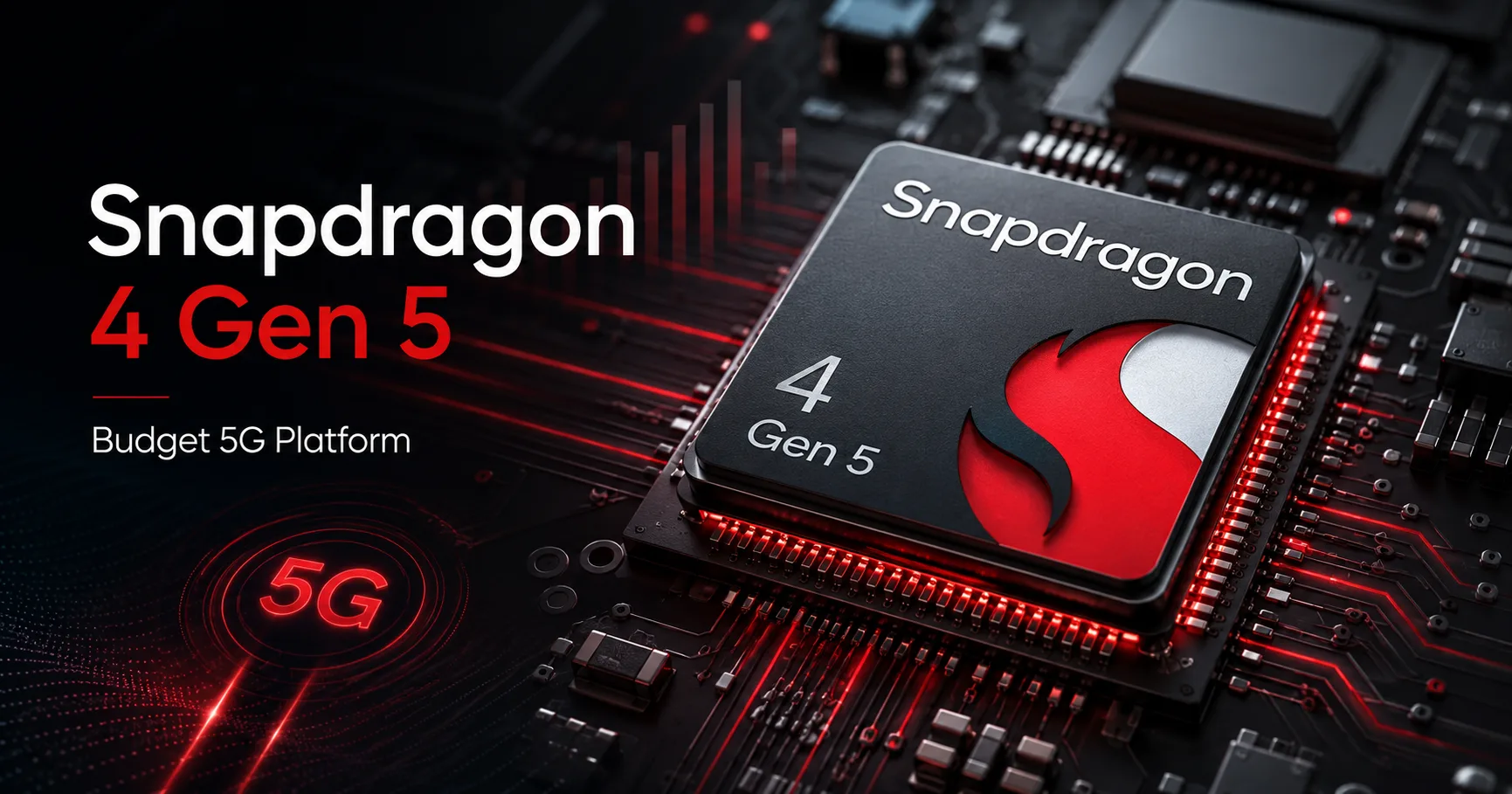
Qualcomm Snapdragon 4 Gen 5: An Honest Budget 5G Chip Focused on Smooth Performance
Cheap smartphones rarely annoy with their failure to set benchmark records. What stands out more is that applications open with a pause, the interface stutters, games quickly hit graphics limits, and using dual SIM cards is not always convenient. Qualcomm Snapdragon 4 Gen 5 aims to address these everyday weaknesses in the budget segment.
The platform was introduced in May 2026 alongside the Snapdragon 6 Gen 5. The first smartphones featuring Snapdragon 4 Gen 5 are expected in the second half of 2026, with Qualcomm naming OPPO, realme, and REDMI as some of the first brands. This immediately sets the right context: we are looking at a chip not designed for expensive models, but rather as a foundation for mass-market affordable 5G smartphones.
Positioning
Snapdragon 4 Gen 5 is classified as an entry-level chip, but it raises the bar beyond merely making messaging apps work. Qualcomm focuses on a smoother interface, improved graphics, 5G Release 17, Dual SIM Dual Active, and support for UFS 3.1. For a budget phone, these aspects are more important than claims of nearly flagship performance.
In essence, Snapdragon 4 Gen 5 will compete not with the Snapdragon 7-series or speedy Dimensity mid-range chips, but with budget 5G platforms from MediaTek and older Snapdragon 4-series chips. Its goal is not to outperform higher-end chips but to make a cheap smartphone significantly more enjoyable in everyday operations.
Key Specifications
| Specification | Qualcomm Snapdragon 4 Gen 5 |
|---|---|
| Class | Budget 5G SoC for smartphones |
| Process Technology | 4 nm |
| CPU | Qualcomm Kryo, up to 2.4 GHz |
| GPU | Qualcomm Adreno |
| Memory | LPDDR4x up to 2133 MHz |
| Storage | UFS 3.1 2-Lane |
| Display | FHD+ up to 144 Hz, HD+ 900 x 1600 up to 120 Hz |
| Camera and Video | Photos up to 108 MP, 1080p up to 30 FPS, slow-motion 720p up to 120 FPS |
| Connectivity | 5G Sub-6, SA/NSA, up to 2.8 Gbps, 5G/4G DSDA |
| Wi-Fi / Bluetooth | Wi-Fi 5, Bluetooth 5.1 |
Performance and Gaming
The CPU segment of Snapdragon 4 Gen 5 looks steady: Qualcomm lists the Kryo CPU with a frequency of up to 2.4 GHz. This is a normal level for a budget chip, but it is not grounds for expecting miracles in heavy multitasking. In real life, the platform should confidently handle basic scenarios: messaging apps, social networks, browsers, video, navigation, banking applications, and light photo processing.
The main upgrade lies in graphics. Qualcomm claims up to a 77% increase in GPU performance compared to Snapdragon 4 Gen 4 and, for the first time for the Snapdragon 4-series, mentions support for 90 FPS in games. It sounds impressive, but the point is not that a budget smartphone will suddenly become a gaming device. Instead, it provides an opportunity for a more stable experience in light and well-optimized games, where older budget chips would start to struggle.
Smoothness Over Dry Numbers
The most practical part of the update is Snapdragon Smooth Motion UI. Qualcomm promises up to 43% faster app launches and up to 25% fewer on-screen stutters compared to the previous generation. For buyers of a budget smartphone, this may be more significant than differences in synthetic tests.
Such features create the impression of a "decent phone" versus a "lagging phone." If the manufacturer does not cut corners on storage, memory, and UI, Snapdragon 4 Gen 5 can provide a noticeably more pleasant everyday experience than older budget platforms.
Modern Connectivity, but Budget Constraints
With mobile connectivity, Snapdragon 4 Gen 5 performs confidently. It features 5G Release 17, Sub-6 GHz, SA/NSA, download speeds up to 2.8 Gbps, upload speeds up to 900 Mbps, and support for Global 5G Multi-SIM, including 5G/4G DSDA. For smartphones with dual SIM cards, this is an important detail: both work and personal numbers can remain active simultaneously without frequent manual switching.
However, alongside modern mobile capabilities, class-related compromises become apparent. Wi-Fi here is only Wi-Fi 5, Bluetooth is 5.1, and memory is limited to LPDDR4x up to 2133 MHz. Interestingly, Qualcomm had previously indicated LPDDR5 support up to 3.2 GHz for Snapdragon 4 Gen 4. Therefore, Snapdragon 4 Gen 5 does not appear to be a clean upgrade in all areas but rather a fresher and more user-friendly budget platform with noticeable but conscious limitations.
Camera and Display
The camera block is designed for a solid budget level. The chip supports photos up to 108 MP, a single camera up to 32 MP with Zero Shutter Lag, dual cameras up to 16 + 16 MP, electronic stabilization, autofocus, auto-exposure, auto white balance, and facial recognition. This is not a claim to be a camera phone, but a good foundation for an affordable smartphone that can take decent daytime photos.
The restriction on video is expected: 1080p at 30 FPS. There is no 4K here, and this honestly reflects the platform's class. On the other hand, displays look promising: FHD+ up to 144 Hz is supported. However, mere support does not guarantee a good display in a specific smartphone; the manufacturer may opt for a cheaper panel and cut costs where the user will notice the difference every day.
What to Understand Before Purchasing
- Snapdragon 4 Gen 5 is a budget chip, not a replacement for Snapdragon 6-series.
- The main advantages of the platform include interface smoothness, 5G, DSDA, UFS 3.1, and improved graphics.
- 90 FPS in games does not imply high settings in demanding titles.
- Wi-Fi 6, Wi-Fi 7, and 4K video are absent here.
- LPDDR4x seems questionable compared to the LPDDR5 of Snapdragon 4 Gen 4.
- The overall speed will heavily depend on the specific smartphone regarding memory, storage, cooling, and UI quality.
Conclusion
Qualcomm Snapdragon 4 Gen 5 appears to be the right update for affordable 5G smartphones, but not an unequivocal upgrade across the board. Its strengths lie in interface smoothness, improved graphics, support for 90 FPS in suitable games, modern 5G connectivity, DSDA, and UFS 3.1 support. The weaknesses are also clear: Wi-Fi 5, Bluetooth 5.1, lack of 4K video, and LPDDR4x instead of faster memory.
If a smartphone with Snapdragon 4 Gen 5 is priced reasonably, it could serve as a successful basis for a mass-market model. However, it would not be wise to pay a premium for such a device as if it were a full-fledged mid-range model. The power of Snapdragon 4 Gen 5 lies in its honest budget positioning: it should make an affordable phone more comfortable, not replace more powerful platforms.
SOC Comparison
Compare Snapdragon 4 Gen 5 with other SOCs
Basic
GPU Specifications
Connectivity
Memory Specifications
Miscellaneous
Benchmarks
Compared to Other SoC
Related SoC Comparisons






Share in social media
Or Link To Us
<a href="https://cputronic.com/soc/qualcomm-snapdragon-4-gen-5" target="_blank">Qualcomm Snapdragon 4 Gen 5</a>