MediaTek Helio G200
vs
Qualcomm Snapdragon 8 Elite

SoC Comparison Result
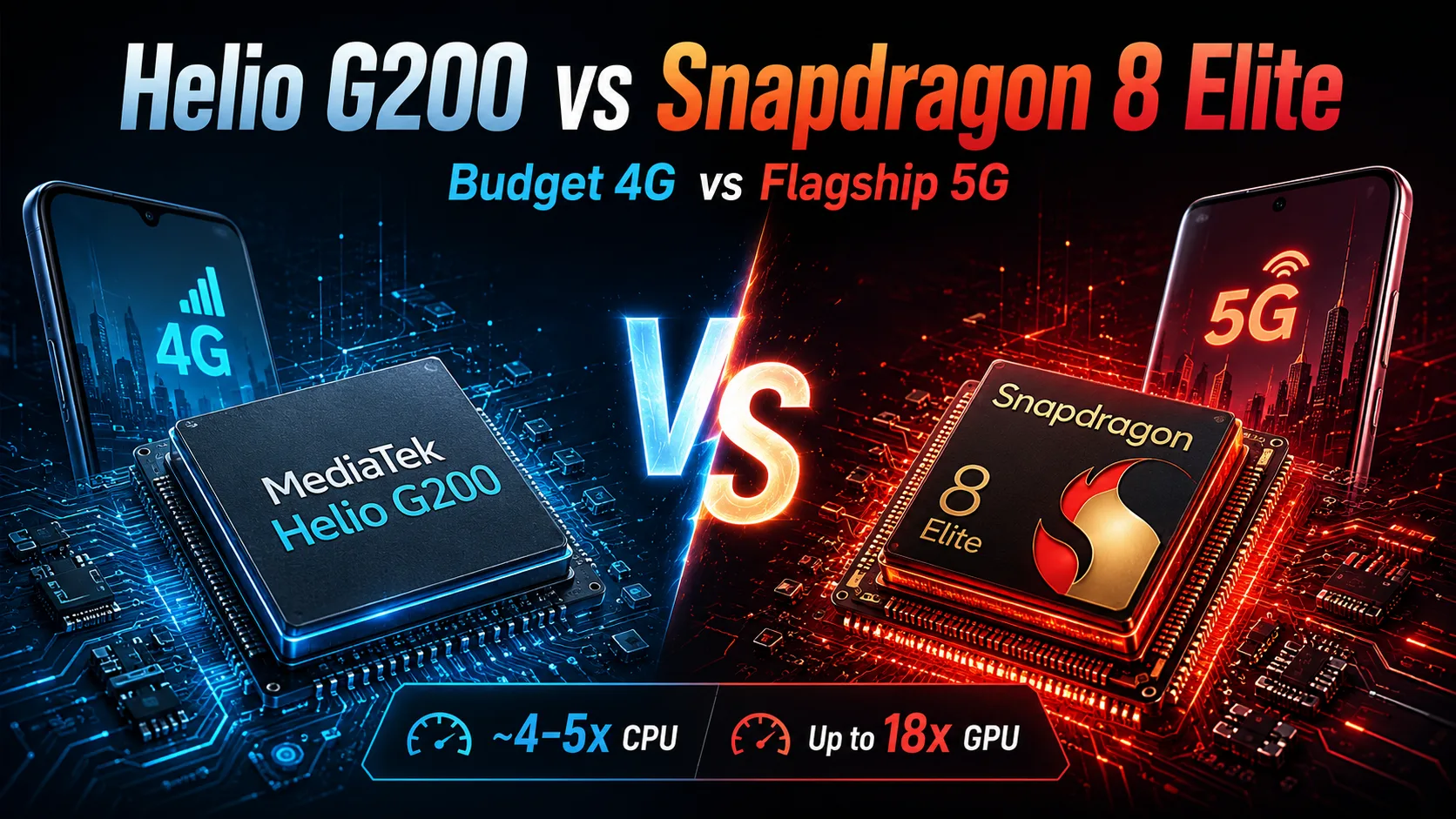
MediaTek Helio G200 vs Snapdragon 8 Elite: new in terms of date versus new in terms of architecture
There is no intrigue when it comes to performance: the Snapdragon 8 Elite is significantly faster. What is more interesting is that the Helio G200 appeared later, even though its technical foundation is much older. The G200 still combines a 6nm process, Cortex-A76, Mali-G57, and 4G, while the Snapdragon has moved to 3nm, its own Oryon cores, flagship Adreno, and 5G. This comparison effectively shows how long MediaTek has extended the life of the Helio G99 platform.
| Specification | MediaTek Helio G200 | Qualcomm Snapdragon 8 Elite |
|---|---|---|
| Class | Budget 4G smartphones | Flagship smartphones |
| Process Node | TSMC 6nm | TSMC 3nm |
| CPU | 2× Cortex-A76 2.2 GHz + 6× Cortex-A55 2.0 GHz | 2× Oryon up to 4.47 GHz + 6× Oryon up to 3.53 GHz |
| GPU | Mali-G57 MC2, up to 1.1 GHz | Adreno |
| Memory | LPDDR4X | LPDDR5X |
| Storage | UFS 2.2 | UFS 4.x in most flagship devices |
| Mobile Network | 4G LTE Cat.13 | 5G, Snapdragon X80 |
| Wi-Fi | Wi-Fi 5 | Wi-Fi 7 |
| Cameras | Up to 200 MP | Up to 320 MP |
| Video | Up to 2K 30 FPS | Up to 4K 120 FPS |
| Ray Tracing | No | Hardware |
| Main Role | Budget 4G platform | Maximum mobile performance |
The similarity in the number of cores means nothing here. Behind the same eight cores lies architecture from different generations, and the gap in GPU, memory, modem, and ISP is even greater.
Helio G200 - continuation of G99, not a new generation CPU
The name Helio G200 creates an impression of a new generation, but the CPU has hardly changed since the G99.
The previous Helio G99 featured 2× Cortex-A76 up to 2.2 GHz and 6× Cortex-A55 up to 2.0 GHz, a 6nm process node, LPDDR4X, UFS 2.2, and LTE Cat.13. The Helio G100 maintained this foundation, and the G200 again did not alter the configuration of CPU, memory, and storage.
Therefore, the Helio G200 is more accurately considered another upgrade of the G99/G100 line, rather than a new generation of processor architecture.
MediaTek has increased the frequency of the Mali-G57 MC2 to 1.1 GHz, added 12-bit DCG, and updated 4G features. However, the CPU cores remain the same.
The Snapdragon 8 Elite has changed almost all of its key hardware. Qualcomm has moved to a 3nm process and its own Oryon cores, while also updating the GPU, NPU, ISP, and modem.
CPU Performance: Snapdragon is 4-5 times faster
In real smartphones, the gap looks like this. These are separate runs of Geekbench 6: firmware and cooling affect results, so the order of the numbers is more important than the score differences.
| Smartphone | Processor | Geekbench 6 Single-Core | Geekbench 6 Multi-Core |
|---|---|---|---|
| Infinix Hot 60 Pro | Helio G200 | 724 | 1 974 |
| Infinix Hot 60 Pro+ | Helio G200 | 736 | 2 003 |
| ASUS Zenfone 12 Ultra | Snapdragon 8 Elite | 3 164 | 9 880 |
| Honor GT Pro | Snapdragon 8 Elite | 3 245 | 10 151 |
The Snapdragon 8 Elite here is approximately 4.4 times faster in single-threaded tests and about five times faster in multi-threaded ones.
Such a gap cannot be explained by the usual difference between adjacent SoC classes. Cortex-A76 is still sufficient for Android, browsers, and everyday applications, but under heavy workloads, their age is noticeable. The Oryon is significantly faster in heavy gaming, photo and video processing, emulators, local AI tasks, and when multiple heavy applications are running simultaneously.
AnTuTu: nearly sevenfold difference across the platform
| Test | Helio G200 | Snapdragon 8 Elite |
|---|---|---|
| Geekbench 6 Single-Core | ~755 | ~3 301 |
| Geekbench 6 Multi-Core | ~2 038 | ~9 848 |
| AnTuTu 10 | ~436 000 | ~3 010 000 |
In AnTuTu, the Snapdragon scores almost seven times more: the test accounts for not only the CPU but also the GPU, memory, and storage.
Graphics: the gap is even harsher
The Helio G200 uses Mali-G57 MC2 with two graphics cores - a budget-class solution. The frequency has been raised to 1.1 GHz, but the GPU configuration remains minimal.
The Adreno in the Snapdragon 8 Elite is much larger and supports hardware ray tracing.
In 3DMark Steel Nomad Light, the difference reaches about 18 times:
| Device | SoC | 3DMark Steel Nomad Light |
|---|---|---|
| Infinix Hot 60 Pro+ | Helio G200 | 147 |
| Honor GT Pro | Snapdragon 8 Elite | 2 661 |
The gaming designation for the Helio G200 refers to the budget class. Games can run on it, but in demanding titles, graphics settings will need to be lowered, and one must contend with lower frame rates.
The Snapdragon 8 Elite allows for high settings in demanding 3D games, emulation, and hardware ray tracing.
LPDDR4X and UFS 2.2 against LPDDR5X and UFS 4.x
The Helio G200 supports LPDDR4X and UFS 2.2. For a budget smartphone, this is sufficient, but the manufacturer cannot switch to faster LPDDR5X and UFS 4.x.
Smartphones using the Snapdragon 8 Elite typically utilize LPDDR5X and UFS 4.x. For example, the ASUS Zenfone 12 Ultra employs this combination.
The faster memory and storage are particularly noticeable when loading large games, working with large files, and running demanding applications.
4G and Wi-Fi 5 against 5G and Wi-Fi 7
The Helio G200 does not support 5G. Its LTE Cat.13 supports frequency aggregation, 4×4 MIMO, and 256QAM, and these features are sufficient for a budget 4G smartphone.
The Snapdragon 8 Elite uses the Snapdragon X80 5G modem and supports Wi-Fi 7. The Helio G200 features Wi-Fi 5.
The G200 is aimed at a market where the low cost of the device is more important than 5G and new wireless standards.
200 MP does not make cameras equal
Support for 200 MP sensors on paper places the Helio G200 alongside much more expensive SoCs. However, the maximum resolution of the sensor says almost nothing about the class of ISP and the quality of computational photography.
The Helio G200 has a triple-core ISP and 12-bit DCG, but video recording is limited to 2K at 30 FPS or Full HD at 60 FPS.
The Snapdragon 8 Elite has a significantly more powerful ISP and NPU, supporting video up to 4K 120 FPS. Computational photography here also belongs to a completely different class.
Therefore, identical "200 MP" specs say nothing about the real equality of the cameras.
Why MediaTek continues to develop this platform
These SoCs target opposite market segments.
MediaTek continues to develop its well-established 6nm platform. Such SoCs allow for the creation of budget smartphones without 5G, expensive memory, and large GPUs. In the budget segment, this helps keep the device’s cost lower.
The priority for the Snapdragon 8 Elite is different - performance, graphics, connectivity, AI, and cameras. Along with Oryon, it receives a significantly more powerful Adreno, 5G, Wi-Fi 7, LPDDR5X, fast storage, and a much stronger NPU.
Thus, a smartphone on the Helio G200 is not a "slow alternative" to a device with a Snapdragon 8 Elite, but a device from a different price class and purpose.
Conclusion
The Snapdragon 8 Elite is approximately 4-5 times faster in CPU performance, scores nearly seven times more in AnTuTu, and in demanding graphics tests, the gap reaches about 18 times. This is complemented by 5G, Wi-Fi 7, LPDDR5X, faster storage, and much more powerful NPUs and ISPs.
The Helio G200 is more interesting as an example of an unusually long life for a single platform. The G99 foundation with Cortex-A76 remains on the market years later, while MediaTek updates the GPU, camera, and connectivity around it.
There are not just several steps of performance between the Helio G200 and the Snapdragon 8 Elite - they essentially represent different eras of mobile SoCs.
Advantages
- Newer Launch Date: May 2025 (May 2025 vs October 2024)
- Higher Technology: 3 nm (6 nm vs 3 nm)
- Higher Frequency: 4320 MHz (2200 MHz vs 4320 MHz)
Basic
GPU Specifications
Connectivity
Memory Specifications
Miscellaneous
- AIFF
- CAF
- MP3
- MP4
- WAV
- H.265
- VP9
Benchmarks
Comparison of Devices
Related SoC Comparisons




Share in social media
Or Link To Us
<a href="https://cputronic.com/soc/compare/mediatek-helio-g200-vs-qualcomm-snapdragon-8-elite" target="_blank">MediaTek Helio G200 vs Qualcomm Snapdragon 8 Elite</a>