Qualcomm Snapdragon 8 Elite Extreme Gen 6

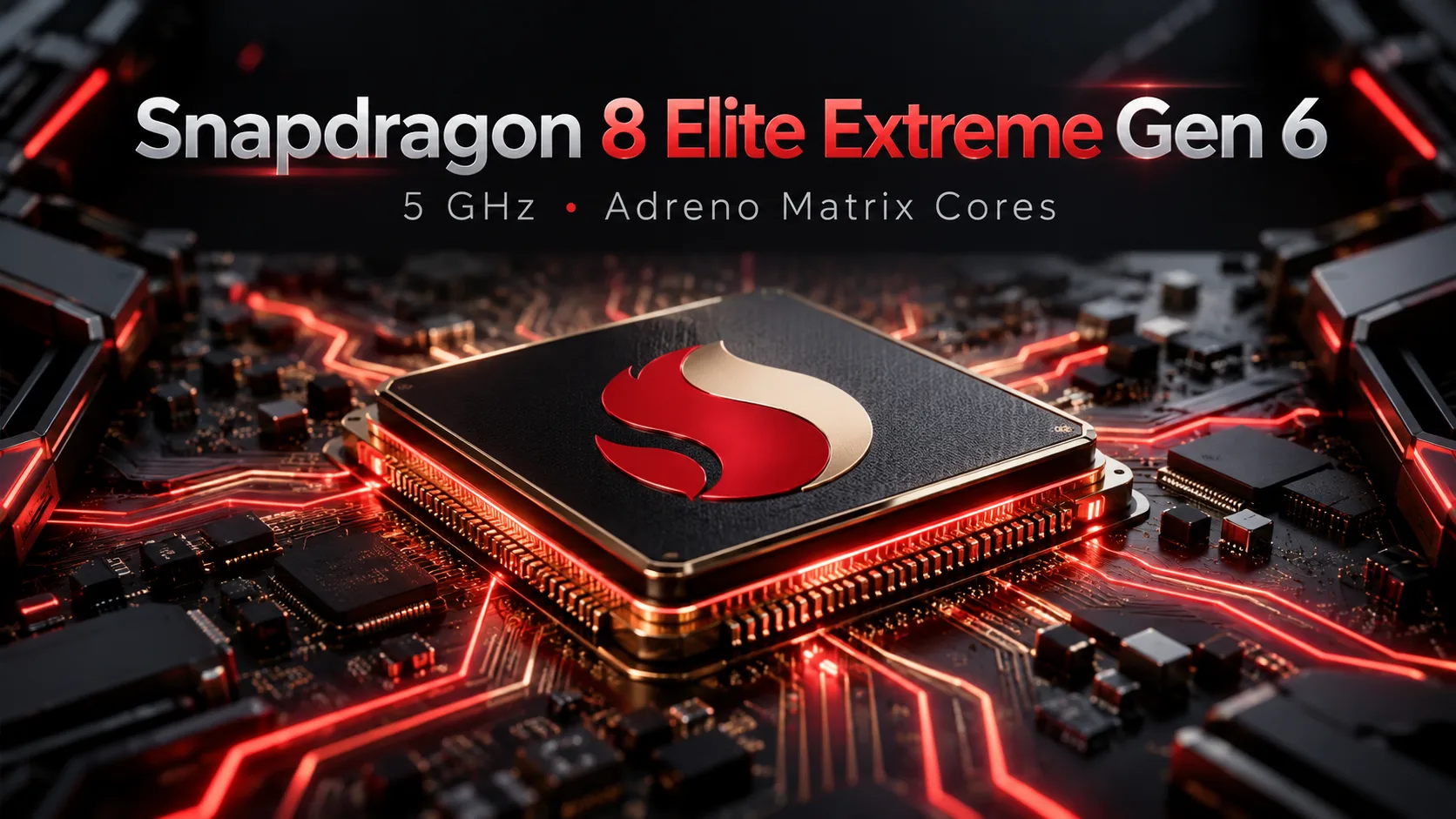
Qualcomm Snapdragon 8 Elite Extreme Gen 6: 5 GHz and Adreno Matrix Cores
The Qualcomm Snapdragon 8 Elite Extreme Gen 6 is Qualcomm’s flagship mobile chip for 2026. It features Oryon cores clocked at up to 5 GHz, Adreno graphics with Matrix Cores, and additional capabilities for gaming, AI processing, and professional video. The Snapdragon 8 Elite Gen 6 is close to the Extreme in CPU performance, but falls behind it in GPU and multimedia capabilities.
How the Extreme Differs from the Snapdragon 8 Elite Gen 6
| Feature | Snapdragon 8 Elite Extreme Gen 6 | Snapdragon 8 Elite Gen 6 |
|---|---|---|
| Adreno Matrix Cores | Yes | No |
| Adreno Neural Fusion | Yes | No |
| APV | Yes | No |
Qualcomm claims a 13% CPU performance increase, a 44% GPU performance increase, and a 40% improvement in graphics energy efficiency over the previous generation. According to the manufacturer, the Hexagon NPU is 35% faster. These are results from Qualcomm’s internal tests.
Performance in Smartphones
Snapdragon 8 Elite Extreme Gen 6 results vary noticeably among the first retail smartphones.
| Smartphone | AnTuTu 11 | Geekbench 6 Single | Geekbench 6 Multi | Starting price |
|---|---|---|---|---|
| Honor Magic 9 Pro Max | 5 524 187 | 3590 | 9929 | ~$970 |
| iQOO 16 | 5 498 720 | 3764 | 11 619 | ~$895 |
| Xiaomi 18 Pro Max | 5 001 234 | 3762 | 11 459 | ~$1045 |
Prices are listed in U.S. dollars for the base configurations at launch.
The spread in Geekbench 6 is particularly large. The Honor Magic 9 Pro Max scores around 3590 points in Single-Core and 9929 in Multi-Core, while the iQOO 16 reaches 3764 and 11 619 points, respectively.
In AnTuTu 11, the difference between the devices is smaller-around 5.0-5.5 million points.
The Motorola Signature 27 also features the Snapdragon 8 Elite Extreme Gen 6. In early tests, the device scored up to 4320 points in Geekbench 6 Single-Core and around 12,703 in Multi-Core, but the smartphone has not yet gone on sale.
Graphics and 3DMark
The Extreme’s performance increase is most noticeable in graphics tests. The Qualcomm Reference Design scored around 9897 points in 3DMark Wild Life Extreme Unlimited.
| Device | Processor | 3DMark Wild Life Extreme Unlimited |
|---|---|---|
| Qualcomm Reference Design | Snapdragon 8 Elite Extreme Gen 6 | 9897 |
| Apple iPhone 18 Pro Max | Apple A20 Pro | 8812 |
| Samsung Galaxy S26 Ultra | Snapdragon 8 Elite Gen 5 for Galaxy | 7584 |
| Honor Magic 8 Pro | Snapdragon 8 Elite Gen 5 | 7517 |
The Qualcomm Reference Design is an engineering platform, not a retail smartphone.
In Wild Life Extreme Unlimited, the Qualcomm Reference Design scores approximately 30% higher than the Galaxy S26 Ultra with the Snapdragon 8 Elite Gen 5 for Galaxy. The result is also approximately 12% higher than that of the iPhone 18 Pro Max with the Apple A20 Pro.
On the same platform, it scored around 4310 points in 3DMark Steel Nomad Light and 18 485 points in Solar Bay.
Adreno Matrix Cores and Neural Fusion
The Extreme features Adreno Matrix Cores-computational blocks for AI operations directly within the GPU. Adreno Neural Fusion uses them for image upscaling, frame generation, and image reconstruction.
Some AI computations are performed directly on the GPU without using a separate NPU.
Qualcomm has already demonstrated the technology in Honkai: Star Rail, Diablo Immortal, and War Thunder: Mobile.
Separate stress tests are needed to evaluate performance under sustained load.
Camera and Video
The Snapdragon 8 Elite Extreme Gen 6 supports Advanced Professional Video, 8K recording at 60 FPS, and 4K recording at 240 FPS. The chip also supports the simultaneous operation of three cameras with resolutions of up to 64 MP each.
The specific set of video modes depends on the manufacturer’s implementation.
Conclusion
The Extreme’s main advantage over the Snapdragon 8 Elite Gen 6 is more powerful graphics with Matrix Cores and additional video modes.
The first retail smartphones score around 5.0-5.5 million points in AnTuTu 11, but Geekbench 6 results still vary noticeably between models. The most significant difference is in the GPU: the Qualcomm Reference Design scores around 9900 points in 3DMark Wild Life Extreme Unlimited.
SOC Comparison
Compare Snapdragon 8 Elite Extreme Gen 6 with other SOCs
Basic
GPU Specifications
Connectivity
Memory Specifications
Miscellaneous
Benchmarks
Phones with Snapdragon 8 Elite Extreme Gen 6

Comparison of Devices with Snapdragon 8 Elite Extreme Gen 6
Compared to Other SoC
Related SoC Comparisons



Share in social media
Or Link To Us
<a href="https://cputronic.com/soc/qualcomm-snapdragon-8-elite-extreme-gen-6" target="_blank">Qualcomm Snapdragon 8 Elite Extreme Gen 6</a>