Qualcomm Snapdragon 6 Gen 5

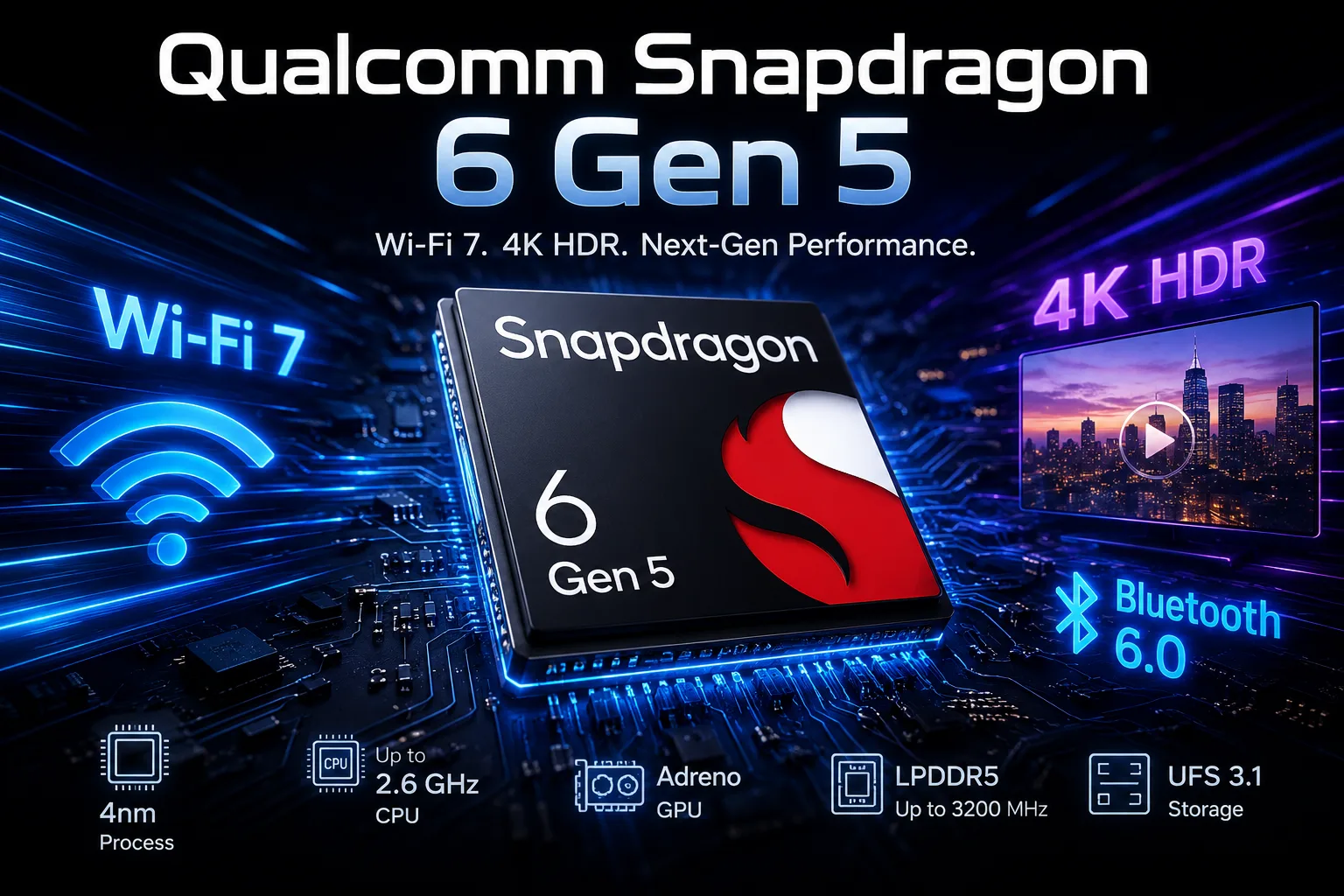
Snapdragon 6 Gen 5: a step backward for the CPU, a step forward for the GPU
Snapdragon 6 Gen 5 turned out to be an unusual upgrade. Qualcomm brought back the older Cortex-A78 and Cortex-A55 CPU cores, even though Snapdragon 6 Gen 4 used the more modern Cortex-A720 and Cortex-A520. The graphics side, however, improved far more than the processor: in some tests, the GPU advantage reaches 25-30%.
That is why the generation number is a poor reflection of the changes inside the platform. In terms of the CPU, Snapdragon 6 Gen 5 takes a step backward architecturally, while the real progress comes in graphics and wireless connectivity.
Older cores return in a new generation
Snapdragon 6 Gen 5 is manufactured using TSMC’s 4nm process and uses an octa-core CPU in a 4+4 configuration.
Four performance cores run at up to 2.6 GHz, while another four efficiency cores reach up to 2.0 GHz.
Qualcomm traditionally calls its CPU cores Kryo, but Geekbench results point to the Cortex-A78 and Cortex-A55.
This is where things get interesting.
Snapdragon 6 Gen 4 used the more modern Cortex-A720 and Cortex-A520 in a 1+3+4 configuration. It also supported ARMv9.
With Snapdragon 6 Gen 5, Qualcomm returned to the Cortex-A78/A55 architecture and ARMv8.2.
In other words, this is a rare situation in which a new-generation SoC receives an older CPU architecture than its direct predecessor.
Four A78 cores pull up Multi-Core, but Single-Core barely improves
Older cores do not necessarily mean that Snapdragon 6 Gen 5 is slower.
Qualcomm installed four performance Cortex-A78 cores and raised their clock speed to 2.6 GHz. As a result, multi-threaded performance increased.
The aggregated Geekbench 6 results look like this:
| SoC | Geekbench 6 Single-Core | Geekbench 6 Multi-Core |
|---|---|---|
| Snapdragon 6 Gen 5 | 1099 | 3481 |
| Snapdragon 6 Gen 4 | 1087 | 3148 |
| Difference | +1% | +11% |
The Multi-Core improvement is noticeable. Four performance cores provide an advantage when an application can load multiple threads simultaneously.
But Single-Core has barely changed.
The Multi-Core gain comes from four Cortex-A78 cores running at a high frequency, not from a more modern architecture.
Tests on shipping smartphones are even more revealing.
The Honor X80 Pro Max with Snapdragon 6 Gen 5 scores around 1095 points in Geekbench 6 single-threaded and 3355 points in multi-threaded testing.
The Honor Magic 8 Lite with Snapdragon 6 Gen 4 scores around 1112 and 3124 points, respectively.
In single-threaded testing, the new generation is not faster than its predecessor at all.
The GPU, however, really is faster
If the CPU raises questions, the graphics side looks considerably more convincing.
Snapdragon 6 Gen 5 uses the Adreno 812. Qualcomm claims up to a 21% increase in graphics performance compared with Snapdragon 6 Gen 4.
In independent tests, the advantage is sometimes even higher.
| Test | Snapdragon 6 Gen 5 | Snapdragon 6 Gen 4 | Difference |
|---|---|---|---|
| 3DMark Wild Life Extreme - best pass | 1214 | 968 | +25% |
| 3DMark Wild Life Extreme - worst pass | 1210 | 964 | +26% |
| 3DMark Stability | 99.7% | 99.6% | ≈ |
| AnTuTu 11 GPU | 215,763 | 163,828 | +32% |
Here, the difference between the generations is no longer merely symbolic.
In Wild Life Extreme, Snapdragon 6 Gen 5 is roughly a quarter faster, while the AnTuTu graphics score differs by almost a third.
At the same time, stability has barely changed. The best and worst Wild Life Extreme passes differ by less than 1%.
The comparison was conducted on different smartphones, so some of the difference may depend on cooling, power limits, and firmware. But the direction is clear: Snapdragon 6 Gen 5’s main performance boost came from the GPU.
For gaming, Gen 5 is more interesting than its CPU suggests
Snapdragon 6 Gen 5 does not turn an inexpensive smartphone into a gaming flagship.
In demanding titles, Snapdragon 7-and especially Snapdragon 8-remain significantly faster. Maximum settings in demanding games are not the primary goal for this class of chip.
But the GPU gain here is far more important than the nearly nonexistent difference in Geekbench Single-Core.
The faster graphics processor makes higher settings possible in less demanding games and provides more headroom in demanding titles.
If the choice between Snapdragon 6 Gen 4 and Gen 5 is being made specifically for gaming, the new chip looks significantly more appealing despite its older CPU architecture.
In terms of CPU, Snapdragon 6 Gen 5 resembles Dimensity 7400
The age of the processor side becomes especially clear when compared with the MediaTek Dimensity 7400.
Both chips use virtually the same configuration:
- 4× Cortex-A78 at up to 2.6 GHz;
- 4× Cortex-A55 at up to 2.0 GHz;
- TSMC 4nm process.
The Dimensity 7400 appeared back in February 2025.
That means Qualcomm released a new-generation Snapdragon in 2026 with a CPU configuration that its competitor had already been using in the mid-range segment for more than a year.
| Chip | CPU | AnTuTu v11 | GB6 SC | GB6 MC | GPU Compute |
|---|---|---|---|---|---|
| Snapdragon 6 Gen 5 | 4×A78 + 4×A55 | 1,012,134 | 1099 | 3481 | 4253 |
| Snapdragon 6 Gen 4 | A720/A520 | 975,254 | 1087 | 3148 | 3972 |
| Dimensity 7400 | 4×A78 + 4×A55 | 953,150 | 1061 | 3185 | 3069 |
Once again, it is clear where Qualcomm managed to pull ahead.
Not in the CPU, but in graphics.
Snapdragon 6 Gen 5’s GPU Compute score is noticeably higher than the Dimensity 7400’s. So having the same Cortex-A78 cores does not make these platforms equal.
The wireless side is more modern, but the wired side is not
Snapdragon 6 Gen 5 adds Wi-Fi 7 with channels up to 320 MHz, Bluetooth 6.0, LE Audio, and Bluetooth Channel Sounding.
The modem supports 5G Sub-6 with download speeds of up to 2.8 Gbps.
But USB 2.0 remains alongside all of that.
This is insignificant for charging, but the limitation is noticeable when copying large videos, photos, and backups. USB 2.0 looks especially strange alongside Wi-Fi 7 and UFS 3.1.
There are other cutbacks as well. Snapdragon 6 Gen 4 supported mmWave, while Gen 5 is limited to Sub-6. Instead of three 12-bit ISPs, there are now only two; hardware AV1 decoding is not supported, and aptX Lossless is no longer listed among the platform’s capabilities.
Therefore, Gen 5 cannot be considered an upgrade over Snapdragon 6 Gen 4 in every respect.
The bottom line
Snapdragon 6 Gen 5 is an uneven upgrade.
In terms of the CPU, the architecture has regressed: Cortex-A720/A520 and ARMv9 have been replaced by Cortex-A78/A55 and ARMv8.2.
High clock speeds and four performance cores deliver good Multi-Core results, but there is virtually no Single-Core advantage over Snapdragon 6 Gen 4.
The GPU, however, has genuinely taken a noticeable step forward.
In graphics tests, the advantage reaches roughly 25-30%, and for gaming, that difference matters far more than a single percent in Geekbench Single-Core.
Wi-Fi 7 and Bluetooth 6.0 have also been added.
The conclusion is simple: the CPU is architecturally older, but the GPU received the kind of boost you actually expect from a new generation.
If a smartphone with Snapdragon 6 Gen 5 costs roughly the same as a model with Gen 4, the faster GPU is a compelling argument in favor of the newer chip.
But if the Gen 5 model costs noticeably more, there is no reason to pay extra just for the generation number-especially when what lies beneath it is Cortex-A78, ARMv8.2, and USB 2.0.
SOC Comparison
Compare Snapdragon 6 Gen 5 with other SOCs
Basic
GPU Specifications
Connectivity
Memory Specifications
Miscellaneous
Benchmarks
Phones with Snapdragon 6 Gen 5

Comparison of Devices with Snapdragon 6 Gen 5
Compared to Other SoC
Related SoC Comparisons



Share in social media
Or Link To Us
<a href="https://cputronic.com/soc/qualcomm-snapdragon-6-gen-5" target="_blank">Qualcomm Snapdragon 6 Gen 5</a>