Unisoc T7300

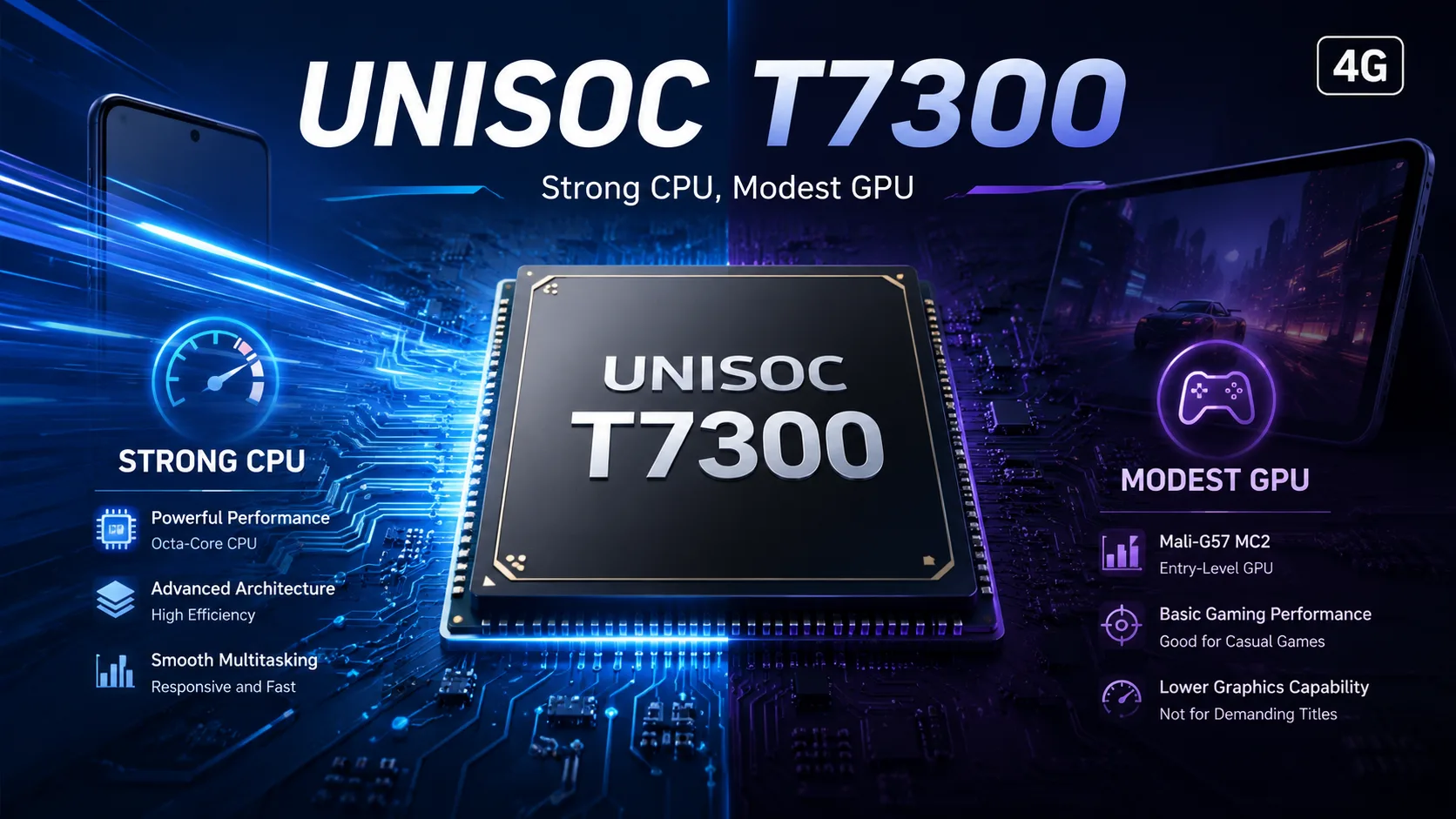
Unisoc T7300: A Powerful CPU for the 4G Segment, but Weak Graphics
The Unisoc T7300 looks unusual for 2026: it lacks 5G support but features two Cortex-A78 cores and a 6nm manufacturing process, allowing it to significantly improve CPU performance compared to older budget 4G platforms. However, the Mali-G57 MC2 graphics are noticeably weaker than the CPU part, making T7300 appear more convincing in everyday tasks than in heavy gaming.
The T7300 was officially announced in July 2025. Unisoc positions it as a high-end 4G platform, specifically referring to the upper part of the company's own 4G lineup. The real niche of the chip is low-cost smartphones and tablets.
Main Change - Transition to Cortex-A78
The previous Unisoc T7280 featured two Cortex-A75 cores with a frequency of up to 2.2 GHz and six Cortex-A55 cores at up to 1.8 GHz, and was manufactured using a 12nm process. In the T7300, the company switched to two Cortex-A78 cores at 2.2 GHz and six Cortex-A55 cores at 2.0 GHz, while simultaneously reducing the manufacturing process to 6nm.
The transition from Cortex-A75 to A78 provides most of the CPU performance boost. For a budget 4G platform, this configuration looks significantly more modern than many solutions from previous generations.
The graphics part is more modest: the Mali-G57 MC2 operates at a frequency of up to 950 MHz. This is sufficient for interfaces, video, and light gaming, but modern heavy projects quickly push the GPU to its limits.
Hidden Context of the Lineup
| Chip | CPU | Process | GPU | Networks |
|---|---|---|---|---|
| Unisoc T7280 | 2× Cortex-A75 2.2 GHz + 6× A55 1.8 GHz | 12nm | Mali-G57 up to 850 MHz | 4G |
| Unisoc T7300 | 2× Cortex-A78 2.2 GHz + 6× A55 2.0 GHz | 6nm | Mali-G57 MC2 950 MHz | 4G |
| Unisoc T8300 | 2× Cortex-A78 2.2 GHz + 6× A55 2.0 GHz | 6nm | Mali-G57 MC2 950 MHz | 5G |
The T7300 and T8300 share a very similar computational foundation. The main difference is the modem: the T8300 supports 5G Release 17, while the T7300 is limited to LTE. There are also differences in multimedia capabilities, so this is not just one platform under a different name, although the CPU and GPU are practically identical.
Performance in Real Devices
The T7300 is already used in several commercial devices, allowing for evaluation beyond merely Unisoc's reference results.
| Device | Geekbench 6 Single | Geekbench 6 Multi | 3DMark Wild Life | AnTuTu |
|---|---|---|---|---|
| itel SUPER 26 Ultra | 910 | 2 083 | 1 247 | 686 444, v11 |
| ALLDOCUBE iPlay 70E | 922 | 2 226 | 1 260 | 637 199, v10* |
| ALLDOCUBE iPlay 80 mini Pro | 857 | 2 245 | 1 255 | 662 842, v11 |
*AnTuTu 10 and AnTuTu 11 cannot be directly compared, so the result of the iPlay 70E should be considered separately. For comparing devices against one another, Geekbench 6 and 3DMark are more indicative.
Unisoc's reference device scores approximately 924 points in single-core and 2249 in multi-core Geekbench 6. Commercial smartphones and tablets come quite close to these figures, meaning that the performance level of the reference platform is largely maintained in real devices.
Geekbench: Around 900 Points per Core
In Geekbench 6, the T7300 typically scores around 850-920 points in single-core and 2100-2250 in multi-core. This is significantly higher than the level of many older budget 4G platforms.
In one test, the iPlay 80 mini Pro using the T7300 scored 857/2140 points, while the Helio G99 in the same comparison scored 714/1872. The specific gap depends on the devices and cooling solutions, but the Cortex-A78 indeed gives the T7300 a noticeable advantage in single-thread performance.
Higher single-thread performance is particularly beneficial in interfaces, browsers, and other short workloads.
Mali-G57 MC2 Limits Gaming Capabilities
The weak point of the T7300 is its GPU. Three different devices show nearly identical scores of 1247-1260 points in 3DMark Wild Life, indicating minimal variation between implementations.
The iPlay 70E's graphics score in AnTuTu was around 43,000 points, despite a significantly higher overall system score. A similar picture is observed with other devices featuring the T7300.
Thus, the final AnTuTu scores of 620,000 to 680,000 should not be interpreted as a measure of high gaming performance. The T7300 handles Mobile Legends, Free Fire, and other relatively light games well; however, in heavy 3D projects, graphics settings will need to be reduced.
Unisoc itself claims support for optimized modes up to 90 fps in Free Fire and Mobile Legends and up to 60 fps in PUBG. These figures more reflect the possibilities of optimizing popular games for the platform rather than the overall GPU capability.
UFS 2.2 and 120Hz Displays
Support for UFS 2.2 is important in the budget segment. In devices of this class, a fast storage solution often impacts system responsiveness as much as additional CPU points.
The T7300 is also designed for FHD+ displays with refresh rates of up to 120 Hz. The main limitation of the platform regarding connectivity is the lack of 5G support: the chip supports LTE, Wi-Fi 5, and Bluetooth 5.4.
For a tablet that predominantly operates via Wi-Fi, the absence of 5G usually doesn't play a significant role. However, for a smartphone intended for multi-year use, this limitation is more crucial.
Which Devices Use the T7300
One notable smartphone featuring the T7300 is the itel SUPER 26 Ultra. It combines this SoC with an AMOLED display, 8GB of RAM, and UFS 2.2. With a price of approximately $150-200, the combination of AMOLED, 8GB of RAM, UFS 2.2, and the T7300 looks compelling.
The T7300 is particularly popular in low-cost Android tablets.
| Device | Format | Approximate Price |
|---|---|---|
| itel SUPER 26 Ultra | Smartphone | $150-200 |
| ALLDOCUBE iPlay 70E | 11" Tablet | from $149 |
| ALLDOCUBE iPlay 80 mini Pro | 8.4" Compact Tablet | about $169 |
The ALLDOCUBE iPlay 70E is interesting as an inexpensive large tablet with LTE, whereas the iPlay 80 mini Pro is a compact model for browsing, video, reading, and navigation. In both cases, the strong CPU component of the T7300 is more beneficial than its limited gaming capabilities.
The T7300 is also found in the ALLDOCUBE iPlay 70 Max Pro, Blackview Mega 5, DOOGEE U13 Pro, Ulefone Tab A12 Pro, and other models. It is no longer an experimental platform limited to a single device, but rather a fairly widespread solution for low-cost Android tablets.
Conclusion
The Unisoc T7300 is primarily interesting for its CPU capabilities. The two Cortex-A78 cores and the 6nm process allow it to significantly outperform many older budget 4G platforms and provide decent performance in browsing, interfaces, video, and everyday applications.
The Mali-G57 MC2 appears considerably weaker. Therefore, the high overall AnTuTu score creates a somewhat inflated impression of the chip's gaming capabilities: heavy games remain its weak point.
In low-cost devices of this class, such a balance is quite understandable: the manufacturer saves on 5G and graphics but retains a sufficiently fast CPU.
The T7300 is particularly well-suited for inexpensive tablets where 5G is rarely a necessity, and a powerful CPU and UFS 2.2 significantly enhance usability.
For a gaming device or a smartphone aimed at 5G, it is better to look at more modern platforms. However, the T7300 demonstrates an essential truth: a budget 4G device in 2026 need not be slow.
SOC Comparison
Compare T7300 with other SOCs
Basic
GPU Specifications
Connectivity
Memory Specifications
Miscellaneous
Benchmarks
Compared to Other SoC
Related SoC Comparisons


Share in social media
Or Link To Us
<a href="https://cputronic.com/soc/unisoc-t7300" target="_blank">Unisoc T7300</a>