NVIDIA GeForce GTX 1660 SUPER
NVIDIA GeForce GTX 1660 SUPER in 2026: Gaming Tests and Whether to Buy a 6 GB Card
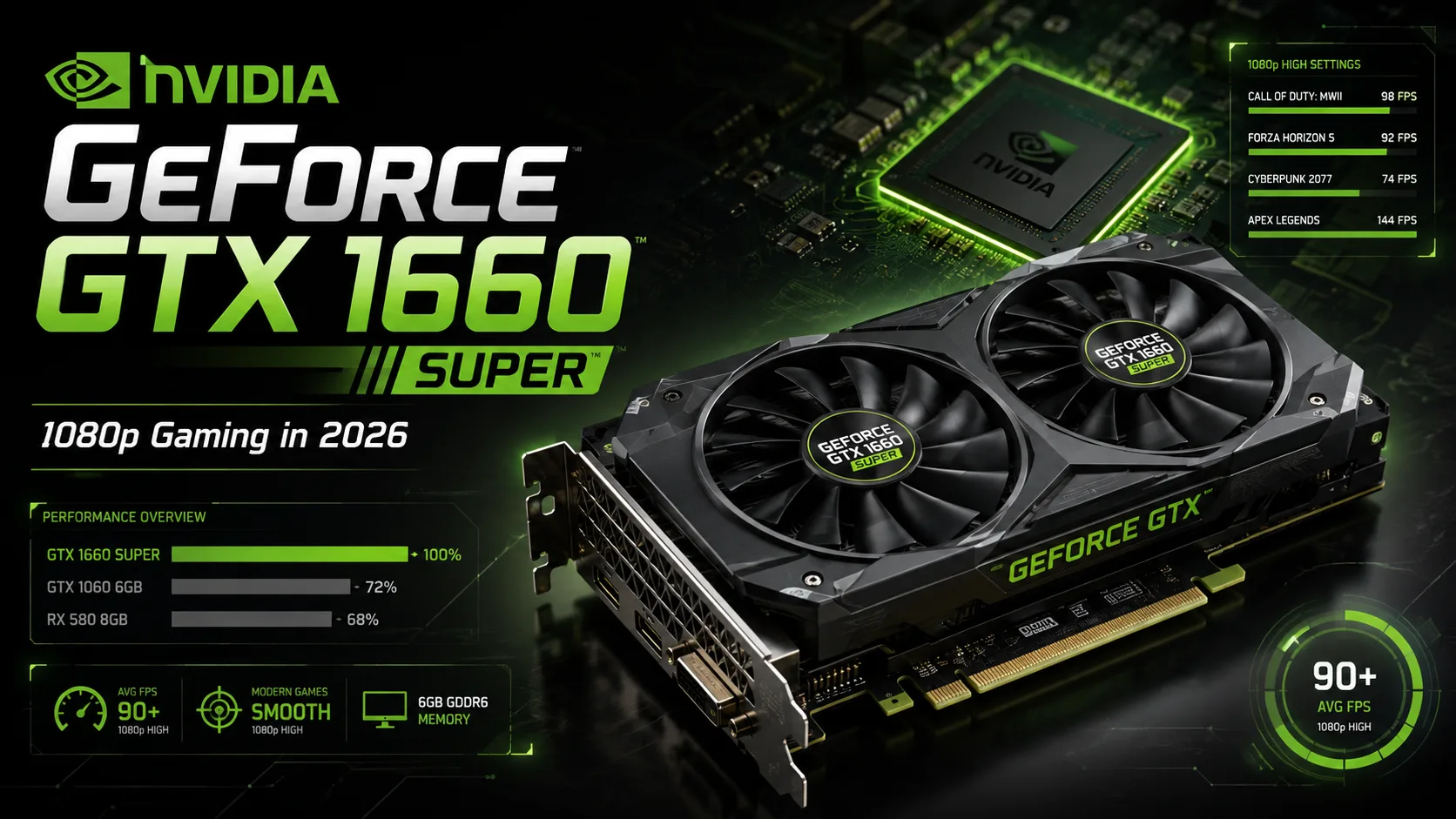
The GeForce GTX 1660 SUPER was released in 2019, but its performance is still sufficient for many games at Full HD. The fast GDDR6 memory helped this model significantly outperform the standard GTX 1660 and get closer to the GTX 1660 Ti, making the SUPER one of the most successful cards in the family.
By 2026, the situation has changed: computational power for 1080p is still adequate, but 6 GB of video memory is increasingly becoming the main limitation. Therefore, the GTX 1660 SUPER is primarily worth considering as a budget graphics card from the secondary market rather than as the foundation for a new gaming PC.
GDDR6 Made the GTX 1660 SUPER Much More Interesting Than the Standard GTX 1660
The GTX 1660 SUPER is based on the same TU116 chip with 1408 CUDA cores as the standard GTX 1660. The main difference is the memory.
The switch from GDDR5 to GDDR6 has increased the memory bandwidth from 192 to 336 GB/s. In initial gaming tests, this allowed the SUPER to outperform the GTX 1660 by about 10% on average and get within just a few percentage points of the GTX 1660 Ti.
Therefore, today, the standard GTX 1660 makes sense only at a significantly lower price point. The SUPER uses nearly the same GPU but is much less constrained by memory bandwidth.
GTX 1660 SUPER in Games: What to Expect at 1080p
For the GTX 1660 SUPER, the optimal resolution remains Full HD. In light and well-optimized games, the card can deliver high FPS, but in heavier titles, it requires medium to high settings.
| Game | Resolution and Settings | Average FPS |
|---|---|---|
| Rainbow Six Siege | 1080p | ~129 FPS |
| Forza Horizon 5 | 1080p High | ~95 FPS |
| Far Cry New Dawn | 1080p | ~90 FPS |
| The Division 2 | 1080p | ~74 FPS |
| Hogwarts Legacy | 1080p Medium | just over 60 FPS |
The results were obtained in different test systems and game versions, so they should be viewed as a guideline rather than guaranteed FPS for any PC.
For Counter-Strike 2, Valorant, Dota 2, Rainbow Six Siege, and other online games, the performance of the GTX 1660 SUPER is still sufficient. In heavy AAA projects, a reasonable starting point becomes 1080p with medium settings.
In new games, high textures increasingly hit the 6 GB memory limit before the GPU's performance runs out.
How Different GTX 1660 SUPER Models Compare in Benchmarks
The GTX 1660 SUPER was released by many NVIDIA partners. However, paying extra for the most overclocked version for performance is almost pointless.
| Graphics Card | 3DMark Time Spy Extreme Graphics |
|---|---|
| Gigabyte GeForce GTX 1660 SUPER Gaming OC 6G | ~2841 |
| ASUS Dual GeForce GTX 1660 SUPER EVO OC | ~2841 |
| MSI GeForce GTX 1660 SUPER Gaming X | ~2819 |
| Zotac Gaming GTX 1660 SUPER Twin Fan | ~2783 |
The difference between the top and bottom lines is about 2%. In real games, this difference is practically imperceptible.
Therefore, when choosing a used GTX 1660 SUPER, the condition of the specific unit, the cooling system, and noise level are much more important. A good dual- or triple-fan model is preferable not for a few extra FPS, but for temperature management and acoustics.
Secondary Market: Plenty of Previously Used Mining GTX 1660 SUPER
The GTX 1660 SUPER was actively used for mining due to its GDDR6 memory and relatively low power consumption. Therefore, the age of the card is far from the only concern. More important is how the specific unit was used and maintained.
Before purchasing, it's worth checking for:
- absence of artifacts under load;
- video memory stability;
- GPU temperatures;
- noise, play, and vibration of fans;
- signs of disassembly and repair;
- stability after prolonged gaming or stress load;
- BIOS compliance with the stock version.
The mere fact of having been used for mining does not mean that the card is defective. However, buying a GTX 1660 SUPER without checking is already risky: the oldest units of this model are about seven years old.
GTX 1660 SUPER vs Alternatives: Price is Everything
On the secondary market, the GTX 1660 SUPER cannot be evaluated in isolation from other budget graphics cards.
| Graphics Card | Compared to GTX 1660 SUPER | Memory | Important Notes |
|---|---|---|---|
| GTX 1660 | slower | 6 GB | only makes sense if significantly cheaper |
| GTX 1660 Ti | slightly faster | 6 GB | large markup is not justified |
| RTX 2060 | faster | 6 GB | has DLSS and hardware Ray Tracing |
| RX 6600 | significantly faster | 8 GB | much more attractive at a similar price |
The Radeon RX 6600 is particularly noteworthy. It is faster than the GTX 1660 SUPER, offers 8 GB of video memory, and has greater headroom for modern games. If both cards cost about the same, choosing the GTX 1660 SUPER becomes nearly meaningless.
The RTX 2060 is also more interesting at a slight price difference: it offers better performance, and DLSS support can significantly help in compatible games.
GTX 1660 SUPER Lacks DLSS but Has Turing NVENC
The GTX 1660 SUPER belongs to the Turing architecture, but the GTX 16 series does not have dedicated RT and Tensor cores. Therefore, hardware Ray Tracing and DLSS are not available for it.
The absence of DLSS is felt more strongly today than a few years ago; the GTX 1660 SUPER has to rely mainly on its raw performance or universal scaling technologies like FSR.
At the same time, the card has Turing NVENC. For recording gameplay and streaming, the hardware video encoder still remains a useful advantage.
Is It Worth Buying GTX 1660 SUPER in 2026
Yes, but only if it’s cheap.
The GTX 1660 SUPER is still suitable for Full HD, especially for online games, older AAA titles, or upgrading from a GTX 1050 Ti, GTX 960, or similar cards.
However, its drawbacks are now too pronounced: 6 GB of VRAM, lack of DLSS, lack of hardware Ray Tracing, and the age of most units.
The main benchmark when buying is the RX 6600. If the GTX 1660 SUPER costs only a little less, it’s not worth saving: the Radeon is faster and has 8 GB of memory. The GTX 1660 SUPER only becomes genuinely interesting when it is sold significantly cheaper than more modern alternatives.
In 2026, the GTX 1660 SUPER is still a functioning card for 1080p, but its appeal is determined not by performance but by price.
GPU Comparison
Compare GeForce GTX 1660 SUPER with other GPUs
Basic
Memory Specifications
Display and Media
1x HDMI 2.0
1x DisplayPort 1.4a
Theoretical Performance
Miscellaneous
Benchmarks
Compared to Other GPU
Related GPU Comparisons


Share in social media
Or Link To Us
<a href="https://cputronic.com/index.php/gpu/nvidia-geforce-gtx-1660-super" target="_blank">NVIDIA GeForce GTX 1660 SUPER</a>