NVIDIA GeForce GTX 1660
NVIDIA GeForce GTX 1660
NVIDIA GeForce GTX 1660 graphics card review

NVIDIA GeForce GTX 1660 in 2026: Is it worth buying for 80 euros?

In 2026, the fate of the GTX 1660 in the secondary market is primarily determined by its price. It still handles Full HD in many games, but the GTX 1660 SUPER and GTX 1660 Ti often cost almost the same. The regular GTX 1660 is appealing at around 70-80 euros.

Turing Without RTX

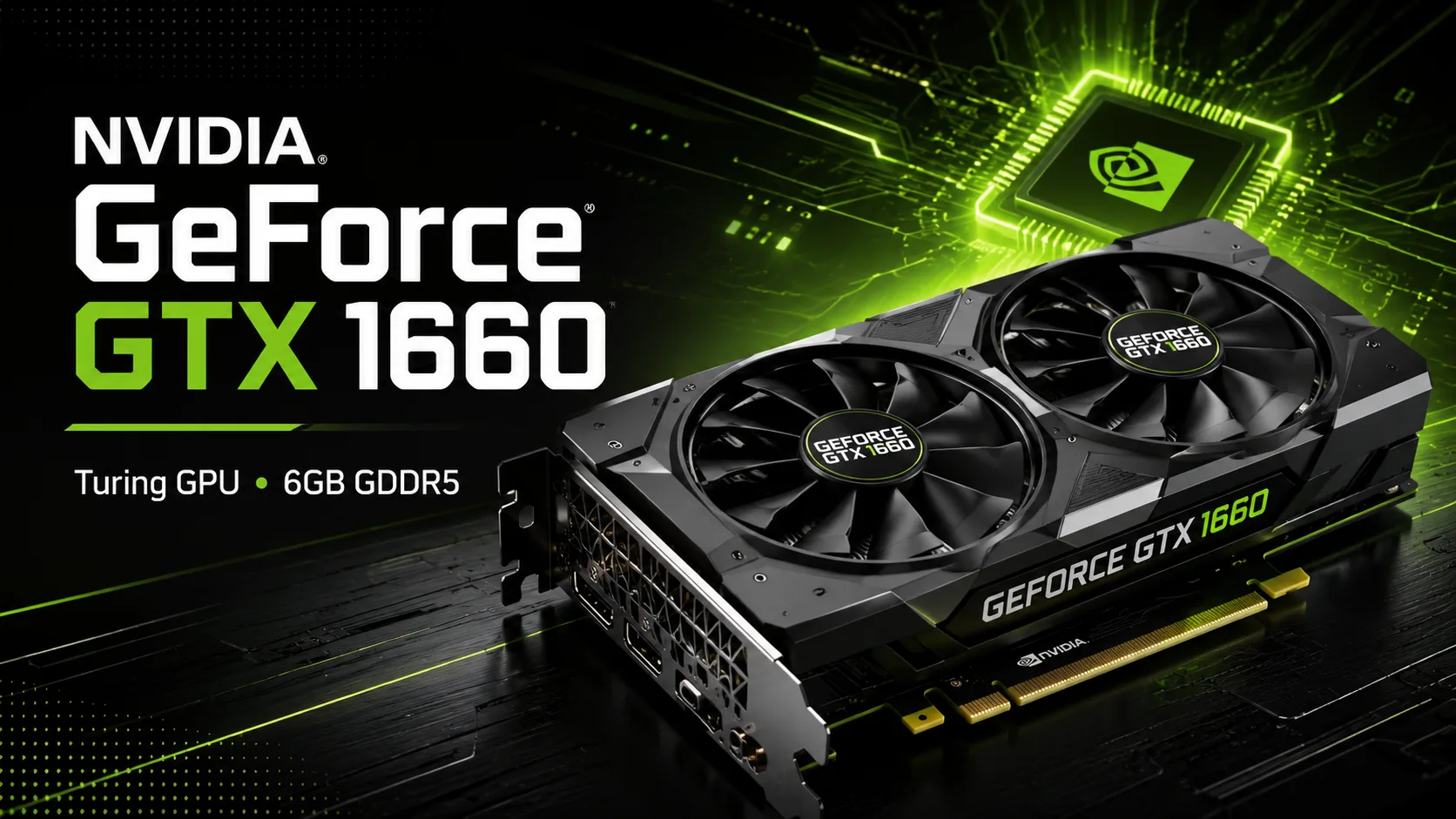
The GTX 1660 is built on the TU116 GPU using Turing architecture. It features 1408 CUDA cores, with no RT cores or Tensor Cores. There is no hardware ray tracing or DLSS support.

However, the card does include the Turing generation NVENC hardware encoder, which allows for video recording and streaming without putting a significant load on the CPU.

The regular GTX 1660 is equipped with 6 GB GDDR5 with an effective speed of 8 Gbps and a 192-bit bus. The bandwidth is 192 GB/s. The GTX 1660 SUPER and GTX 1660 Ti have faster GDDR6 memory.

GTX 1660, SUPER, and Ti

Despite their similar names, the performance of the three models differs significantly.

Model CUDA Cores Memory Bandwidth
GTX 1660 1408 6 GB GDDR5 192 GB/s
GTX 1660 SUPER 1408 6 GB GDDR6 336 GB/s
GTX 1660 Ti 1536 6 GB GDDR6 288 GB/s

The GTX 1660 SUPER has the same 1408 CUDA cores but much faster GDDR6 memory. In Full HD, the GTX 1660 SUPER typically outperforms the GTX 1660 by about 10-15%. The GTX 1660 Ti adds a few more percentage points.

If the price difference is 10-15 euros, it is better to pay extra for the GTX 1660 SUPER.

Benchmarks of Stock GTX 1660

Graphics Card 3DMark Time Spy Graphics Shadow of the Tomb Raider, 1080p
MSI GeForce GTX 1660 GAMING 6G 5,395 80 FPS
ZOTAC GAMING GeForce GTX 1660 Twin Fan 5,395 80 FPS
Palit GeForce GTX 1660 Dual OC 5,465 82 FPS

The Palit Dual OC shows only a slight advantage.

Gaming Performance

In older and relatively undemanding games, the GTX 1660 is still capable of delivering high frame rates at 1920x1080. In Shadow of the Tomb Raider, the tested cards achieve around 80 FPS, while in Battlefield V, they get 77-79 FPS.

In The Last of Us Part I, the result drops to about 40 FPS at 1080p on high settings.

In newer AAA games, settings often need to be lowered to medium at 1080p.

The card does not support DLSS, but FSR and other scaling technologies can be used in compatible games.

6 GB of Memory Already Limits Settings

In 2019, 6 GB was sufficient for the GTX 1660 class, but modern games do not always have enough memory.

Problems more frequently arise with high texture settings. Reducing texture quality from max to medium decreases video memory usage and can eliminate frame drops.

For many games at Full HD, 6 GB is still adequate, but it is not wise to expect headroom for future AAA titles.

Power Consumption

The typical power consumption of the GTX 1660 is around 120 watts. Therefore, the card is suitable for upgrading older systems without needing to replace the power supply, provided it has enough power capacity.

Dual-fan versions are generally quieter than compact single-fan models. One-fan versions should be checked particularly closely for noise and temperature.

How Much Should the GTX 1660 Cost

On the secondary market, regular GTX 1660 cards can be found for 75-110 euros, with GTX 1660 SUPER often priced similarly. GTX 1660 Ti is usually more expensive.

Price of GTX 1660 What to Do
up to 70 euros can be purchased if in good condition
70-80 euros can be purchased if the card is functioning
80-90 euros compare with GTX 1660 SUPER
90-100 euros regular GTX 1660 is no longer worth it
over 100 euros look for GTX 1660 SUPER, GTX 1660 Ti, or newer cards

New unsold GTX 1660 cards are sometimes listed at several times their actual value. At such prices, buying a GTX 1660 is pointless.

What to Check Before Buying

On the secondary market, the condition of a specific card is more important than the brand or factory overclocking.

Before purchasing, it is advisable to check:

  • stability under load;
  • GPU temperature;
  • video memory errors and artifacts;
  • condition and noise of the fans;
  • functionality of the video outputs.

The GTX 1660 has been actively used in both gaming systems and mining. The fact that it was used for mining does not automatically indicate the card's condition. More important are temperature, stability, and the state of the fans after prolonged load.

Conclusion

The GTX 1660 is still capable of handling many games at Full HD and consumes around 120 watts.

However, in 2026, it is only justified at a low price.

For 70-80 euros, a functioning GTX 1660 can be purchased. Above 90 euros, it is better to look for the GTX 1660 SUPER, and at around 100 euros - the GTX 1660 Ti.

If the GTX 1660 is already installed in a computer and its performance is sufficient, there is no need to replace it solely due to its age. When buying from scratch, the GTX 1660 should be significantly cheaper than the GTX 1660 SUPER and GTX 1660 Ti.

Basic

Label Name
NVIDIA
Platform
Desktop
Launch Date
March 2019
Model Name
GeForce GTX 1660
Generation
GeForce 16
Base Clock
1530MHz
Boost Clock
1785MHz
Bus Interface
PCIe 3.0 x16
Transistors
6,600 million
TMUs
?
Texture Mapping Units (TMUs) serve as components of the GPU, which are capable of rotating, scaling, and distorting binary images, and then placing them as textures onto any plane of a given 3D model. This process is called texture mapping.
88
Foundry
TSMC
Process Size
12 nm
Architecture
Turing

Memory Specifications

Memory Size
6GB
Memory Type
GDDR5
Memory Bus
?
The memory bus width refers to the number of bits of data that the video memory can transfer within a single clock cycle. The larger the bus width, the greater the amount of data that can be transmitted instantaneously, making it one of the crucial parameters of video memory. The memory bandwidth is calculated as: Memory Bandwidth = Memory Frequency x Memory Bus Width / 8. Therefore, when the memory frequencies are similar, the memory bus width will determine the size of the memory bandwidth.
192bit
Memory Clock
2001MHz
Bandwidth
?
Memory bandwidth refers to the data transfer rate between the graphics chip and the video memory. It is measured in bytes per second, and the formula to calculate it is: memory bandwidth = working frequency × memory bus width / 8 bits.
192.1 GB/s

Display and Media

Outputs
1x DVI
1x HDMI 2.0
1x DisplayPort 1.4a

Theoretical Performance

Pixel Rate
?
Pixel fill rate refers to the number of pixels a graphics processing unit (GPU) can render per second, measured in MPixels/s (million pixels per second) or GPixels/s (billion pixels per second). It is the most commonly used metric to evaluate the pixel processing performance of a graphics card.
85.68 GPixel/s
Texture Rate
?
Texture fill rate refers to the number of texture map elements (texels) that a GPU can map to pixels in a single second.
157.1 GTexel/s
FP16 (half)
?
An important metric for measuring GPU performance is floating-point computing capability. Half-precision floating-point numbers (16-bit) are used for applications like machine learning, where lower precision is acceptable. Single-precision floating-point numbers (32-bit) are used for common multimedia and graphics processing tasks, while double-precision floating-point numbers (64-bit) are required for scientific computing that demands a wide numeric range and high accuracy.
10.05 TFLOPS
FP64 (double)
?
An important metric for measuring GPU performance is floating-point computing capability. Double-precision floating-point numbers (64-bit) are required for scientific computing that demands a wide numeric range and high accuracy, while single-precision floating-point numbers (32-bit) are used for common multimedia and graphics processing tasks. Half-precision floating-point numbers (16-bit) are used for applications like machine learning, where lower precision is acceptable.
157.1 GFLOPS
FP32 (float)
?
An important metric for measuring GPU performance is floating-point computing capability. Single-precision floating-point numbers (32-bit) are used for common multimedia and graphics processing tasks, while double-precision floating-point numbers (64-bit) are required for scientific computing that demands a wide numeric range and high accuracy. Half-precision floating-point numbers (16-bit) are used for applications like machine learning, where lower precision is acceptable.
5.128 TFLOPS

Miscellaneous

SM Count
?
Multiple Streaming Processors (SPs), along with other resources, form a Streaming Multiprocessor (SM), which is also referred to as a GPU's major core. These additional resources include components such as warp schedulers, registers, and shared memory. The SM can be considered the heart of the GPU, similar to a CPU core, with registers and shared memory being scarce resources within the SM.
22
Shading Units
?
The most fundamental processing unit is the Streaming Processor (SP), where specific instructions and tasks are executed. GPUs perform parallel computing, which means multiple SPs work simultaneously to process tasks.
1408
L1 Cache
64 KB (per SM)
L2 Cache
1536KB
TDP
120W
Vulkan Version
?
Vulkan is a cross-platform graphics and compute API by Khronos Group, offering high performance and low CPU overhead. It lets developers control the GPU directly, reduces rendering overhead, and supports multi-threading and multi-core processors.
1.3
OpenCL Version
3.0
OpenGL
4.6
CUDA
7.5
DirectX
12 (12_1)
Power Connectors
1x 8-pin
ROPs
?
The Raster Operations Pipeline (ROPs) is primarily responsible for handling lighting and reflection calculations in games, as well as managing effects like anti-aliasing (AA), high resolution, smoke, and fire. The more demanding the anti-aliasing and lighting effects in a game, the higher the performance requirements for the ROPs; otherwise, it may result in a sharp drop in frame rate.
48
Shader Model
6.6
Suggested PSU
300W

Benchmarks

Shadow of the Tomb Raider 2160p
Score
24 fps
Shadow of the Tomb Raider 1440p
Score
48 fps
Shadow of the Tomb Raider 1080p
Score
72 fps
Battlefield 5 2160p
Score
39 fps
Battlefield 5 1440p
Score
74 fps
Battlefield 5 1080p
Score
93 fps
GTA 5 2160p
Score
49 fps
GTA 5 1440p
Score
53 fps
GTA 5 1080p
Score
153 fps
FP32 (float)
Score
5.128 TFLOPS
3DMark Steel Nomad
Score
1047
3DMark Time Spy
Score
5521
Blender
Score
794
OctaneBench
Score
114
Vulkan
Score
55223
OpenCL
Score
59526

Compared to Other GPU

Shadow of the Tomb Raider 2160p / fps
45 +87.5%
35 +45.8%
1 -95.8%
Shadow of the Tomb Raider 1440p / fps
69 +43.8%
49 +2.1%
Shadow of the Tomb Raider 1080p / fps
101 +40.3%
Battlefield 5 2160p / fps
58 +48.7%
7 -82.1%
Battlefield 5 1440p / fps
113 +52.7%
28 -62.2%
Battlefield 5 1080p / fps
141 +51.6%
68 -26.9%
GTA 5 2160p / fps
68 +38.8%
55 +12.2%
GTA 5 1440p / fps
153 +188.7%
103 +94.3%
82 +54.7%
61 +15.1%
GTA 5 1080p / fps
175 +14.4%
122 -20.3%
FP32 (float) / TFLOPS
5.193 +1.3%
4.993 -2.6%
4.922 -4%
3DMark Time Spy
9718 +76%
7479 +35.5%
4126 -25.3%
3DMark Steel Nomad
1081 +3.2%
1023 -2.3%
1005 -4%
Vulkan
106450 +92.8%
81133 +46.9%
33763 -38.9%
17987 -67.4%
OpenCL
102880 +72.8%
75816 +27.4%
36927 -38%