NVIDIA GeForce GTX 1070
GeForce GTX 1070 in 2026: Performance Tests, 8 GB VRAM, and Is It Worth Buying
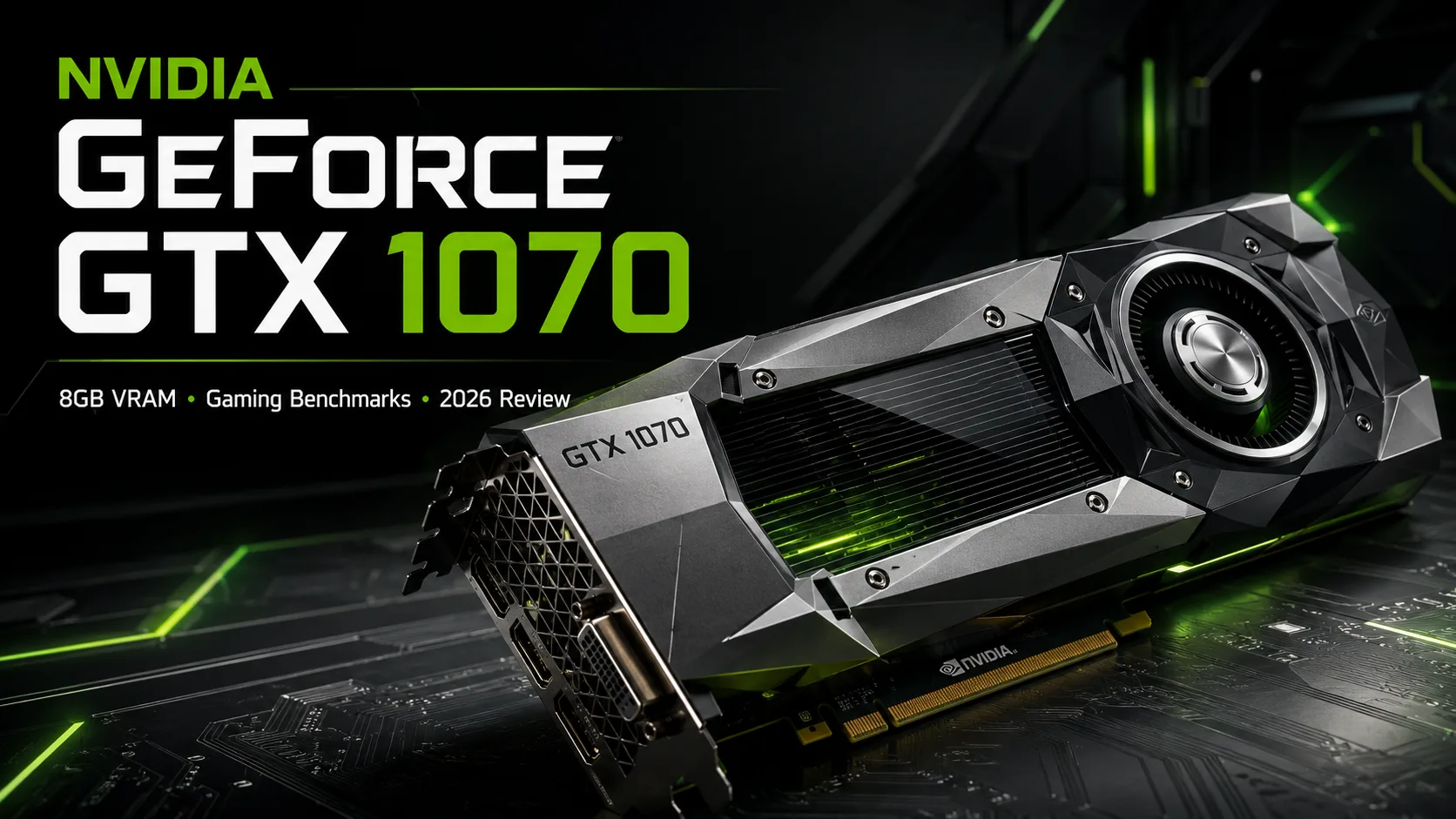
NVIDIA GeForce GTX 1070 was released in 2016, but it's still too early to write it off after ten years. The 8 GB of video memory allows the card to appear more convincing than some newer budget models with 4 GB, and its performance is still sufficient for many games in Full HD. The problem lies elsewhere: Pascal no longer receives Game Ready optimizations, there is no DLSS support here, and in demanding new games, GTX 1070 increasingly has to drop to medium settings.
Thus, in 2026, the GTX 1070 is no longer a 1440p card as it was at launch but a budget option for 1080p. The appeal of such a purchase almost entirely depends on the price and condition of the specific unit.
8 GB of Video Memory Helps GTX 1070 Age More Slowly
The amount of VRAM turned out to be one of the main advantages of the GTX 1070. At 1080p, 8 GB still allows for the use of fairly high-quality textures and reduces encounters with memory limitations typical of older models with 4 GB.
However, 8 GB does not transform Pascal into a modern architecture. The GTX 1070 lacks RT and Tensor cores, so hardware ray tracing and DLSS are unavailable. In games with AMD FSR, upscaling can be used, but it primarily helps maintain an acceptable FPS rather than eliminating the gap with modern GPUs.
The strength of the GTX 1070 today lies not in its set of technologies but in the combination of 8 GB of memory and still respectable raster performance.
How Many FPS Does GTX 1070 Achieve in Games
The results of older tests cannot be automatically accounted for as the performance of the game version from 2026: patches, drivers, and CPUs significantly affect the numbers. However, measurements on real setups clearly show the performance class of the GTX 1070.
In TechSpot's retesting, the card provided about 50 FPS in Cyberpunk 2077 at 1080p Medium, 73 FPS in Watch Dogs: Legion at 1080p High, and 84 FPS in Resident Evil Village at maximum settings. In Star Wars Jedi: Fallen Order, the result reached 102 FPS at 1080p High.
| Game | Settings | Average FPS |
|---|---|---|
| Cyberpunk 2077 | 1080p Medium | ~50 FPS |
| Watch Dogs: Legion | 1080p High | 73 FPS |
| Resident Evil Village | 1080p Maximum | 84 FPS |
| Star Wars Jedi: Fallen Order | 1080p High | 102 FPS |
| Hogwarts Legacy | 1080p Medium | just below 60 FPS |
In Hogwarts Legacy, the GTX 1070 also fell just below the 60 FPS mark at 1080p Medium in TechSpot's testing.
These numbers were obtained from different game versions and do not constitute a unified test for 2026, so they should be viewed as a guideline. The picture is clear: around 60 FPS at 1080p for the GTX 1070 is still realistic, but in demanding games, you must choose Medium over High or Ultra.
1440p remains a workable resolution for older and well-optimized projects. It is not worth buying a GTX 1070 specifically for modern AAA games at 1440p.
Different GTX 1070s: A Few Percent FPS vs. Dozens of Watts
The GTX 1070 was produced in a vast number of variations - from the compact Gigabyte Mini ITX to larger ASUS ROG Strix, MSI Gaming X, and Palit GameRock.
Tom's Hardware compared several such cards on one test bench. The differences clearly illustrate why chasing the most expensive factory overclocking in 2026 is pointless.
| GTX 1070 Model | GTA V 1440p | Rise of the Tomb Raider 1440p | Power Consumption in Game |
|---|---|---|---|
| NVIDIA GTX 1070 Founders Edition | 69.1 FPS | 76.1 FPS | 148 W |
| Gigabyte GTX 1070 Mini ITX OC | 71.3 FPS | 77.3 FPS | 155 W |
| ASUS ROG Strix GTX 1070 OC | 72.7 FPS | 80.2 FPS | 165 W |
| MSI GTX 1070 Gaming X 8G | 72.7 FPS | 79.9 FPS | 181 W |
| Palit GTX 1070 GameRock Premium | 72.9 FPS | 80.2 FPS | 173 W |
The difference between the Founders Edition and the faster factory versions yields about 3-5% additional FPS, while the power consumption difference can exceed 30 W. Therefore, good cooling, low noise, and the state of the card are more important than the factory frequency boost.
For the benchmark table, particularly telling are the GTX 1070 Founders Edition, Gigabyte GTX 1070 Mini ITX OC, ASUS ROG Strix GTX 1070 OC, and MSI GTX 1070 Gaming X 8G - they cover the range from the reference model to large OC variations.
Game Ready Support for Pascal Has Ended
This is one of the main limitations of the GTX 1070 in 2026.
After the final Game Ready Driver in October 2025, NVIDIA has moved the Maxwell, Pascal, and Volta GPUs to quarterly security updates. Such updates are planned to be released until October 2028. GTX 1070 no longer receives new game optimizations, features, or routine Game Ready fixes.
This does not change the existing performance of the card in older games. However, with future releases, the risk of compatibility issues and lack of special optimizations will gradually increase.
For purchasing a graphics card with the expectation of several more years, this is already a serious downside.
Buying a Used GTX 1070: Don’t Forget About Mining
Age is not the only problem in the secondary market. The GTX 1070 was widely used for mining Ethereum and other cryptocurrencies, so among the units for sale, there are cards that have been under constant load for years. The fact of mining does not necessarily mean malfunction, but the operational history of such a card is often unknown.
Before purchasing, it is worth checking:
- GPU temperature after prolonged load;
- Stability of Boost frequency;
- Noise and any play in the fans;
- Absence of artifacts;
- All video outputs;
- Stability in several games;
- VRAM with a separate memory test.
Old thermal paste and worn-out fans are far more common than problems that can be identified by appearance.
It is also not worth overpaying for Strix, Gaming X, or GameRock just because of the name. A well-preserved plain GTX 1070 is better than a worn-out premium version.
Is It Worth Buying a GTX 1070 in 2026?
If the GTX 1070 is already installed in your computer and provides the required FPS, there is no urgent need to replace it. For 1080p, it still handles a vast number of games, and the 8 GB of memory remain surprisingly useful.
Buying a GTX 1070 from scratch is only worth it at a genuinely low price. It lacks DLSS and hardware ray tracing, Game Ready support has ended, and in demanding new games, medium settings are gradually becoming the norm.
For a budget build for older games and 1080p, the GTX 1070 may still make sense. However, with only a small price difference to a more modern graphics card, the savings become questionable.
In 2016, the GTX 1070 was an excellent graphics card for 1440p. Ten years later, it has turned into a budget model for 1080p - and the very fact that it took a whole decade to arrive at this point well illustrates how successful the Pascal generation was.
GPU Comparison
Compare GeForce GTX 1070 with other GPUs
Basic
Memory Specifications
Display and Media
1x HDMI 2.0
3x DisplayPort 1.4a
Theoretical Performance
Miscellaneous
Benchmarks
Compared to Other GPU
Related GPU Comparisons


Share in social media
Or Link To Us
<a href="https://cputronic.com/index.php/gpu/nvidia-geforce-gtx-1070" target="_blank">NVIDIA GeForce GTX 1070</a>