NVIDIA GeForce GTX 960
NVIDIA GeForce GTX 960: Why the 4 GB Version Couldn’t Save the Graphics Card
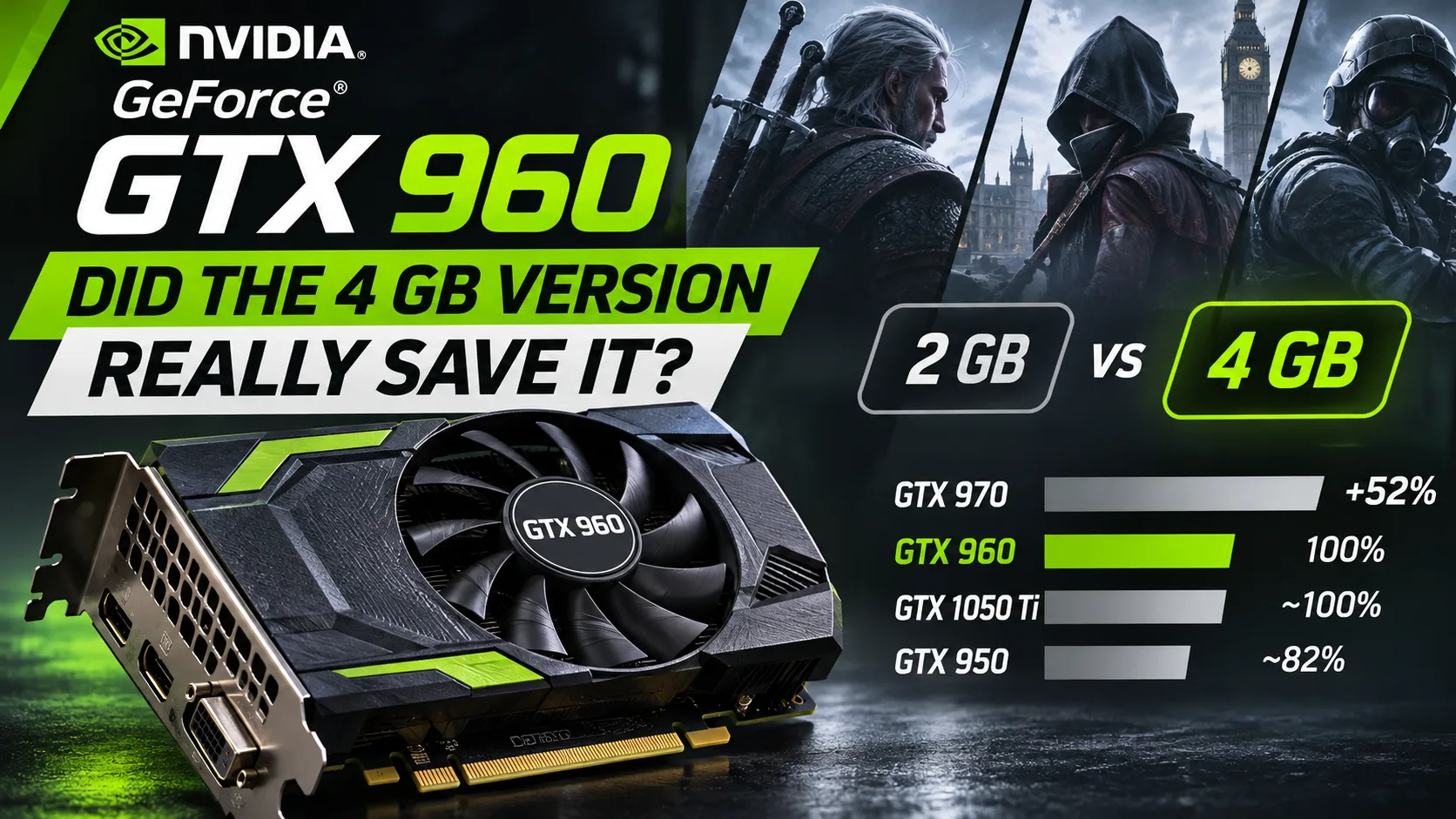
The NVIDIA GeForce GTX 960 was released on January 22, 2015, for $199 and was intended for 1080p gaming. The Maxwell-based graphics card featured 1024 CUDA cores, a 120 W power rating, and 2 GB of GDDR5 memory. 4 GB versions appeared later, but the additional memory helped only in certain games and had almost no effect on FPS at moderate settings.
The extra memory did not compensate for the limitations of GM206: the GTX 960 still fell well behind the GTX 970 and performed roughly on par with the more efficient GTX 1050 Ti.
Position in the Lineup
| Graphics card | CUDA cores | Memory | Bus | Power |
|---|---|---|---|---|
| GTX 950 | 768 | 2 GB GDDR5 | 128-bit | 90 W |
| GTX 960 | 1024 | 2/4 GB GDDR5 | 128-bit | 120 W |
| GTX 1050 Ti | 768 | 4 GB GDDR5 | 128-bit | 75 W |
| GTX 970 | 1664 | 4 GB GDDR5 | 256-bit | 145 W |
The GTX 960 has one-third more CUDA cores than the GTX 950. However, the GTX 970 had 62% more CUDA cores and significantly higher memory bandwidth.
The GTX 1050 Ti, introduced in October 2016, used the Pascal architecture and consumed 45 W less while offering similar gaming performance.
Maxwell Architecture and Specifications
The GTX 960 is built around the GM206 chip, manufactured by TSMC on a 28 nm process. It contains 1024 CUDA cores, 64 texture units, and 32 raster operation units.
Key specifications:
- GPU clock: 1127 MHz, Boost up to 1178 MHz.
- Memory: 2 or 4 GB of GDDR5, 7 Gb/s.
- Memory bandwidth: 112 GB/s.
- Interface: PCIe 3.0 x16.
- Graphics card power: 120 W.
- Power connector: one 6-pin connector as standard.
- Recommended power supply: 400 W.
The card supports DirectX 12 with feature level 12_1, HDMI 2.0, and hardware H.265/HEVC decoding. It does not support hardware ray tracing or DLSS.
Partner models from MSI, ASUS, Gigabyte, and EVGA featured factory overclocks and enhanced cooling. Operating frequencies and additional power requirements could differ from the reference specifications.
GTX 960 2 GB vs. 4 GB: How Much Did the Extra Memory Help?
Both versions use the same GM206 GPU, 128-bit bus, and 112 GB/s of memory bandwidth. At identical clock speeds, the cards differ only in memory capacity.
In January 2016, TechSpot compared the 2 GB and 4 GB GTX 960 in 11 games, setting identical GPU and memory clock speeds.
| Game, 1080p | GTX 960 2 GB and 4 GB result |
|---|---|
| Rainbow Six Siege, Ultra | 4 GB: 59 FPS, 16% faster than the 2 GB version |
| Assassin's Creed Syndicate, High | Both versions: 56 FPS |
| Assassin's Creed Syndicate, Ultra High | The 4 GB version was 29% faster, but both versions were below 30 FPS |
TechSpot, January 2016. Graphics cards tested at identical clock speeds.
In Rainbow Six Siege, the 4 GB version was 16% faster. In Assassin's Creed Syndicate, an advantage appeared at the highest settings, but both cards produced less than 30 FPS. After switching to High, the results were identical.
The additional memory helped in certain games with high VRAM requirements. When settings were lowered, the advantage usually disappeared. If a game was limited by GM206’s performance, the extra 2 GB did not help.
Benchmarks: GTX 960 vs. GTX 950, GTX 970, and GTX 1050 Ti
In 3DMark Fire Strike Graphics, the GTX 960 scores slightly higher than the GTX 1050 Ti but falls substantially behind the GTX 970.
| Graphics card | 3DMark Fire Strike Graphics |
|---|---|
| GeForce GTX 950 2 GB | 6208 |
| GeForce GTX 960 2/4 GB | 7916 |
| GeForce GTX 1050 Ti 4 GB | 7491 |
| GeForce GTX 970 4 GB | 11802 |
Average values from available 3DMark Fire Strike Standard Graphics results on Notebookcheck. For the GTX 960, the average was calculated from two measurements, including the MSI GTX 960 Gaming 4G. The tests were conducted on different systems, so the results also depend on clock speeds and system configurations.
For the gaming comparison, Geektopia measurements from February 2017 were used. All cards were tested on the same system with an Intel Core i7-6700K, 16 GB of DDR4-3000, and the GeForce 378.66 driver.
| Graphics card | Rise of the Tomb Raider, 1080p | The Witcher 3, 1080p |
|---|---|---|
| GeForce GTX 950 2 GB | 40.6 FPS | 28 FPS |
| GeForce GTX 960 2 GB | 49.6 FPS | 34 FPS |
| GeForce GTX 1050 Ti 4 GB | 48.8 FPS | 34 FPS |
| GeForce GTX 970 4 GB | 75.5 FPS | 52 FPS |
Rise of the Tomb Raider: DX11, maximum settings without PureHair and HBAO+. The Witcher 3: Ultra without HairWorks. Game versions from 2017.
The GTX 960 is virtually equal to the GTX 1050 Ti: the difference in Rise of the Tomb Raider is less than 1 FPS, while the results in The Witcher 3 are identical. At the same time, the GTX 1050 Ti’s rated power is 75 W, compared with 120 W for the GTX 960.
The GTX 970 is approximately 52-53% faster in both games.
What Limits the GTX 960 in 2026
The GTX 960 is still suitable for many games from the mid-2010s, including the original PC version of GTA V, Skyrim, and the 2013 version of Tomb Raider. Three main limitations become apparent in newer, demanding games:
- Video memory. When 2 GB of VRAM is insufficient, the game has to access system memory more often, which can cause stuttering and FPS drops.
- GPU performance. GM206 does not always deliver an acceptable FPS even when settings are reduced. The graphics card does not support DLSS.
- Drivers. Since October 2025, NVIDIA has discontinued Game Ready support for the Maxwell architecture.
Security updates are still being released. NVIDIA plans to support Maxwell through October 2028. For example, on September 30, 2026, the company released security driver 582.78, compatible with the GTX 960.
Is the GTX 960 Still Worth Using Today?
If the GTX 960 is already installed in a computer, its capabilities may be sufficient for older games. Between the two versions, if the price and condition are the same, it is better to choose the 4 GB model, especially for games with higher video memory requirements.
The GTX 960 is not suitable for purchase for modern games. The GTX 1050 Ti offers similar performance with lower power consumption, while the GTX 970 is noticeably faster in games from its generation.
The GTX 960 was limited not only by its 2 GB of memory but also by GM206’s performance. The extra 2 GB helped in certain games, but did not turn the graphics card into a full-fledged alternative to the GTX 970. Today, it makes more sense to keep it for older games or a backup computer than to use it as the foundation of a new gaming system.
GPU Comparison
Compare GeForce GTX 960 with other GPUs
Basic
Memory Specifications
Display and Media
1x HDMI 2.0
3x DisplayPort 1.4a
Theoretical Performance
Miscellaneous
Benchmarks
Compared to Other GPU
Related GPU Comparisons



Share in social media
Or Link To Us
<a href="https://cputronic.com/index.php/gpu/nvidia-geforce-gtx-960" target="_blank">NVIDIA GeForce GTX 960</a>