Qualcomm Snapdragon 7s Gen 3

Qualcomm Snapdragon 7s Gen 3: Why €329 and €599 Smartphones Are Nearly Equal in Benchmarks
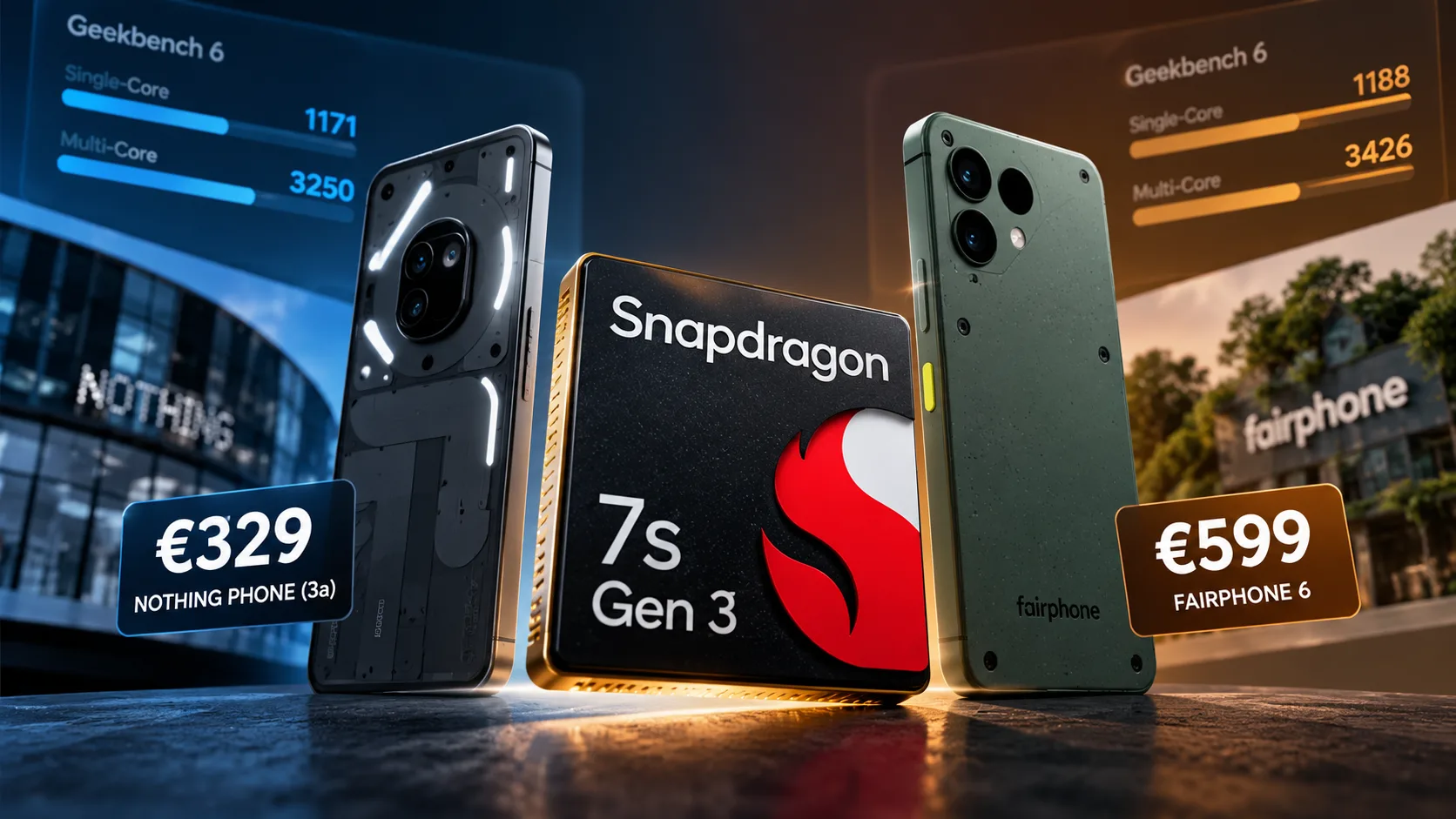
Qualcomm Snapdragon 7s Gen 3 powers both the €329 Nothing Phone (3a) and the €599 Fairphone 6. Despite the €270 difference in launch prices, the latter is less than 2% faster in the single-core test and about 5% faster in the multi-core test in Geekbench 6. Buyers are paying extra not for the processor, but for the smartphone’s features. The Snapdragon 7s Gen 3 itself is noticeably faster than its predecessor thanks to its new Cortex-A720 cores, although its graphics performance falls behind that of the older Snapdragon 7 Gen 3.
Introduced in August 2024, the chip is manufactured by TSMC using a 4 nm process. It features eight CPU cores, Adreno 810 graphics, and support for LPDDR5 memory and 5G networks.
CPU: What the New Cortex-A720 Cores Bring
The Snapdragon 7s Gen 3 uses one Cortex-A720 core clocked at 2.5 GHz, three Cortex-A720 cores at 2.4 GHz, and four power-efficient Cortex-A520 cores at 1.8 GHz.
The previous Snapdragon 7s Gen 2 used Cortex-A78 and Cortex-A55 cores. The move to the newer architecture delivered a substantial performance increase without a significant rise in clock speeds.
In Geekbench 6, the average result across the five smartphones in the table below is about 1173 points in the single-core test and 3289 points in the multi-core test. Compared with the Snapdragon 7s Gen 2, the advantage in aggregate results reaches approximately 14% and 26%, respectively.
In CPU performance, the Snapdragon 7s Gen 3 has approached the Snapdragon 7 Gen 3. However, the similarity in compute benchmarks does not extend to graphics performance.
Adreno 810: Faster Than Its Predecessor, Weaker Than the Snapdragon 7 Gen 3
The Adreno 810 GPU substantially outperforms the Adreno 710 in the Snapdragon 7s Gen 2. In 3DMark Steel Nomad Light, the difference is 49%.
| Processor | 3DMark Steel Nomad Light |
|---|---|
| Snapdragon 7s Gen 2 | 254 |
| Snapdragon 7s Gen 3 | 379 |
| Snapdragon 7 Gen 3 | 490 |
At the same time, the Snapdragon 7 Gen 3 is 29% ahead of the 7s Gen 3. For gaming, this GPU advantage is more important than the small difference in CPU performance.
The Snapdragon 7s Gen 3 can run PUBG Mobile and Call of Duty: Mobile, but in the more demanding Genshin Impact and Honkai: Star Rail, graphics settings have to be lowered to maintain a stable frame rate. Sustained workloads further reveal differences between the smartphones’ cooling systems.
Snapdragon 7s Gen 3 Benchmarks in Five Smartphones
| Smartphone | Geekbench 6 Single / Multi | 3DMark Steel Nomad Light | Starting price |
|---|---|---|---|
| Nothing Phone (3a) | 1171 / 3250 | 379 | €329 |
| Nothing Phone (3a) Pro | 1179 / 3298 | 380 | €459 |
| Redmi Note 14 Pro+ 5G (Global) | 1162 / 3239 | 362 | €500 |
| Realme 14 Pro+ | 1167 / 3232 | 370 | €530 |
| Fairphone 6 | 1188 / 3426 | 413 | €599 |
Prices are European launch-price reference points, including an early offer for the Redmi, rather than current store prices. The benchmark results apply to specific smartphone configurations.
In Geekbench 6, the difference between the fastest and slowest devices is 2.2% in the single-core test and 6% in the multi-core test. The Fairphone 6 delivers the best CPU result despite having 8 GB of RAM.
The spread is larger in Steel Nomad Light: from 362 points for the Redmi Note 14 Pro+ to 413 for the Fairphone 6, or 14%. Differences in cooling, power settings, and firmware affect the results but do not change the class of graphics performance.
In AnTuTu 10, the Snapdragon 7s Gen 3 usually scores around 750,000-830,000 points. In AnTuTu 11, the score is approximately 1.04 million. These test versions use different assessment methods, so their results cannot be compared directly.
What Buyers Pay More For
At €329, the Nothing Phone (3a) offers one of the most affordable ways to get Snapdragon 7s Gen 3 performance. The €459 Nothing Phone (3a) Pro adds a periscope camera with 3x optical zoom, but processor performance is practically unchanged.
The Redmi Note 14 Pro+ stands out with its 200 MP main camera and fast charging. The Realme 14 Pro+ comes with a periscope telephoto lens, while some regional versions feature a 6000 mAh battery.
The €599 Fairphone 6 is aimed at a different audience. Its main advantages are a repairable design, replaceable components, a five-year warranty, and promised software support at least through 2033.
Thus, the Fairphone 6’s high price is primarily tied to its service life and repairability, rather than superiority over the Nothing Phone (3a) in compute workloads.
Snapdragon 7s Gen 3 vs. 7s Gen 4
In 2025, Qualcomm released the Snapdragon 7s Gen 4. It retained the 4 nm process and a similar core configuration, but increased the maximum CPU clock speed from 2.5 to 2.7 GHz.
Qualcomm claims a 7% increase in CPU and GPU performance. In Geekbench 6, the new chip is approximately 5-6% ahead of its predecessor in the single-core test, while multi-core results are close.
The difference in 3DMark Steel Nomad Light is also small: about 396 points for the Snapdragon 7s Gen 4 versus 379 for the 7s Gen 3.
Therefore, it makes more sense to choose between smartphones using these processors based on price, display, cameras, and battery life. The generational change itself does not deliver a significant performance increase.
Cameras, Memory, and Connectivity
The Snapdragon 7s Gen 3 supports LPDDR5 at up to 3200 MHz, LPDDR4X, and UFS 3.1 storage. The memory and storage speeds in a particular smartphone depend on the components selected by the manufacturer.
The Qualcomm Spectra triple ISP supports cameras with resolutions of up to 200 MP and 4K video recording at 30 frames per second. Photo quality, however, is determined not only by the processor but also by the sensor, optics, and image-processing algorithms.
Wireless connectivity includes 5G with download speeds of up to 2.9 Gbps, Wi-Fi 6E, and Bluetooth 5.4. Specific connectivity capabilities depend on how they are implemented in the device.
Conclusion
The Snapdragon 7s Gen 3 is noticeably faster than its predecessor, especially in graphics, but it does not match the Snapdragon 7 Gen 3 in games. The successor, the 7s Gen 4, also failed to deliver a major performance increase.
Therefore, in 2026, the processor’s name matters less than the smartphone’s price and features. Paying extra for cameras, repairability, or long-term software support may be justified. Paying for essentially the same speed is not.
SOC Comparison
Compare Snapdragon 7s Gen 3 with other SOCs
Basic
3x 2.4 GHz – Kryo Gold
4x 1.8 GHz – Kryo Silver
GPU Specifications
Connectivity
Memory Specifications
Miscellaneous
Benchmarks
Phones with Snapdragon 7s Gen 3








Tablets with Snapdragon 7s Gen 3

Comparison of Devices with Snapdragon 7s Gen 3
Compared to Other SoC
Related SoC Comparisons





Share in social media
Or Link To Us
<a href="https://cputronic.com/soc/qualcomm-snapdragon-7s-gen-3" target="_blank">Qualcomm Snapdragon 7s Gen 3</a>