Qualcomm Snapdragon 7s Gen 3
vs
HiSilicon Kirin 8000


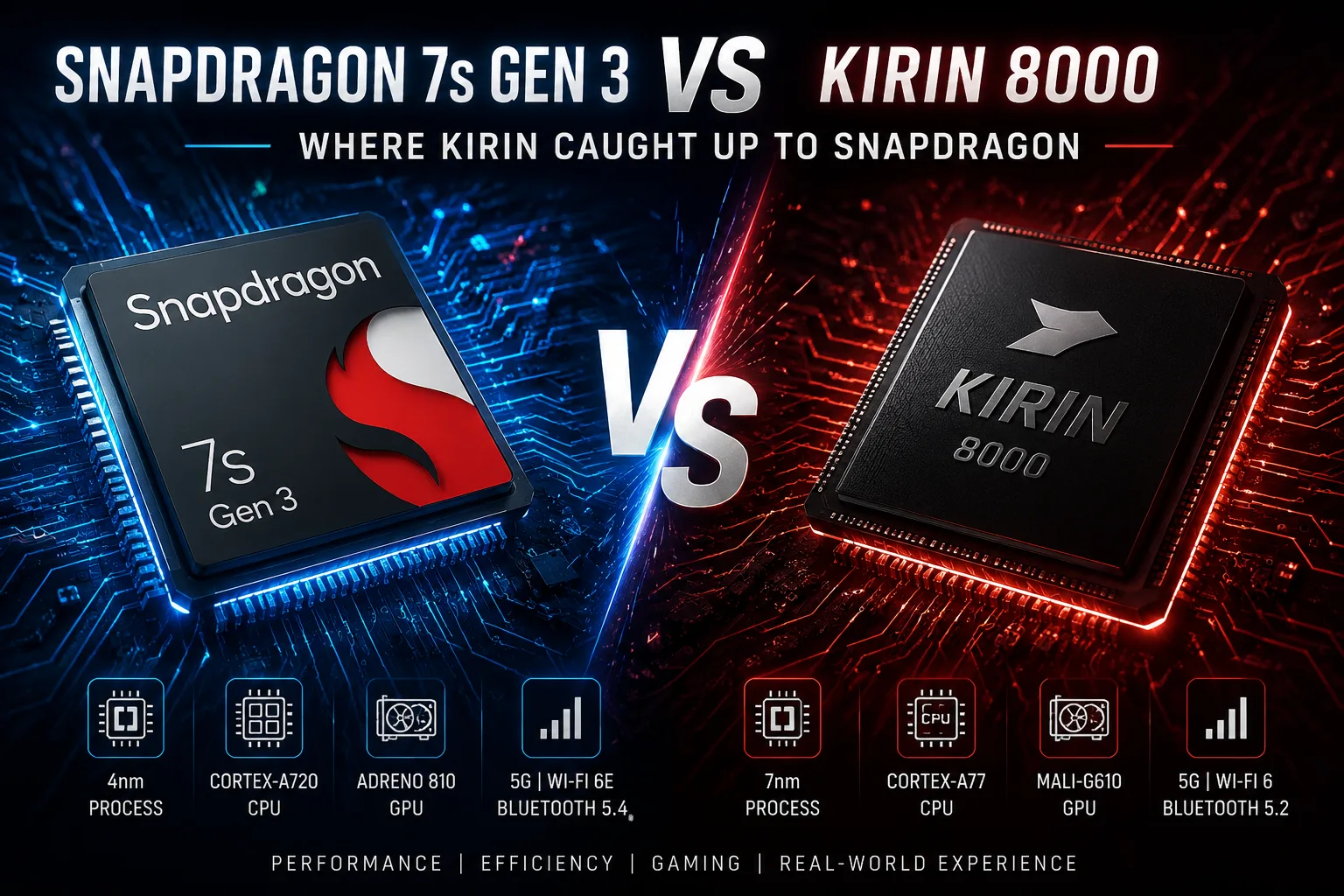
SoC Comparison Result
Snapdragon 7s Gen 3 vs Kirin 8000: Where Kirin Comes Close to Snapdragon
The Snapdragon 7s Gen 3 and Kirin 8000 are both mid-range chips, but they are built on different technical foundations. Qualcomm uses a 4nm process with Cortex-A720/A520 cores and Adreno 810 graphics, while Huawei uses a 7nm process with Cortex-A77/A55 cores and Mali-G610 graphics.
Benchmarks alone don’t tell the whole story. Snapdragon is faster in almost every scenario, but the Kirin 8000 no longer looks like a budget chip. The key question is where Huawei has managed to close the gap with the modern Snapdragon and where optimizations do not compensate for the older cores and 7nm manufacturing.
Specifications: Kirin Holds Up in Everyday Tasks but Lags in Architecture
| Parameter | Snapdragon 7s Gen 3 | Kirin 8000 |
|---|---|---|
| Process | 4nm | 7nm |
| CPU | 1× Cortex-A720 up to 2.5 GHz + 3× Cortex-A720 up to 2.4 GHz + 4× Cortex-A520 up to 1.8 GHz | 1× Cortex-A77 up to 2.4 GHz + 3× Cortex-A77 up to 2.19 GHz + 4× Cortex-A55 up to 1.84 GHz |
| Architecture | ARMv9.2-A | ARMv8.2-A |
| GPU | Adreno 810 | Mali-G610 |
| Memory | LPDDR5, up to 25.6 GB/s | LPDDR5, up to 51.2 GB/s |
| Connectivity | 5G, Wi-Fi 6E, Bluetooth 5.4 | 5G, Wi-Fi 6, Bluetooth 5.2 in typical devices |
The main difference is not in clock speeds, but in the generation of cores. The Snapdragon 7s Gen 3 uses Cortex-A720 and Cortex-A520, while the Kirin 8000 employs Cortex-A77 and Cortex-A55-an old but still viable combination.
In everyday tasks, the Kirin 8000 does not falter: the interface, browser, messengers, camera, and video do not require flagship power. However, Snapdragon performs better in peak tasks, manages multi-threaded loads more effectively, and is more energy-efficient.
Benchmarks: Kirin is Mid-Range but Lags Behind Snapdragon
In synthetic tests, the Snapdragon 7s Gen 3 consistently leads. The exact figures depend on the smartphone, cooling, and version of the test, but the overall trend remains unchanged: Qualcomm is faster in CPU, GPU, and overall performance.
| Test | Snapdragon 7s Gen 3 | Kirin 8000 | Difference |
|---|---|---|---|
| AnTuTu 11 | around 1,040,000 | around 830,000 | Snapdragon is about 25% faster |
| Geekbench 6 Single Core | around 1160 | around 960 | Snapdragon is about 20% faster |
| Geekbench 6 Multi Core | around 3300 | around 2550 | Snapdragon is about 30% faster |
| Geekbench GPU Compute | around 4460 | around 3030 | Snapdragon is about 45-50% faster |
| 3DMark Steel Nomad Light | around 380 | around 310 | Snapdragon is about 20% faster |
These numbers do not mean that a smartphone with the Kirin 8000 will noticeably lag. For basic tasks, it is sufficient for a normal mid-range user. However, in more demanding scenarios, the gap re-emerges: gaming, photo processing, video recording, and active multitasking quickly hit the limits of CPU and GPU.
The Kirin 8000 is significantly above budget SoCs but still falls short of the Snapdragon 7s Gen 3.
Graphics: Kirin Falls Behind More in Gaming
The most noticeable gap between the chips lies in graphics. The Adreno 810 in the Snapdragon 7s Gen 3 outperforms the Mali-G610 in the Kirin 8000 and handles heavy Android games better. While it is not a flagship GPU, Qualcomm has more headroom for mid-range performance.
In simpler games, the difference will be minimal. MOBA, arcade games, card games, and light 3D games run adequately on both chips. However, in demanding titles like Genshin Impact, Honkai: Star Rail, Wuthering Waves, and others, the Snapdragon is the better choice: higher GPU performance, more stable FPS, and less risk of overheating after several minutes of play.
The Kirin 8000 is suited for casual gaming but lags behind the Snapdragon 7s Gen 3 in gaming capabilities.
Energy Efficiency: 4nm Helps Snapdragon Maintain Frequencies
The manufacturing process does not solve everything, but for a mobile chip, it directly impacts heat, battery life, and frequency stability. The Snapdragon 7s Gen 3 is built on a 4nm process, while the Kirin 8000 is on a 7nm process.
Under short loads, the difference is not always noticeable. Under prolonged stress, the Snapdragon has the edge: it sustains frequencies longer and approaches thermal limits more slowly. The Kirin 8000 can be tuned carefully, but its older cores and 7nm process restrict it more.
Strength of Kirin 8000 - Memory
The Kirin 8000 has an advantage that is not always apparent in overall specifications: memory bandwidth. Its open specifications often cite LPDDR5 up to 51.2 GB/s, while the Snapdragon 7s Gen 3 is usually reported at up to 25.6 GB/s.
This partly explains why the Kirin 8000 does not lag in system scenarios. Fast memory aids the interface, camera, data loading, and multimedia tasks. Thus, in everyday usage, the chip performs better than expected from Cortex-A77/A55.
However, this is a localized advantage. It does not compensate for the shortcomings of the CPU and GPU and does not change the overall balance: the Kirin is stronger in everyday scenarios than in heavy tests.
Connectivity and Ecosystem: Snapdragon is Easier for the Global Market
The Snapdragon 7s Gen 3 is more suitable for international smartphones: there are more models across different markets, familiar Android with Google services, and predictable support for games, networks, and applications. Additionally, Qualcomm has a stronger set of wireless capabilities: Wi-Fi 6E, Bluetooth 5.4, and modern 5G modems.
The Kirin 8000 is more closely tied to Huawei. In China, this does not create problems for users, but outside the Chinese market, chip speed is not the only consideration. Services, applications, updates, and compatibility become part of the comparison. Therefore, the Snapdragon 7s Gen 3 remains a more versatile platform.
Conclusion: Kirin Caught Up with Snapdragon Only in Everyday Tasks
The Kirin 8000 has come close to the Snapdragon 7s Gen 3 in everyday performance. The interface, camera, browser, connectivity, and basic applications do not feel budget. This is a fully-fledged mid-range option, not an entry-level one.
In terms of hardware, the Kirin still noticeably lags behind. The Snapdragon 7s Gen 3 is faster in CPU, stronger in graphics, handles prolonged workloads better, and is more suitable for the global market. The gap is particularly evident in gaming and tasks where the smartphone operates at high power for extended periods.
The conclusion is simple: Huawei has created a working chip for a standard smartphone, but Qualcomm still retains the advantage in CPU, graphics, energy efficiency, and global support.
Advantages
- Higher Technology: 4 nm (4 nm vs 7 nm)
- Higher Frequency: 2500 MHz (2500 MHz vs 2400 MHz)
- Newer Launch Date: October 2024 (August 2024 vs October 2024)
Basic
3x 2.4 GHz – Kryo Gold
4x 1.8 GHz – Kryo Silver
3x 2.19 GHz – 1xA77 L
4x 1.84 GHz – A55
GPU Specifications
Connectivity
Memory Specifications
Miscellaneous
- AIFF
- CAF
- MP3
- MP4
- WAV
- H.265
- VP9
Benchmarks
Comparison of Devices
Related SoC Comparisons





Share in social media
Or Link To Us
<a href="https://cputronic.com/soc/compare/qualcomm-snapdragon-7s-gen-3-vs-hisilicon-kirin-8000" target="_blank">Qualcomm Snapdragon 7s Gen 3 vs HiSilicon Kirin 8000</a>