Intel Graphics 48EU (Arrow Lake)

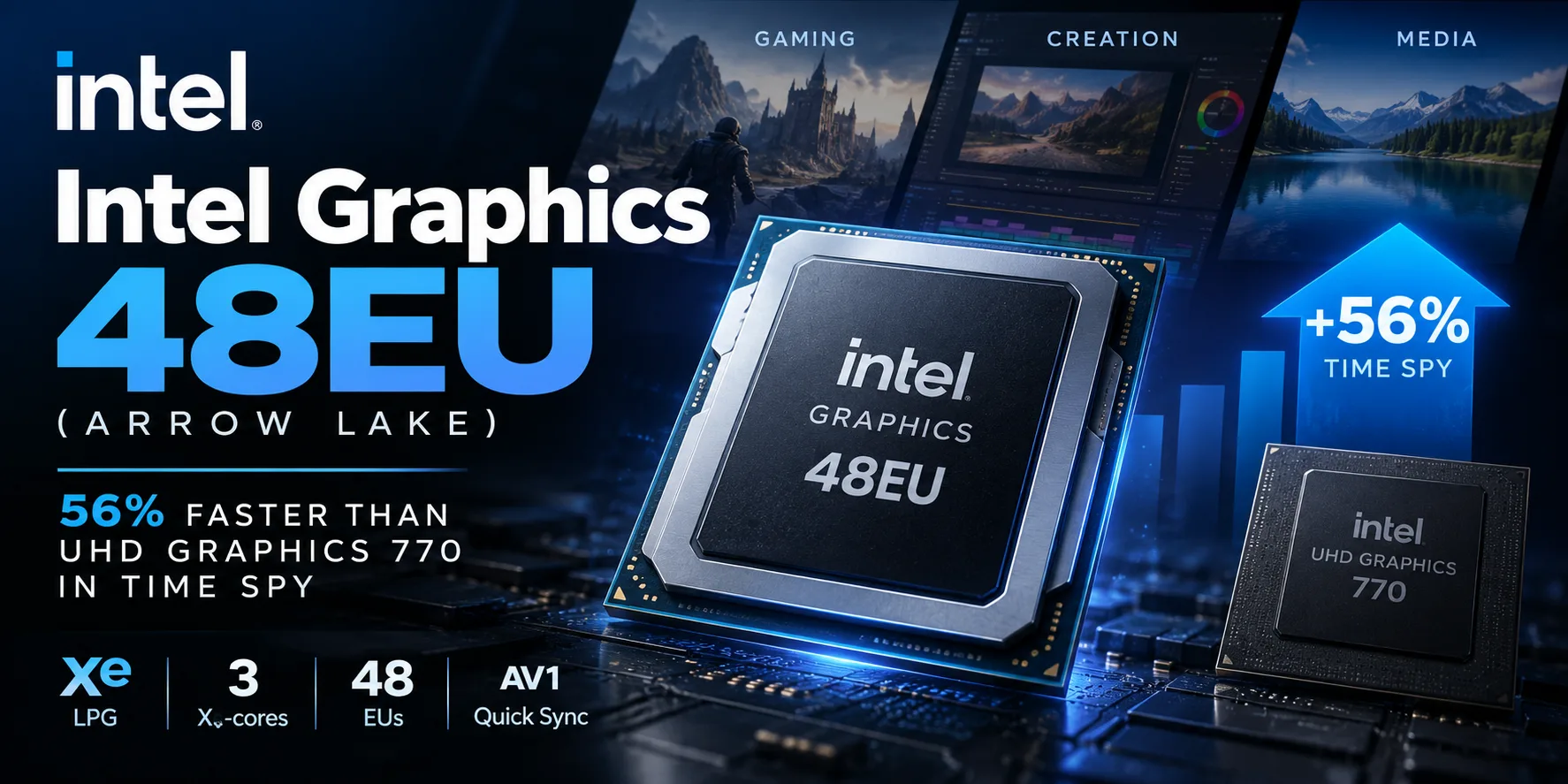
Intel Graphics 48EU (Arrow Lake): 56% Faster Than UHD Graphics 770 in Time Spy
Intel Graphics 48EU is the integrated Arrow Lake GPU with 3 Xe cores based on the Xe-LPG architecture. It is found in desktop Core Ultra 200S and mobile Core Ultra 200HX processors, with a maximum clock speed of 2.0 GHz. In Time Spy Graphics, the Core Ultra 5 235 outperforms the UHD Graphics 770 by 55.7%, but 48 EU are still primarily intended for multimedia and light graphics workloads.
GPU Configuration
The higher-end integrated graphics configuration in Arrow Lake contains 4 Xe cores, whereas the 48EU version is limited to three.
Theoretical FP32 performance is approximately 1.54 TFLOPS at 2.0 GHz and 1.38 TFLOPS at 1.8 GHz.
There is no dedicated video memory. The GPU uses system DDR5, so its performance depends on system memory bandwidth.
Which Processors Use Intel Graphics 48EU
| Processor | Segment | Xe cores | Max. GPU clock |
|---|---|---|---|
| Intel Core Ultra 5 235 | Desktop | 3 | 2.0 GHz |
| Intel Core Ultra 5 235T | Desktop, 35 W | 3 | 2.0 GHz |
| Intel Core Ultra 5 235HX | Mobile HX | 3 | 1.8 GHz |
| Intel Core Ultra 5 245HX | Mobile HX | 3 | 1.9 GHz |
The Intel Graphics name covers different configurations, so the number of Xe cores needs to be checked separately for each processor.
Benchmarks
There are still relatively few tests of 48EU. HX processors usually operate alongside discrete GeForce RTX GPUs, so their integrated graphics are rarely tested separately.
| Device or processor | Configuration | Test | Result |
|---|---|---|---|
| Desktop with Core Ultra 5 235 | Intel Graphics 48EU, up to 2.0 GHz | 3DMark Steel Nomad | 333 |
| Dell Pro Micro | Core Ultra 5 235T, Intel Graphics 48EU | 3DMark Steel Nomad | 292 |
| Minisforum MS-02 Ultra | Core Ultra 5 235HX, Intel Graphics 48EU, 1.8 GHz | Geekbench 6 OpenCL | 13,785 |
The Core Ultra 5 235 scored 333 points in Steel Nomad, while the Dell Pro Micro with the Core Ultra 5 235T scored 292 points.
In the Minisforum MS-02 Ultra with the Core Ultra 5 235HX, Geekbench reports 48 compute units and a clock speed of up to 1.8 GHz. Its OpenCL result was 13,785 points.
In PC-Koubou tests, the Core Ultra 5 235 was directly compared with the Core i9-14900 and its UHD Graphics 770. The new graphics achieved a 55.7% higher Graphics Score in 3DMark Time Spy and a 42.9% higher result in Fire Strike.
Even with this performance gain, 48EU remains an entry-level GPU and is not intended to compete with modern discrete graphics cards.
Xe-LPG Instead of the Older UHD Architecture
Xe-LPG introduced RT units and a more modern graphics architecture, while the hardware media engine retained support for current video codecs.
Intel Graphics supports hardware encoding and decoding for H.264, H.265, and AV1, as well as Intel Quick Sync Video. Hardware processing reduces the CPU load during video playback and transcoding.
Support is also provided for up to four displays, DisplayPort 2.1, and HDMI 2.1. The physical selection of connectors depends on the specific motherboard, mini PC, or laptop.
Gaming Performance
Results of 292-333 points in Steel Nomad indicate modest 3D performance. Modern demanding games at 1080p, especially at high settings, are too demanding for this iGPU.
In less demanding games, performance depends heavily on the DDR5 configuration because the GPU has no dedicated video memory.
In laptops with HX processors, this iGPU is rarely used for gaming. The Core Ultra 5 235HX and 245HX are usually installed alongside a discrete graphics card, while the integrated Intel Graphics handles the desktop, video, and light graphics workloads.
Conclusion
Intel Graphics 48EU is noticeably faster than the UHD Graphics 770: in a system with the Core Ultra 5 235, its advantage reaches 55.7% in Time Spy Graphics and 42.9% in Fire Strike Graphics. However, Steel Nomad results of 292-333 points keep this iGPU in the entry-level class.
Its primary tasks are display output, hardware video processing, and light graphics workloads. 48EU is no longer sufficient for modern demanding games.
GPU Comparison
Compare Graphics 48EU (Arrow Lake) with other GPUs
Basic
Memory Specifications
Display and Media
Theoretical Performance
AI Features
Miscellaneous
Benchmarks
Compared to Other GPU
Share in social media
Or Link To Us
<a href="https://cputronic.com/en/gpu/intel-graphics-48eu-arrow-lake" target="_blank">Intel Graphics 48EU (Arrow Lake)</a>