Samsung Exynos 1380

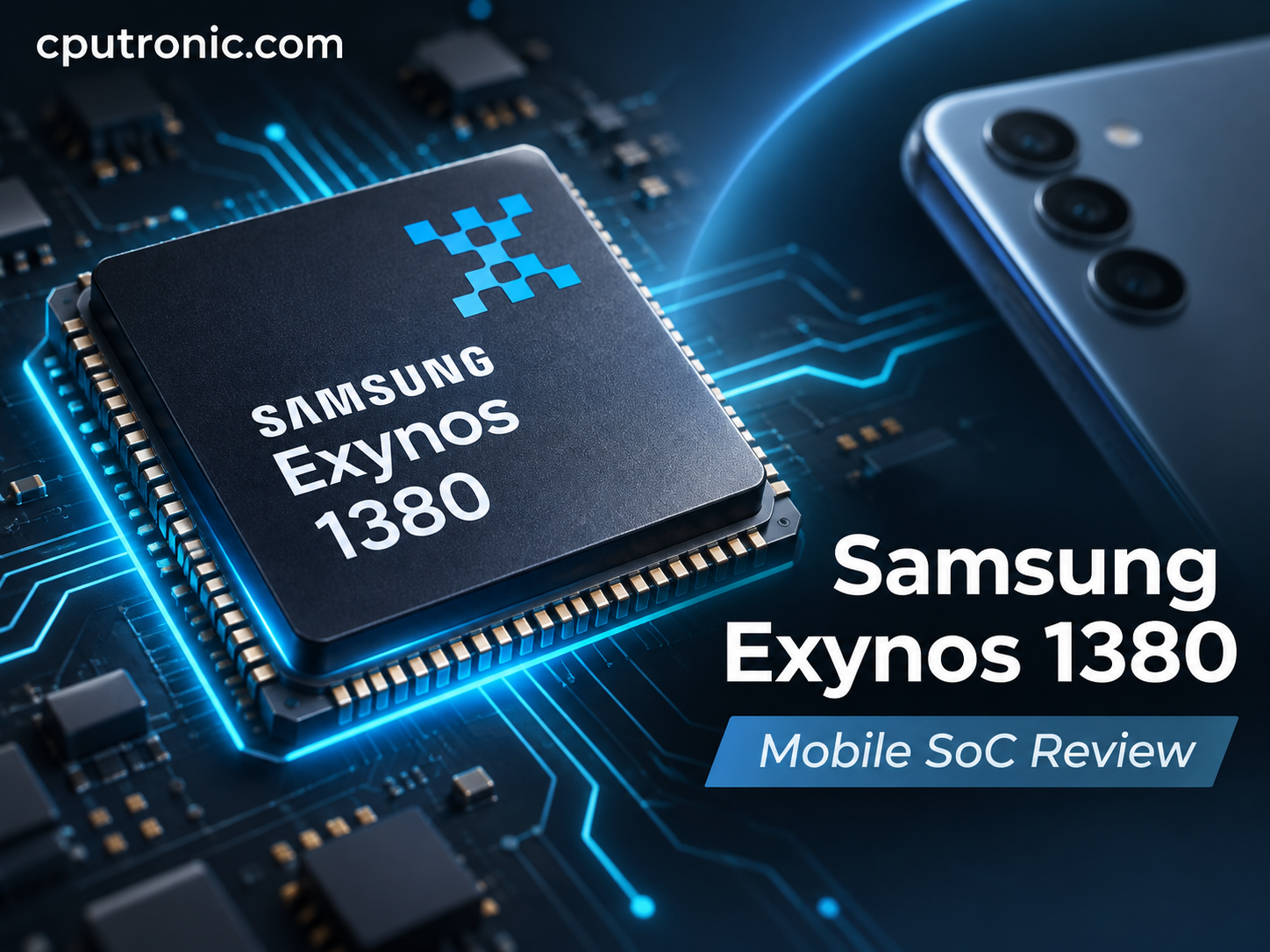
Samsung Exynos 1380: Performance and Relevance in 2026
The Samsung Exynos 1380 is a mid-range mobile octa-core processor introduced in February 2023. Compared with its predecessor, the Exynos 1280, it features more performance cores, improved graphics, and support for faster memory.
The first mass-market smartphone based on this platform was the Samsung Galaxy A54 5G. The processor later appeared in the Galaxy A35, Galaxy A26, and several Samsung tablets. Devices powered by the Exynos 1380 continued to be released in 2025.
Key Specifications
| Parameter | Samsung Exynos 1380 |
|---|---|
| Process technology | Samsung 5 nm EUV |
| Performance cores | 4 × Cortex-A78, 2.4 GHz |
| Efficiency cores | 4 × Cortex-A55, 2.0 GHz |
| GPU | Mali-G68 MP5, 950 MHz |
| RAM | LPDDR4X, LPDDR5 |
| Storage | Up to UFS 3.1 |
| NPU | Up to 4.9 TOPS |
| Modem | 5G Sub-6 GHz and mmWave |
CPU Architecture and Performance
The main difference between the Exynos 1380 and Exynos 1280 is the increase in the number of Cortex-A78 cores from two to four. The maximum frequency of the performance cores remains unchanged, so the most noticeable gains appear in multithreaded tasks.
In Geekbench 6.7, the Samsung Galaxy A26 5G scores 1008 points in the single-core test and 2857 points in the multi-core test. The Galaxy A25 5G, powered by the Exynos 1280, scores 976 and 2152 points, respectively.
The difference is about 3% in the single-core test and 33% in the multi-core test, demonstrating the advantage of the four-core Cortex-A78 configuration.
The Exynos 1380 delivers sufficient performance for web browsing, messaging, navigation, and working with documents. Its limitations become more noticeable when editing video and running resource-intensive applications.
Performance Comparison in AnTuTu 10
| Device | Processor | AnTuTu 10 |
|---|---|---|
| Nothing Phone (3a) | Snapdragon 7s Gen 3 | 795,329 |
| Samsung Galaxy A55 5G | Exynos 1480 | 740,935 |
| Nothing Phone (2a) | Dimensity 7200 Pro | 693,939 |
| Samsung Galaxy A35 5G | Exynos 1380 | 602,612 |
| Samsung Galaxy Tab S10 Lite | Exynos 1380 | 588,186 |
| Samsung Galaxy A26 5G | Exynos 1380 | 583,142 |
| Xiaomi Redmi Note 13 Pro 5G | Snapdragon 7s Gen 2 | 566,071 |
| Motorola Moto G84 | Snapdragon 695 | 461,567 |
The Galaxy A35 outperforms the Motorola Moto G84 by approximately 31% and the Redmi Note 13 Pro 5G by 6%. At the same time, the Galaxy A55 scores 23% more than the Galaxy A35, while the Nothing Phone (3a) scores 32% more.
The Exynos 1380 is comparable in performance to the Snapdragon 7s Gen 2, but falls noticeably behind the next generation of this platform.
AnTuTu results characterize the device as a whole and depend on its memory configuration, storage, cooling, and software.
Graphics and Gaming
The Mali-G68 MP5 operates at 950 MHz and contains one more graphics core than the Mali-G68 MP4 in the Exynos 1280.
Gaming test results for the Samsung Galaxy A35 5G, conducted in 2024:
| Game | Graphics settings | Average FPS |
|---|---|---|
| Genshin Impact 4.5 | Maximum | 39.7 |
| PUBG Mobile 3.1 | HD | 39.8 |
The Exynos 1380 can run demanding mobile games, but low or medium graphics settings are preferable for a more stable frame rate.
Performance may vary in newer versions of games. Stable 60 FPS in demanding games should not be expected.
Cameras, Multimedia, and Connectivity
The integrated image processor supports cameras with resolutions of up to 200 MP and 4K video recording at 30 FPS. The neural accelerator, with performance of up to 4.9 TOPS, is used for object recognition and image processing.
Samsung states that the platform supports Full HD+ displays with refresh rates of up to 144 Hz. It can also operate with higher resolutions: the Galaxy Tab S9 FE+ tablet features a 2560 × 1600 display.
The integrated modem provides theoretical download speeds of up to 3.79 Gb/s and data transmission speeds of up to 1.28 Gb/s on 5G networks.
The platform supports Wi-Fi 6 and Bluetooth 5.3, although the available connectivity standards depend on the specific device. For example, the Galaxy A35 supports Wi-Fi 6, while the Galaxy A26 is limited to Wi-Fi 5.
Heat and Performance Stability
In the 3DMark Wild Life stress test, the Galaxy A35 demonstrated 97.8% performance stability. After one hour of maximum load in the Burnout test, the surface temperature of the device reached 42.5 °C.
The drop in performance in the graphics stress test was minimal. Results for other devices powered by the Exynos 1380 may vary depending on cooling efficiency.
Devices Powered by the Exynos 1380
- 2023: Samsung Galaxy A54, M54, F54, Galaxy Tab S9 FE, and S9 FE+.
- 2024: Samsung Galaxy A35, M35, and Galaxy Tab Active5.
- 2025: Samsung Galaxy A26 and Galaxy Tab S10 Lite.
When choosing a device in 2026, consider its remaining software support period, battery condition, and amount of RAM. Configurations with 8 GB of RAM are preferable for long-term use.
Advantages and Disadvantages
Advantages:
- Good multithreaded performance compared with the Exynos 1280.
- Support for LPDDR5 and UFS 3.1.
- High graphics performance stability in the Galaxy A35.
- Integrated 5G modem.
Disadvantages:
- Limited performance in demanding games.
- Lower single-core performance than newer mid-range platforms.
Conclusion
In 2026, the Samsung Exynos 1380 remains a suitable platform for affordable smartphones and tablets.
Owners of the Galaxy A54 or Galaxy A35 who are satisfied with their device’s performance do not need to upgrade their smartphone solely because of the processor. When buying a new smartphone, Exynos 1380 models are worth considering if there is a significant price difference compared with more powerful alternatives.
In tablets such as the Galaxy Tab S10 Lite, this chip provides sufficient capabilities for watching videos, reading, studying, and working with documents.
SOC Comparison
Compare Exynos 1380 with other SOCs
Basic
4x 2 GHz – Cortex-A55
GPU Specifications
Connectivity
Memory Specifications
Miscellaneous
Benchmarks
Phones with Exynos 1380






Tablets with Exynos 1380


Comparison of Devices with Exynos 1380
Compared to Other SoC
Related SoC Comparisons


Share in social media
Or Link To Us
<a href="https://cputronic.com/soc/samsung-exynos-1380" target="_blank">Samsung Exynos 1380</a>