MediaTek Dimensity 6360
MediaTek Dimensity 6360: Almost the Same as Dimensity 6300 Under a New Index
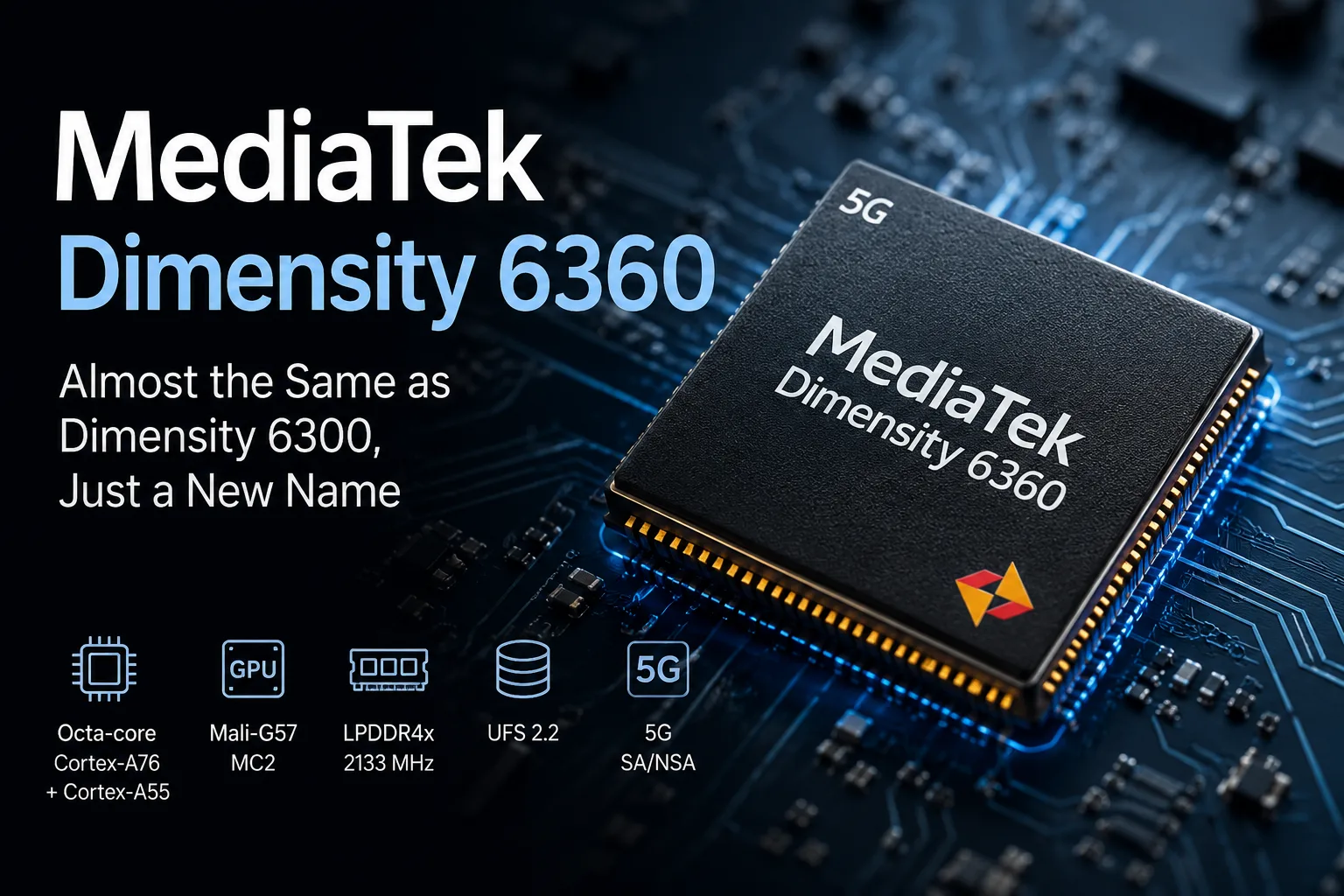
The MediaTek Dimensity 6360 appears to be a new model, but in terms of hardware, it almost duplicates the Dimensity 6300. It is not a new architecture or a notable upgrade; rather, it is a variant of the same basic 5G platform from MediaTek: Cortex-A76, Cortex-A55, Mali-G57 MC2, LPDDR4x, and UFS 2.2.
What is Dimensity 6360
The Dimensity 6360 is a MediaTek platform for affordable 5G smartphones. In terms of classification, it is positioned below the Dimensity 7300, 7400, and other newer mid-range SoCs. The chip does not feature new CPU cores, higher-class graphics, LPDDR5, or UFS 3.x.
This chip is designed for regular workloads rather than heavy gaming or prolonged high-power tasks. It is sufficient for the interface, browsing, messaging, video, navigation, and simple games. In more demanding scenarios, the limitations of the CPU and GPU will become apparent more quickly than with newer mid-range SoCs.
How Dimensity 6360 Differs from Dimensity 6300 and 6400
The main aspect of the Dimensity 6360 is its near-complete overlap with the Dimensity 6300. Both chips have the same CPU configuration: two Cortex-A76 cores up to 2.4 GHz and six Cortex-A55 cores up to 2.0 GHz. The graphics unit is also the same - Mali-G57 MC2. Memory is LPDDR4x, and storage is UFS 2.2.
| Parameter | Dimensity 6300 | Dimensity 6360 | Dimensity 6400 |
|---|---|---|---|
| CPU | 2 × Cortex-A76 + 6 × Cortex-A55 | 2 × Cortex-A76 + 6 × Cortex-A55 | 2 × Cortex-A76 + 6 × Cortex-A55 |
| Performance Core Frequency | up to 2.4 GHz | up to 2.4 GHz | up to 2.5 GHz |
| GPU | Mali-G57 MC2 | Mali-G57 MC2 | Mali-G57 MC2 |
| Memory | LPDDR4x 2133 MHz | LPDDR4x 2133 MHz | LPDDR4x 2133 MHz |
| Storage | UFS 2.2 | UFS 2.2 | UFS 2.2 |
| Screen | FHD+ up to 120 Hz | FHD+ up to 120 Hz | FHD+ up to 120 Hz |
| Camera | up to 108 MP | up to 108 MP | up to 108 MP |
In key specifications, the Dimensity 6360 is not distinct enough to be considered a separate new platform. It matches the Dimensity 6300, while the Dimensity 6400 primarily differs through a slight increase in the performance core frequency.
For an affordable 5G smartphone, such a configuration is sufficient; however, one should not expect a significant boost compared to the Dimensity 6300. The index 6360 should not be the main argument for choosing a smartphone; factors such as price, display, battery, memory capacity, and update life cycle are more crucial.
Dimensity 6360 Max: What Does the Max Suffix Mean?
In OPPO smartphones, the name Dimensity 6360 Max can be found. It is used in devices like the OPPO F33 5G and OPPO A6s Pro. Based on open specifications, it is not a separate architecture or a significantly enhanced version of the Dimensity 6360.
Thus, the Max suffix is more accurately viewed as a marketing designation for specific smartphones rather than a standalone chip with a different configuration. It is advisable to clearly separate the official Dimensity 6360 from the name Dimensity 6360 Max that manufacturers use in their devices.
Performance: Close to Dimensity 6300
In terms of performance, the Dimensity 6360 is close to the Dimensity 6300. The two Cortex-A76 cores handle short-term peak loads: launching applications, opening web pages, processing the interface, and part of the gaming load. The six Cortex-A55 cores manage lighter loads and background processes.
The interface, browsing, messaging, video, and navigation do not require high CPU performance. There is limited headroom for heavy applications and games. Compared to newer mid-range SoCs, the Dimensity 6360 will be weaker in single-threaded speed, multi-threaded workload, and energy efficiency under load.
Public benchmark results for the Dimensity 6360 are still sparse; therefore, benchmarks should be viewed as a guideline. In terms of classification, it aligns with the Dimensity 6300, not a new performance tier.
Graphics: Mali-G57 MC2 Remains the Main Limitation
The Mali-G57 MC2 is the basic graphics unit for smartphones in this class. It is well-suited for interfaces, video, simple games, and less demanding 3D scenes but does not position the Dimensity 6360 as a gaming chip.
For less demanding games, smartphones with the Dimensity 6360 can function without serious issues. In heavier titles, medium or low settings, reduced rendering resolution, and disabling some effects will be necessary. The GPU remains the primary limitation.
HyperEngine does not change the GPU class. These features help manage resources, network, and power consumption, but do not elevate the Mali-G57 MC2 to the level of more expensive SoCs.
Display, Cameras, and Connectivity
The Dimensity 6360 supports displays with resolutions up to 2520 × 1080 and refresh rates up to 120 Hz. The 120 Hz refresh rate enhances scrolling and animations, but does not compensate for the limitations of the CPU and GPU.
Camera support is specified for sensors up to 108 MP or 16 + 16 MP configurations. However, photo quality depends on more than just the SoC. Key factors include the sensor, optics, stabilization, processing algorithms, and firmware of the specific smartphone.
In terms of connectivity, the features are typical for affordable 5G smartphones: it supports 5G SA/NSA, 5G carrier aggregation, and boasts a theoretical download speed of up to 3.3 Gbps. Wi-Fi is limited to the Wi-Fi 5 standard. This is sufficient for budget models, but lacks Wi-Fi 6, 6E, or 7.
In Which Smartphones is Dimensity 6360 Found
The Dimensity 6360 has already appeared in OPPO smartphones under the name Dimensity 6360 Max. Among the first models are the OPPO A6s Pro and OPPO F33 5G.
These models demonstrate where MediaTek and manufacturers position the Dimensity 6360. It is not used for maximum performance but for smartphones with larger batteries, 120 Hz displays, 5G support, and moderate pricing.
Should You Choose a Smartphone with Dimensity 6360?
A smartphone with the Dimensity 6360 makes sense if 5G, battery life, 120 Hz display, and price are important. However, it is not worth paying extra just for the 6360 index. If a similar model with the Dimensity 6300 is available nearby, featuring the same memory capacity, good display, and lower price, the speed difference will not be significant.
It is better to choose based on the display, battery, camera, memory, build quality, and update duration. The Dimensity 6360 does not provide a substantial advantage over the Dimensity 6300.
Conclusion
The MediaTek Dimensity 6360 is a 5G platform on par with the Dimensity 6300. The new index does not imply a notable upgrade: CPU, GPU, memory, and storage remain at the same level.
In smartphones with larger batteries, 120 Hz displays, and moderate pricing, such a SoC is reasonable. If a tangible performance improvement is needed, especially in gaming, it is advisable to look at the Dimensity 7300, 7400, and newer mid-range SoCs.
SOC Comparison
Compare Dimensity 6360 with other SOCs
Basic
GPU Specifications
Connectivity
Memory Specifications
Miscellaneous
Benchmarks
Compared to Other SoC
Related SoC Comparisons


Share in social media
Or Link To Us
<a href="https://cputronic.com/soc/mediatek-dimensity-6360" target="_blank">MediaTek Dimensity 6360</a>