Qualcomm Snapdragon 450

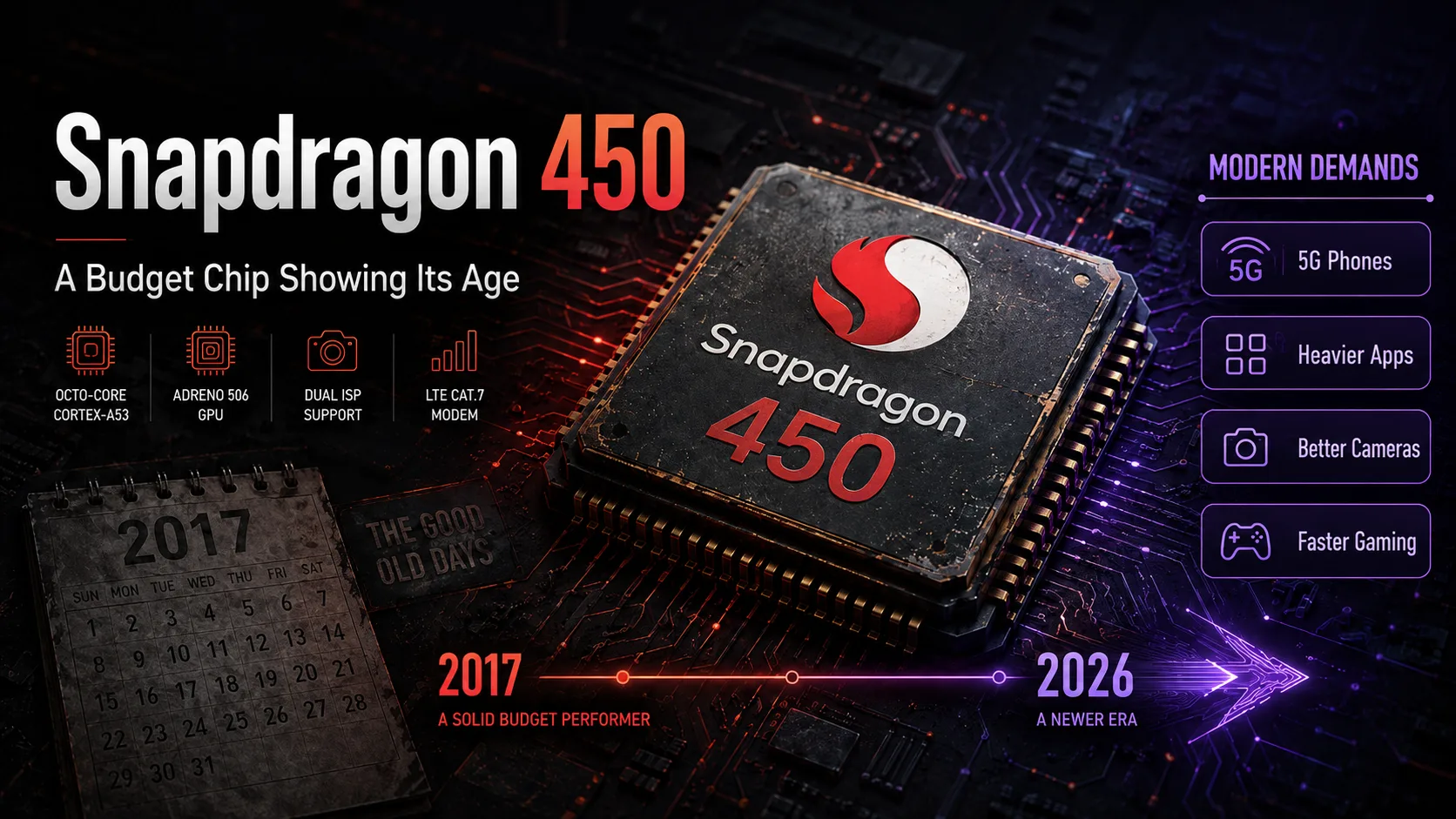
Qualcomm Snapdragon 450: A Successful Budget Chip That Needs to Retire
The Qualcomm Snapdragon 450 was released in 2017 and represented a significant upgrade for the budget 400 series. For the first time in this lineup, Qualcomm switched to a 14nm manufacturing process, raised the clock speed of eight Cortex-A53 cores to 1.8 GHz, and installed the Adreno 506 GPU. For affordable smartphones at the end of the 2010s, this was a strong combination, but today, the age of the platform is impossible to hide.
How Snapdragon 450 Stood Out at Its Time
The predecessor, Snapdragon 435, was manufactured using a 28nm process and utilized eight Cortex-A53 cores with a clock speed of up to 1.4 GHz. The Snapdragon 450 retained the same basic CPU architecture but received a clock speed boost to 1.8 GHz and a much more modern manufacturing process for its class.
Qualcomm claimed CPU and graphical performance boosts of up to 25% compared to the Snapdragon 435. The Adreno 506, which was familiar from the Snapdragon 625, made the GPU capabilities for the budget segment look particularly good.
The platform also featured the Snapdragon X9 LTE modem with download speeds of up to 300 Mbps, support for Quick Charge 3.0, and eMMC 5.1.
The main limitation even back then remained the Cortex-A53 cores themselves. All eight cores were identical, with no separate performance cluster. This design worked well for its time, but the increasing complexity of applications quickly exposed the limits of this architecture.
Snapdragon 450 Performance in Smartphones
The Snapdragon 450 has enough results from smartphones by Samsung, Motorola, Huawei, and Honor. For proper comparisons, it is better to use tests from that period. Modern versions of AnTuTu and Geekbench either did not run on these devices widely or are only represented by a limited number of results.
Results of Smartphones with Snapdragon 450
| Device | AnTuTu v7 | Geekbench 4 Single | Geekbench 4 Multi | PCMark Work 2.0 |
|---|---|---|---|---|
| Huawei Y7 2019 | 73,468 | 761 | 3,870 | 4,499 |
| Motorola Moto G6 | 71,352 | 743 | 3,868 | 4,552 |
| Honor 7C | 71,167 | 758 | 3,913 | 4,736 |
| Samsung Galaxy A6+ (2018) | 70,016 | 754 | 3,912 | 4,422 |
The variance is small. In AnTuTu v7, smartphones score around 70-73 thousand points, while Geekbench 4 Multi typically stays around the 3,900 mark. This shows that the performance of Snapdragon 450 was relatively insensitive to the specific smartphone manufacturer.
Although there were differences in firmware, memory, and cooling, they could not transform the Snapdragon 450 into a noticeably faster chip.
Relation to Snapdragon 625
The Snapdragon 450 is interesting because it is technically much closer to the Snapdragon 625 than to the older models in the 400 series.
| Platform | CPU | Clock Speed | Process Node | GPU |
|---|---|---|---|---|
| Snapdragon 435 | 8x Cortex-A53 | up to 1.4 GHz | 28 nm | Adreno 505 |
| Snapdragon 450 | 8x Cortex-A53 | up to 1.8 GHz | 14 nm | Adreno 506 |
| Snapdragon 625 | 8x Cortex-A53 | up to 2.0 GHz | 14 nm | Adreno 506 |
The Snapdragon 450 has the same 14nm process and Adreno 506 as the Snapdragon 625, but its CPU runs at a lower clock speed. Essentially, Qualcomm transferred some capabilities of the more expensive platform to the budget series.
This is why the transition from Snapdragon 435 to Snapdragon 450 was more pronounced than what one would expect from a typical internal upgrade.
What Snapdragon 450 Can Do Today
For calls, messaging, music, and a few simple applications, the performance is still sufficient. However, even in such scenarios, the results significantly depend on the condition of the specific smartphone, the amount of RAM, and the speed of the storage.
Modern browsers, heavy websites, and applications have significantly increased CPU demands. The older Cortex-A53 struggles to handle such loads, resulting in prolonged application launches and delays when switching between them becoming commonplace.
The Adreno 506 is even more outdated. Simple games run fine, but demanding modern projects are no longer a realistic scenario for this GPU.
The problem is not limited to performance. Most smartphones with the Snapdragon 450 are themselves seven to eight years old, have long stopped receiving full updates, and use eMMC storage systems. Therefore, evaluating such a purchase solely based on the capabilities of the processor is no longer valid.
Should You Buy a Smartphone with Snapdragon 450 in 2026?
There are almost no reasons to specifically seek out a smartphone with the Snapdragon 450 in 2026. The platform is significantly outdated in terms of performance, graphics, and software support, and most devices using it are themselves too old.
Even among inexpensive used smartphones, one can find models built on significantly more modern platforms. A slight cost saving rarely justifies the notably slower performance of the device and the lack of current support.
Conclusion
The Snapdragon 450 was a successful budget chip for its time. The switch to 14nm, increased CPU frequency, and Adreno 506 allowed it to pull far ahead of the Snapdragon 435 and bring the capabilities of affordable smartphones closer to those of higher-end models.
However, by 2026, that advantage is exhausted. The eight Cortex-A53 cores and Adreno 506 are too weak for modern demands, and the age of the smartphones themselves adds problems with memory, storage, and updates.
Buying a smartphone with the Snapdragon 450 today is justified only at a very low price, but for a primary device, it's better to look for more modern options right away.
SOC Comparison
Compare Snapdragon 450 with other SOCs
Basic
GPU Specifications
Connectivity
Memory Specifications
Miscellaneous
Benchmarks
Compared to Other SoC
Related SoC Comparisons


Share in social media
Or Link To Us
<a href="https://cputronic.com/soc/qualcomm-snapdragon-450" target="_blank">Qualcomm Snapdragon 450</a>