Samsung Exynos 9611
Samsung Exynos 9611 in 2026: Benchmarks and Real Performance
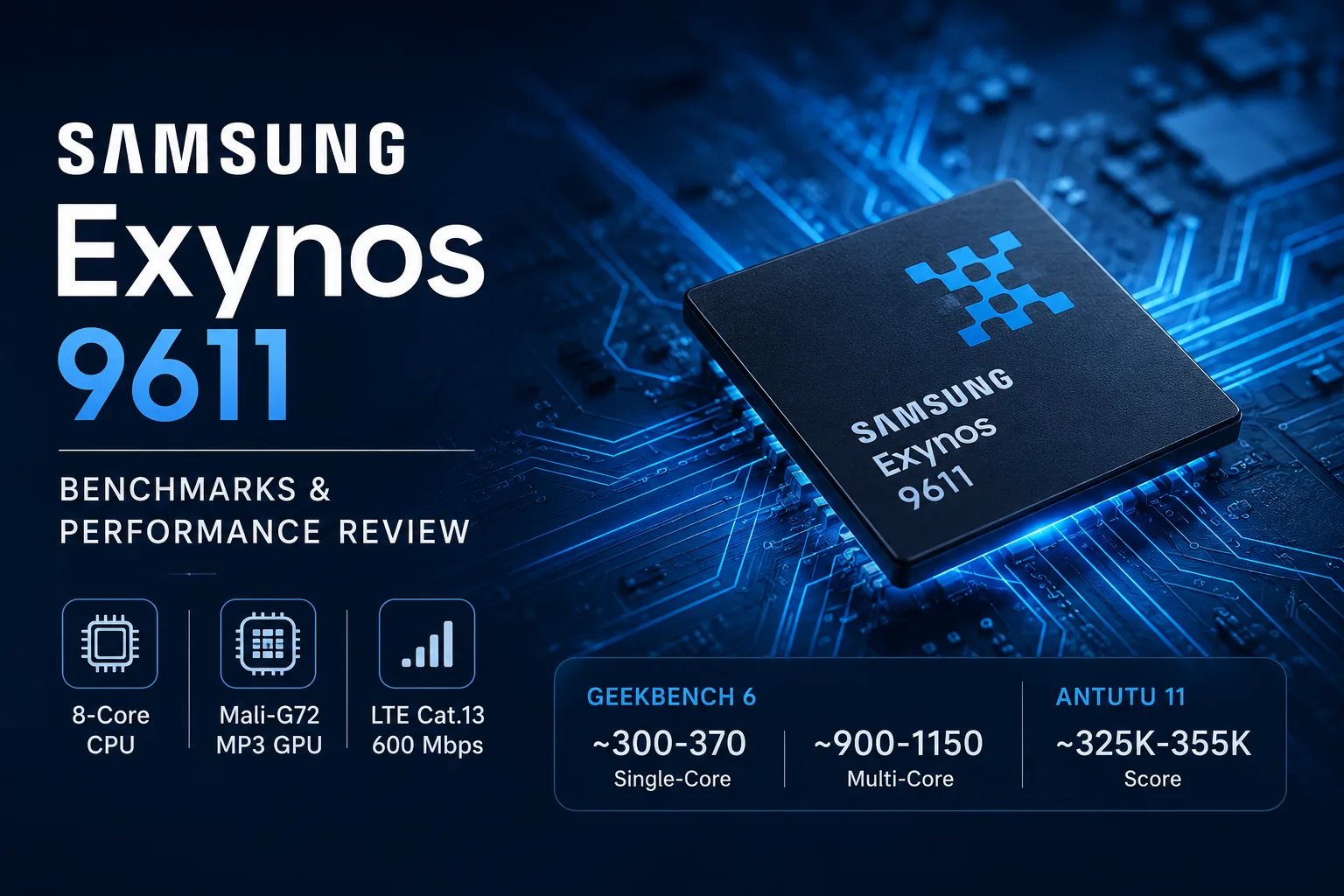
Samsung Exynos 9611 is an 8-core SoC, primarily known from the popular Galaxy A51, M21, and M31 models. At its launch, it was considered mid-range, but by today’s standards, its performance is closer to budget platforms. The four Cortex-A73 cores still provide adequate speed for basic tasks, but the Mali-G72 MP3 significantly limits the smartphone's capabilities in gaming.
Samsung Exynos 9611 in Geekbench 6 and AnTuTu 11
| Device | Geekbench 6 Single-Core | Geekbench 6 Multi-Core | AnTuTu 11 |
|---|---|---|---|
| Samsung Galaxy A51 | 280-370 | 860-1060 | ~353 000 |
| Samsung Galaxy M31 | 275-350 | 910-1120 | ~326 000 |
| Samsung Galaxy M21 | 300-370 | 950-1130 | ~355 000 |
The differences between the models are minimal: results are more strongly influenced by firmware, heating, background processes, and the condition of the specific smartphone. The typical range for the Exynos 9611 is around 300-370 points in Geekbench 6 Single-Core, 900-1150 in Multi-Core, and 325-355 thousand in AnTuTu 11.
Cortex-A73 Keeps Exynos 9611 at an Acceptable Level
The CPU consists of four Cortex-A73 cores clocked up to 2.3 GHz and four energy-efficient Cortex-A53 cores up to 1.7 GHz. The chip is manufactured using a 10-nm process.
Four Cortex-A73 cores are still enough for basic workload. For messengers, video, navigation, and light apps, the performance is sufficient.
Delays become more noticeable on heavy websites, during app installations, photo processing, and active multitasking. This is especially true for smartphones with 4 GB of RAM.
Exynos 9611 supports LPDDR4X, UFS 2.1, and eMMC 5.1. Therefore, the speed of a specific smartphone depends not only on the processor: a faster storage reduces delays during app launches and file handling, even with the same SoC.
Mali-G72 MP3 - The Main Limitation of Exynos 9611
The Mali-G72 MP3 handles graphics. For a mid-range smartphone from 2019, this configuration seemed appropriate, but today the GPU has become the weakest link of the platform.
Simple and older games remain playable, especially at low or medium settings. In demanding modern projects, graphics quality has to be lowered, and one can no longer count on stable high FPS.
In games, the obsolescence of Exynos 9611 is significantly more pronounced than in everyday applications.
How Much Slower is Exynos 9611 Compared to Newer Processors
| Processor | Geekbench 6 Single-Core | Geekbench 6 Multi-Core | Position |
|---|---|---|---|
| Samsung Exynos 9611 | ~300-370 | ~900-1150 | old budget level |
| Qualcomm Snapdragon 680 | ~430-450 | ~1350-1450 | budget 4G |
| MediaTek Helio G99 | ~630-650 | ~1900-2000 | newer budget 4G |
Even the Snapdragon 680 is significantly faster than the Exynos 9611, especially in multi-threaded tasks. The Helio G99 goes even further: its multi-core results approach a two-fold advantage, while single-core performance is about 70-100% higher.
Today, the Exynos 9611 lags not only behind flagships but also ordinary budget 4G platforms of newer generations.
4G Without 5G Support
The Exynos 9611 features a built-in LTE modem with a claimed download speed of up to 600 Mbps and upload speed up to 150 Mbps. It also supports Wi-Fi 802.11ac, Bluetooth 5.0, and basic satellite navigation systems.
5G is not supported, although for smartphones of this generation, limited performance of the SoC itself is much more crucial.
Which Smartphones Feature Exynos 9611
The processor has been used in a large number of Samsung models. Among the most well-known:
- Samsung Galaxy A50s;
- Samsung Galaxy A51;
- Samsung Galaxy M30s;
- Samsung Galaxy M21;
- Samsung Galaxy M21 2021 Edition;
- Samsung Galaxy M31;
- Samsung Galaxy M31s;
- Samsung Galaxy F41.
The most recognizable model from this list is the Galaxy A51, while the M21 and M31 have made the Exynos 9611 particularly ubiquitous in the Galaxy M series.
Is it Worth Using Exynos 9611 Today?
For demanding games and active multitasking, the Exynos 9611 is already weak, but it can still handle basic scenarios.
There’s no need to replace a functioning smartphone just because it has the Exynos 9611: for communication, navigation, video, and messaging, the performance is still adequate.
The Exynos 9611 can still be comfortably used in an existing smartphone for basic tasks. However, purchasing a device on this platform today should only be for a symbolic amount: modern budget SoCs are noticeably faster both in CPU performance and especially in graphics.
SOC Comparison
Compare Exynos 9611 with other SOCs
Basic
4x 1.7 GHz – Cortex-A53
GPU Specifications
Connectivity
Memory Specifications
Miscellaneous
Benchmarks
Compared to Other SoC
Related SoC Comparisons



Share in social media
Or Link To Us
<a href="https://cputronic.com/soc/samsung-exynos-9611" target="_blank">Samsung Exynos 9611</a>