Qualcomm Snapdragon 8 Elite Gen 4

Qualcomm Snapdragon 8 Elite (Gen 4): Oryon Architecture, Performance, and Thermals
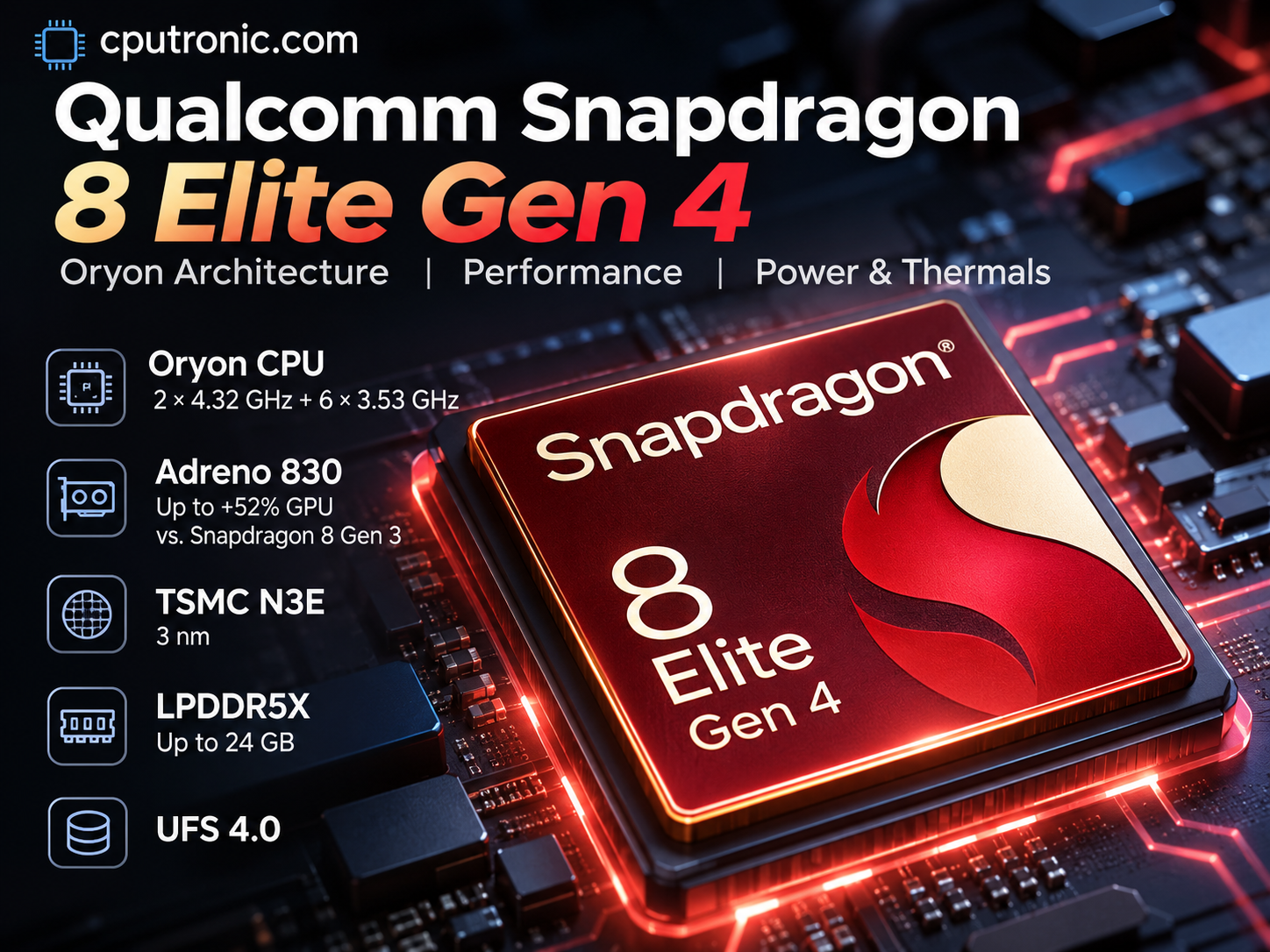
Qualcomm introduced the Snapdragon 8 Elite on October 21, 2024. In this generation, the company replaced Arm Cortex cores with its own second-generation Oryon cores. The chip is manufactured using TSMC’s N3E process (3 nm) and features Adreno 830 graphics.
Before its announcement, the chip was known as the Snapdragon 8 Gen 4, but it received the official name Snapdragon 8 Elite.
Key Specifications
| Parameter | Snapdragon 8 Elite |
|---|---|
| Model | SM8750-AB |
| Process technology | TSMC N3E (3 nm) |
| CPU architecture | Second-generation Qualcomm Oryon |
| Cores and frequencies | 2 × 4.32 GHz + 6 × 3.53 GHz |
| L2 cache | 24 MB |
| GPU | Adreno 830 |
| RAM | LPDDR5X, up to 5300 MHz, up to 24 GB |
| Storage | UFS 4.0 |
Oryon Architecture
The CPU consists of two Prime cores clocked at up to 4.32 GHz and six Performance cores clocked at up to 3.53 GHz. Unlike the Snapdragon 8 Gen 3, it has no separate cluster of energy-efficient Cortex-A520 cores.
Each cluster has 12 MB of shared L2 cache. The large cache reduces the number of accesses to RAM.
The Prime cores are primarily intended for tasks that require high single-threaded performance. Under light loads, the processor reduces clock speeds and voltage to save energy.
Benchmark Performance
Smartphone results in Geekbench 6.7 and AnTuTu 10:
| Smartphone | Processor | Geekbench 6 SC | Geekbench 6 MC | AnTuTu 10 |
|---|---|---|---|---|
| OnePlus 13 | Snapdragon 8 Elite | 3,087 | 9,369 | 2,762,122 |
| Xiaomi 15 | Snapdragon 8 Elite | 3,001 | 9,202 | 2,677,100 |
| OPPO Find X8 Pro | Dimensity 9400 | 2,605 | 7,480 | 2,374,537 |
| OnePlus 12 | Snapdragon 8 Gen 3 | 2,148 | 6,630 | 2,005,881 |
| Samsung Galaxy S24+ | Exynos 2400 | 2,066 | 6,534 | 1,777,871 |
The OnePlus 13 outperforms the OnePlus 12 by 44% in the single-threaded Geekbench 6 test and by 41% in the multi-threaded test. Its advantage over the OPPO Find X8 Pro with the Dimensity 9400 is 19% and 25%, respectively.
In AnTuTu 10, the OnePlus 13 scores 38% more points than its predecessor. This benchmark measures not only CPU speed but also graphics, memory, and storage performance.
The compact Xiaomi 15 falls only slightly behind the OnePlus 13 in short-term tests.
Adreno 830 Graphics and Gaming
The Adreno 830 consists of three compute blocks. The GPU’s internal memory (GMEM) has been increased to 12 MB. This reduces the number of accesses to RAM when rendering images.
The GPU supports Vulkan 1.3, hardware-accelerated ray tracing, and Snapdragon Game Super Resolution image-upscaling technology.
3DMark Wild Life Extreme Results
| Smartphone | GPU | Score | Stress-test stability |
|---|---|---|---|
| OnePlus 13 | Adreno 830 | 6,754 | 51% |
| OPPO Find X8 Pro | Immortalis-G925 MC12 | 6,303 | 58% |
| Xiaomi 15 | Adreno 830 | 5,995 | 68.7% |
| OnePlus 12 | Adreno 750 | 4,444 | 81.4% |
| Samsung Galaxy S24+ | Xclipse 940 | 4,256 | 81.5% |
The OnePlus 13 scores 52% more points than the OnePlus 12, but it reduces performance more significantly under sustained load. The Xiaomi 15 falls behind the OnePlus 13 in peak performance, but demonstrates higher stability.
Stability in 3DMark is the ratio of the worst stress-test result to the best result. A higher percentage by itself does not indicate higher GPU performance.
The Adreno 830 can run Genshin Impact, Honkai: Star Rail, and PUBG Mobile at high graphics settings. During extended gaming, GPU clock speeds and frame rates depend largely on the smartphone’s cooling system.
Power Consumption and Thermals
Qualcomm claims the following improvements over the Snapdragon 8 Gen 3:
- CPU performance - up to 45%.
- CPU energy efficiency - up to 44%.
- GPU performance - up to 40%.
- GPU energy efficiency - up to 40%.
- NPU performance - up to 45%.
Improved energy efficiency does not rule out high power consumption under maximum load. The Snapdragon 8 Elite may use less power than the Snapdragon 8 Gen 3 to perform the same task, but consume more when operating at its maximum clock speeds.
RAM and Storage
The memory controller supports up to 24 GB of LPDDR5X at frequencies of up to 5300 MHz. With a data-transfer rate of 10,600 MT/s and a 64-bit bus, the theoretical memory bandwidth is 84.8 GB/s.
Typical smartphone configurations include 12 or 16 GB of RAM and UFS 4.0 storage.
The Adreno 830 uses the same RAM as the CPU, so its bandwidth also affects graphics performance.
Cameras and Artificial Intelligence
Three 18-bit Qualcomm Spectra image signal processors work together with the Hexagon neural accelerator.
The platform supports:
- Cameras with resolutions of up to 320 MP.
- 4K video recording at 120 FPS.
- Hardware AV1 decoding.
- Real-time recognition and separate processing of image objects (semantic segmentation).
- Running multimodal AI models directly on the smartphone.
The availability of individual features depends on the installed cameras and software.
Connectivity and Wireless Interfaces
The integrated Snapdragon X80 modem supports 5G networks with theoretical download speeds of up to 10 Gb/s and upload speeds of up to 3.5 Gb/s.
The FastConnect 7900 subsystem supports Wi-Fi 7, Bluetooth 6.0, and UWB. The latter technology is not available on all smartphones.
Advantages and Disadvantages
Advantages:
- Significant CPU and GPU performance gains over the Snapdragon 8 Gen 3.
- Improved energy efficiency.
- Large amount of L2 cache.
- Support for Wi-Fi 7 and Bluetooth 6.0.
Disadvantages:
- Pronounced throttling in some smartphones.
- High power consumption under maximum load.
Relevance in 2026
Despite the release of the Snapdragon 8 Elite Gen 5 and Snapdragon 8 Elite Gen 6, the performance of this 2024 chip is sufficient for modern mobile games, emulators, and video editing.
Smartphones based on this platform include the OnePlus 13, Xiaomi 15, iQOO 13, and RedMagic 10 Pro.
For everyday use, switching from the Snapdragon 8 Gen 3 will not provide significant benefits. The difference is more noticeable in demanding games, emulators, and video processing.
When buying a used smartphone, it is worth checking the battery’s condition and finding out how long the device will continue to receive updates.
Conclusion
In 2026, buying a smartphone with the Snapdragon 8 Elite makes sense if it is significantly cheaper than models based on newer flagship platforms. When choosing a device for gaming, it is best to consider the stress-test results of the specific smartphone rather than only the peak benchmark figures.
SOC Comparison
Compare Snapdragon 8 Elite Gen 4 with other SOCs
Basic
GPU Specifications
Connectivity
Memory Specifications
Miscellaneous
- AIFF
- CAF
- MP3
- MP4
- WAV
- H.265
- AV1
- VP8
- VP9
Benchmarks
Compared to Other SoC
Related SoC Comparisons



Share in social media
Or Link To Us
<a href="https://cputronic.com/soc/qualcomm-snapdragon-8-elite-gen-4" target="_blank">Qualcomm Snapdragon 8 Elite Gen 4</a>