Qualcomm Snapdragon 7 Gen 4

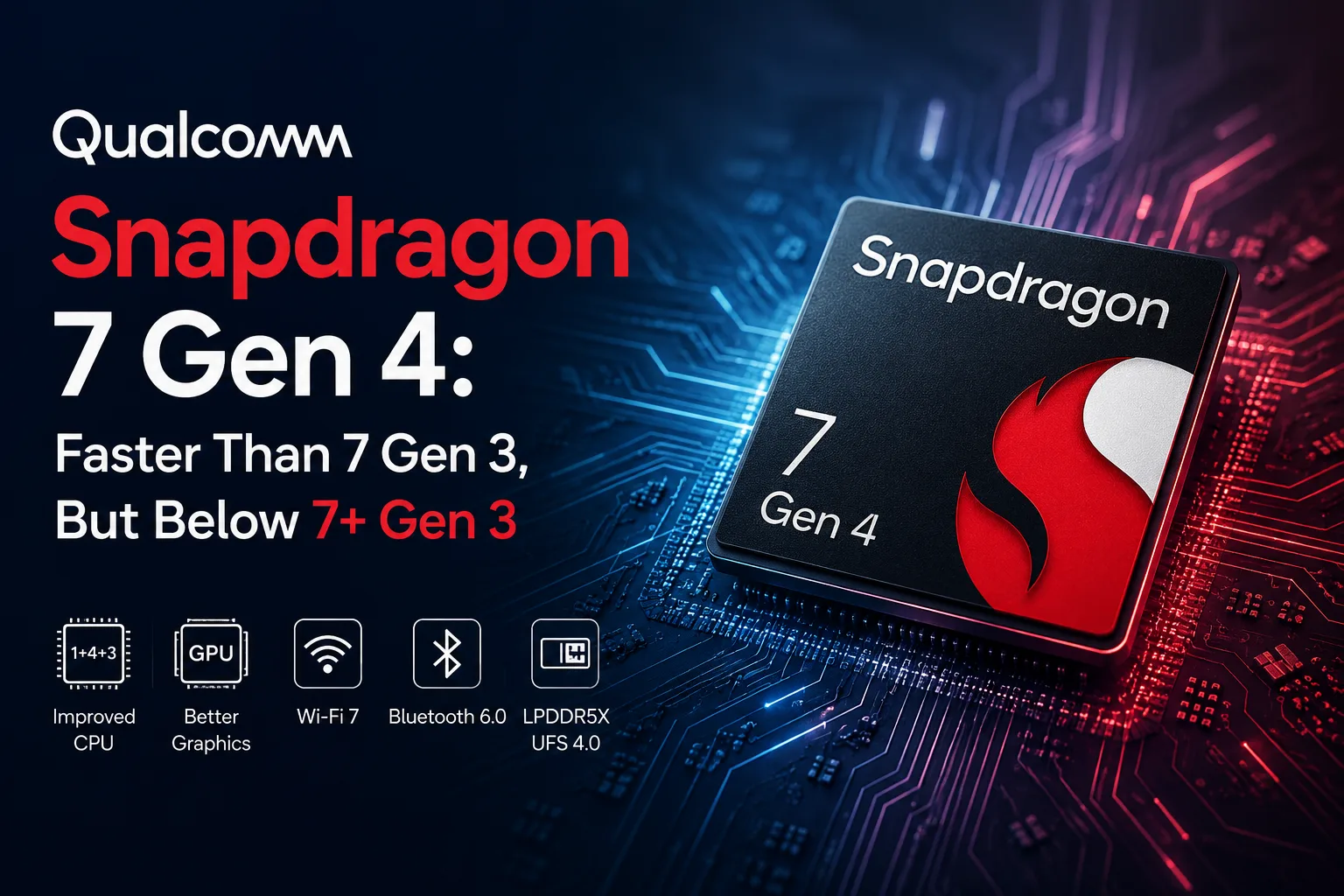
Qualcomm Snapdragon 7 Gen 4: faster than 7 Gen 3, but below 7+ Gen 3
The Snapdragon 7 Gen 4 is a significant update to the Snapdragon 7 lineup. Compared to the Snapdragon 7 Gen 3, the chip has switched to a CPU configuration of 1+4+3, features a faster GPU, Wi-Fi 7, Bluetooth 6.0, and support for LPDDR5X and UFS 4.0.
In terms of class, this platform is aimed at premium mid-range smartphones. It is noticeably faster than the Snapdragon 7 Gen 3 but remains below the Snapdragon 7+ Gen 3 and Snapdragon 8s Gen 3: the higher-end chips excel in graphics performance and are better suited for prolonged gaming loads.
Main Difference from Snapdragon 7 Gen 3
The main change is in the CPU. The Snapdragon 7 Gen 3 used a 1+3+4 configuration: one high-performance core, three powerful cores, and four energy-efficient cores. The Snapdragon 7 Gen 4 adopts a 1+4+3 configuration. Qualcomm added one more powerful core and increased the frequency of the high-performance core to 2.8 GHz.
The change goes beyond just an increase in frequency. The additional powerful core provides a boost in multi-threaded tasks: switching between applications, browser performance, photo processing, background tasks, and gaming.
In summary, the differences look like this:
| Parameter | Snapdragon 7 Gen 3 | Snapdragon 7 Gen 4 |
|---|---|---|
| CPU configuration | 1+3+4 | 1+4+3 |
| Maximum frequency | up to 2.63 GHz | up to 2.8 GHz |
| Memory | LPDDR5 | LPDDR5X |
| Storage | UFS 3.1 | UFS 4.0 |
| Wi-Fi | Wi-Fi 6E | Wi-Fi 7 |
| Bluetooth | 5.4 | 6.0 |
Qualcomm claims a CPU performance increase of 27%, GPU by 30%, and AI task performance by 65% compared to the Snapdragon 7 Gen 3. Changes from the previous generation are particularly noticeable in CPU, graphics, and wireless interfaces.
Performance: CPU, GPU, and Gaming
The Snapdragon 7 Gen 4 features eight CPU cores: one Prime core up to 2.8 GHz, four performance cores up to 2.4 GHz, and three energy-efficient cores up to 1.8 GHz. This configuration sets the chip apart from basic mid-range platforms.
In Geekbench 6, the Snapdragon 7 Gen 4 scores typically range from about 1250-1350 points in single-core and around 4000-4150 points in multi-core tests. The increase is especially pronounced in multi-core performance: not only does the Prime core operate at a higher frequency, but the transition from three to four performance cores also contributes to better results.
Regarding graphics, Qualcomm reports an acceleration of about 30% compared to the Snapdragon 7 Gen 3. This is sufficient for popular online games and some demanding projects at medium or high settings, but the Snapdragon 7 Gen 4 does not replace higher-end gaming platforms.
Overall performance depends on the specific smartphone. Cooling, power limits, memory, GPU frequencies, and manufacturer settings are crucial. One phone using Snapdragon 7 Gen 4 may sustain operational frequencies longer, while another may throttle performance sooner due to heat.
AI, Camera, and Multimedia
Qualcomm highlights the performance improvement in AI tasks separately for the Snapdragon 7 Gen 4. It supports on-device AI functionalities, including Stable Diffusion 1.5. This pertains to image processing, camera algorithms, generative functions, voice tasks, and background interface enhancements.
The AI block should not be overestimated. Qualcomm does not disclose the exact TOPS value, making it misleading to compare the NPU of Snapdragon 7 Gen 4 directly with flagship platforms. Here, the AI block should be seen as an accelerator for camera and generative features rather than a replacement for flagship NPUs.
Regarding cameras, the platform covers the typical mid-range capabilities. It supports 12-bit ISP, cameras up to 200 MP, and 4K HDR video recording up to 60 frames per second. However, photo and video quality depends not only on the processor but also on the sensor, optics, stabilization, cooling, and processing algorithms used by the specific manufacturer.
The Snapdragon 7 Gen 4 provides a hardware foundation for mid-range smartphones focused on camera capabilities, but it does not guarantee a high level of photography on its own.
Memory, Storage, and Connectivity
A crucial difference in the Snapdragon 7 Gen 4 is its support for faster components. The chip works with LPDDR5X and UFS 4.0. For users, this impacts application launch time, interface responsiveness, game installation, video recording, and handling large volumes of data.
However, platform support does not mean every smartphone utilizing Snapdragon 7 Gen 4 will feature fast memory and storage. The manufacturer may opt for a cheaper configuration, such as LPDDR4X or UFS 2.2/3.1. Therefore, when choosing a phone, it’s essential to consider not just the processor name but also the specific model's characteristics.
Wi-Fi 7 and Bluetooth 6.0 represent a clear upgrade over Snapdragon 7 Gen 3. This is relevant support for new routers and accessories.
There is no clear advantage regarding the modem. The Snapdragon 7 Gen 4 supports 5G sub-6 and claims a download speed of up to 4.2 Gbps, but the final capabilities depend on the smartphone, region, carrier frequencies, and manufacturer settings.
Snapdragon 7 Gen 4 and Snapdragon 7s Gen 4 - Different Chips
The Snapdragon 7 Gen 4 is easily confused with the Snapdragon 7s Gen 4, but these are different platforms. The version with the letter "s" is positioned lower and is intended for more affordable smartphones.
The Snapdragon 7 Gen 4 has a stronger CPU configuration, higher peak frequency, more modern memory and storage support, and includes Wi-Fi 7 and Bluetooth 6.0. In contrast, the Snapdragon 7s Gen 4 is simpler: it is not a slightly modified version of the 7 Gen 4 but rather a separate chip for a different price range.
When choosing a smartphone, it’s crucial to look at the full name of the SoC. Snapdragon 7 Gen 4 and Snapdragon 7s Gen 4 may have similar names, but they differ in positioning and capabilities.
Who is Snapdragon 7 Gen 4 For
The Snapdragon 7 Gen 4 is designed for premium mid-range smartphones. Its performance is sufficient for everyday tasks, multitasking, browsing, social media, photo processing, navigation, video, and most games.
A smartphone featuring Snapdragon 7 Gen 4 makes sense when there is a noticeable price difference compared to models with Snapdragon 7+ Gen 3 and Snapdragon 8s Gen 3, along with fast memory, quick storage, and efficient cooling. The chip itself provides the necessary performance level, but the final class of the device depends on the entire design.
Purchasing a smartphone solely because of the Snapdragon 7 Gen 4 is not advisable. If a model with Snapdragon 7+ Gen 3 or Snapdragon 8s Gen 3 is available nearby at a similar price, it will be more attractive for gaming and demanding tasks. Conversely, if the price is lower, and the manufacturer hasn’t compromised on memory, display quality, cooling, and camera, the Snapdragon 7 Gen 4 can be justified in the mid-range segment.
Conclusion
The Snapdragon 7 Gen 4 substantially advances the standard Snapdragon 7 lineup. The chip transitioned to a CPU configuration of 1+4+3 with four powerful cores, received a faster GPU, Wi-Fi 7, Bluetooth 6.0, and support for LPDDR5X and UFS 4.0.
In terms of positioning, Snapdragon 7 Gen 4 remains between the Snapdragon 7 Gen 3 and the higher 7+/8s chips. It lags behind the higher-end platforms in graphics and prolonged load management, but it provides mid-range smartphones with a faster CPU and new interfaces.
Evaluating a specific smartphone with Snapdragon 7 Gen 4 should not be based solely on the processor. Important factors include memory, storage, cooling, camera, display, battery, and price. The chip alone does not guarantee a good smartphone; its capabilities depend on the device's implementation.
SOC Comparison
Compare Snapdragon 7 Gen 4 with other SOCs
Basic
GPU Specifications
Connectivity
Memory Specifications
Miscellaneous
Benchmarks
Phones with Snapdragon 7 Gen 4









Comparison of Devices with Snapdragon 7 Gen 4
Compared to Other SoC
Related SoC Comparisons



Share in social media
Or Link To Us
<a href="https://cputronic.com/soc/qualcomm-snapdragon-7-gen-4" target="_blank">Qualcomm Snapdragon 7 Gen 4</a>