Qualcomm Snapdragon 6s Gen 4

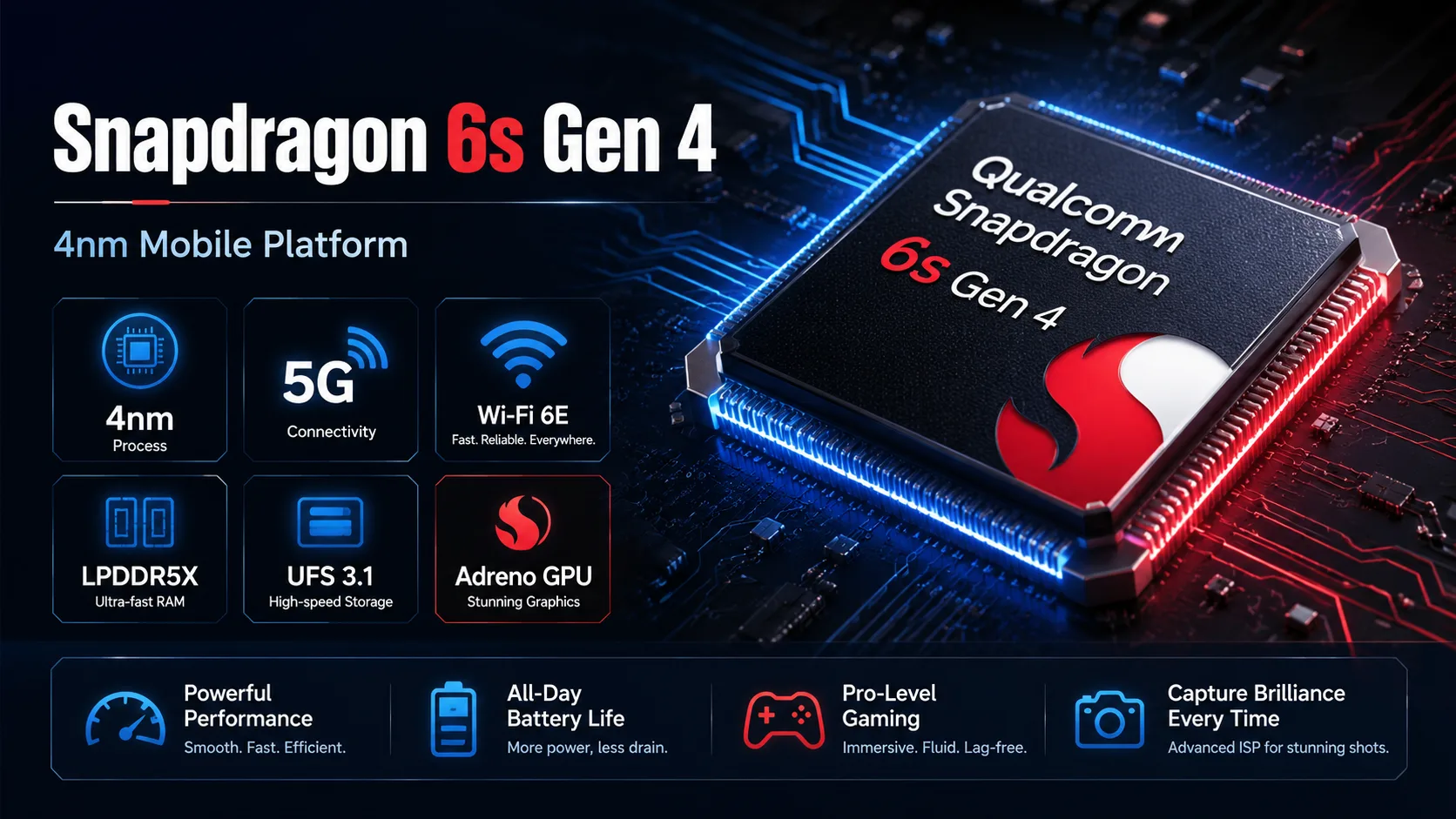
Qualcomm Snapdragon 6s Gen 4: almost Snapdragon 6 Gen 3 under a new name
Qualcomm Snapdragon 6s Gen 4 is an affordable 5G chip that can easily be mistaken for a lower version of the Snapdragon 6 Gen 4. In reality, its CPU architecture is much closer to the Snapdragon 6 Gen 3. The Snapdragon 6s Gen 4 retains the Cortex-A78 and Cortex-A55, while the Snapdragon 6 Gen 4 uses the Cortex-A720 and Cortex-A520. Therefore, the Gen 4 designation here is misleading: in architecture, the Snapdragon 6s Gen 4 is more of an upgraded Snapdragon 6 Gen 3 than a relative of the Snapdragon 6 Gen 4.
Snapdragon 6s Gen 4 vs Snapdragon 6 Gen 3 and 6 Gen 4
| Specification | Snapdragon 6s Gen 4 | Snapdragon 6 Gen 3 | Snapdragon 6 Gen 4 |
|---|---|---|---|
| Process Technology | 4 nm | 4 nm | 4 nm |
| Performance Cores | 4× Cortex-A78 | 4× Cortex-A78 | Cortex-A720 |
| Efficiency Cores | 4× Cortex-A55 | 4× Cortex-A55 | Cortex-A520 |
| Max CPU Clock Speed | 2.4 GHz | 2.4 GHz | up to 2.3 GHz |
| Memory | LPDDR4X / LPDDR5X | LPDDR4X / LPDDR5 | LPDDR5 |
| Storage | up to UFS 3.1 | up to UFS 3.1 | UFS |
| Wi-Fi | Wi-Fi 6E | Wi-Fi 6E | Wi-Fi 6E |
| 5G | Yes | Yes | Yes |
In CPU configuration, there are almost no differences from the Snapdragon 6 Gen 3. Both platforms use four Cortex-A78 cores up to 2.4 GHz and four Cortex-A55 cores. Qualcomm claims up to a 36% CPU boost and up to a 59% GPU improvement over the Snapdragon 6 Gen 3, but this does not necessarily translate to the same differences in Geekbench or AnTuTu.
Performance of Snapdragon 6s Gen 4 in smartphones
In real devices, the Snapdragon 6s Gen 4 scores around 1000 points in Geekbench 6 Single-Core and approximately 2850-2950 Multi-Core, excluding individual outliers. For everyday tasks, this level of CPU performance is more than sufficient.
Snapdragon 6s Gen 4 - results in specific devices
| Device | Geekbench 6 Single | Geekbench 6 Multi | AnTuTu |
|---|---|---|---|
| Motorola Moto G57 | ~1,002 | ~2,470* | - |
| Motorola Moto G57 Power | 1,009-1,013 | 2,864-2,892 | ~809,000 |
| Xiaomi Redmi Note 17 Pro | ~1,011 | ~2,924 | ~877,000 |
- The single result for the Moto G57 is significantly lower than the others, so it shouldn't be used as a typical measure for the Snapdragon 6s Gen 4: Geekbench is sensitive to temperature, background processes, and power settings.
The Moto G57 Power and Redmi Note 17 Pro give close results-around 1000-1010 points in Single-Core and 2850-2950 in Multi-Core. This range better reflects the level of the Snapdragon 6s Gen 4's CPU.
CPU has hardly changed, with the main improvement in GPU
The CPU part almost mirrors the Snapdragon 6 Gen 3. The Cortex-A78 still provides acceptable performance, but in efficiency and power headroom, it lags behind the newer Cortex-A7xx cores.
Qualcomm has concentrated major changes in the GPU. The company claims a significant increase in graphical performance compared to the Snapdragon 6 Gen 3, although the exact designation of the Adreno GPU in the official specifications is not disclosed. It supports Vulkan, Variable Rate Shading, and FHD+ displays with refresh rates up to 144 Hz.
Support for 144 Hz screens does not mean 144 FPS in games. In demanding projects, the frame rate will be noticeably lower than the capabilities of the display itself, so actual gaming performance is best evaluated through tests of specific smartphones.
Older CPU cores compensated by a modern platform
The main advantages of the Snapdragon 6s Gen 4 lie beyond the CPU. The chip supports LPDDR5X, UFS 3.1, Wi-Fi 6E, Bluetooth 5.4, and 5G networks.
Cameras can have resolutions up to 200 MP, and maximum video recording quality reaches 2K HDR at 30 frames per second. The claimed upload speed via 5G is up to 2.9 Gbps.
In terms of interfaces and memory, the Snapdragon 6s Gen 4 is significantly more modern than many budget platforms from previous generations. This is especially important for mid-range and budget smartphones, where an old SoC often limits not just performance but also storage speed, wireless interfaces, or camera capabilities.
Snapdragon 6s Gen 4 among competitors
In terms of CPU, the Snapdragon 6s Gen 4 is close to the Snapdragon 6 Gen 3 but offers a faster GPU and more current platform features. The Snapdragon 6 Gen 4 is a step above: it has transitioned to the Cortex-A720 and Cortex-A520 and features a more modern CPU architecture.
At MediaTek, its competitors are in the Dimensity 7000 family, but the differences between individual models are significant. For instance, the Dimensity 7300 outperforms the Snapdragon 6s Gen 4 in both CPU and graphics, so it is not advisable to categorize them at the same performance level.
Conclusion
The Snapdragon 6s Gen 4 occupies the lower part of the mid-range segment and is noticeably closer to the Snapdragon 6 Gen 3 than the Snapdragon 6 Gen 4. The CPU architecture has hardly changed: four Cortex-A78 cores up to 2.4 GHz provide sufficient performance, but in architecture, it already lags behind newer solutions featuring Cortex-A720.
The main upgrade is in graphics and the platform itself. The Snapdragon 6s Gen 4 supports LPDDR5X, UFS 3.1, Wi-Fi 6E, a modern 5G modem, and cameras up to 200 MP. Therefore, its advantage over older budget SoCs lies not only in CPU speed but also in a more relevant set of features for smartphones as a whole.
In light of the Snapdragon 6 Gen 4 and fast Dimensity 7xxx models, its position is already weaker: they offer a more modern CPU architecture and generally greater performance. The Snapdragon 6s Gen 4 should therefore be considered more as an update to the mainstream Snapdragon 6 Gen 3 platform-with the same CPU foundation, stronger graphics, and a distinctly more modern environment.
SOC Comparison
Compare Snapdragon 6s Gen 4 with other SOCs
Basic
GPU Specifications
Connectivity
Memory Specifications
Miscellaneous
- AIFF
- CAF
- MP3
- MP4
- WAV
- H.265
- VP9
Benchmarks
Phones with Snapdragon 6s Gen 4

Comparison of Devices with Snapdragon 6s Gen 4
Compared to Other SoC
Related SoC Comparisons


Share in social media
Or Link To Us
<a href="https://cputronic.com/soc/qualcomm-snapdragon-6s-gen-4" target="_blank">Qualcomm Snapdragon 6s Gen 4</a>