MediaTek Dimensity 7300e
MediaTek Dimensity 7300e: How It Falls Short Compared to Dimensity 7300
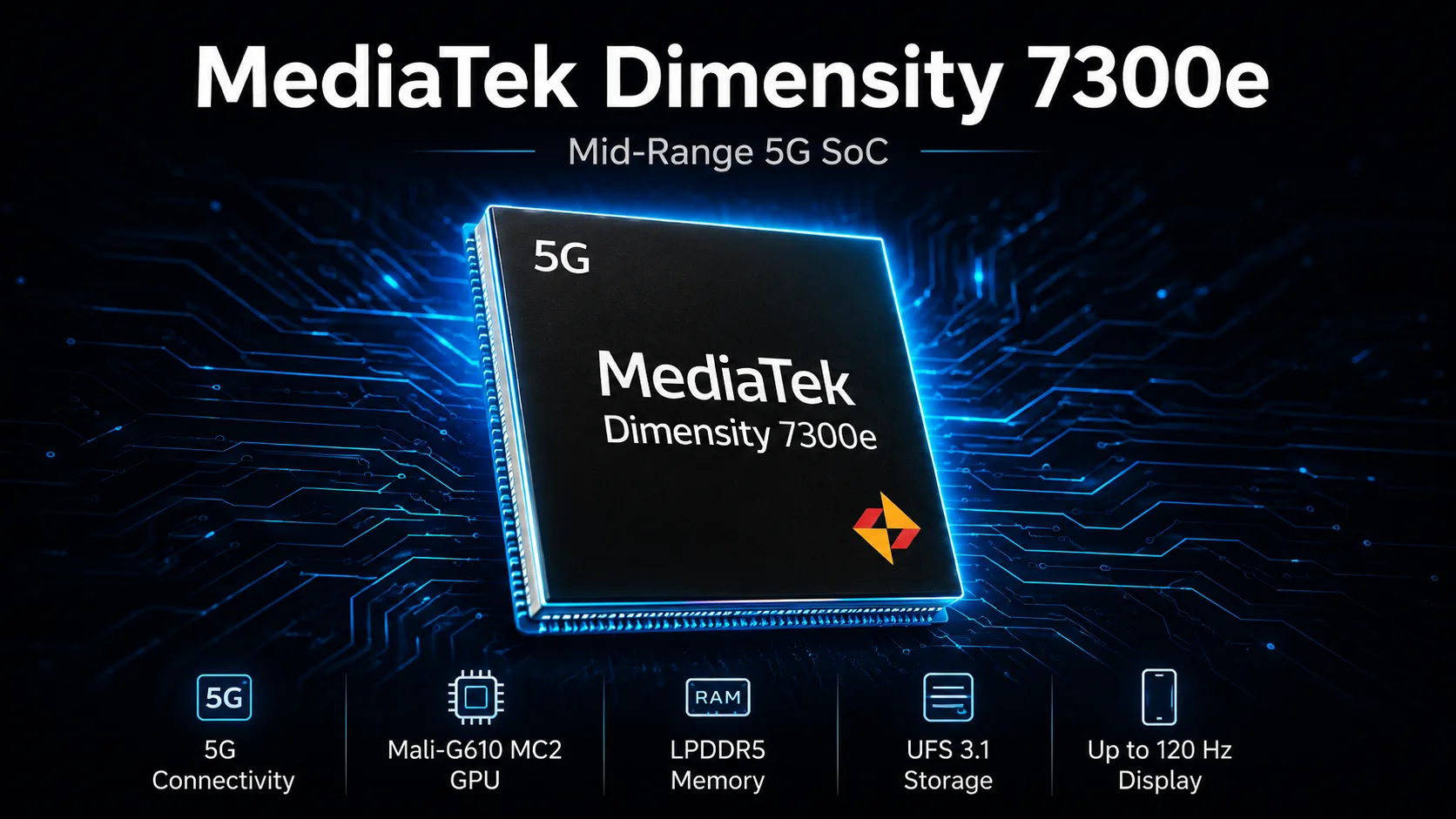
MediaTek Dimensity 7300e might be assumed to be a variant of Dimensity 7300 based on its name, but it is not a rebranded version of the same chip. The CPUs are similar, and 5G and UFS 3.1 support remain, however, the 7300e has simpler graphics, a lower maximum LPDDR5 speed, no Wi-Fi 6E, and utilizes a 6nm process instead of the 4nm found in Dimensity 7300. This is not an upgraded version but a more affordable configuration intended for mid-range smartphones.
What is Dimensity 7300e
Dimensity 7300e is a mobile SoC designed for budget-friendly 5G smartphones. The chip is aimed at fast interfaces, typical applications, and modern mobile communication but is not suited for heavy gaming.
The CPU follows a 4+4 configuration: four Cortex-A78 cores operate at up to 2.5 GHz, while four Cortex-A55 cores handle light and background tasks. This configuration is not new, but it remains sufficient for mid-range devices.
Performance is adequate for standard tasks expected from a mid-range smartphone: browsing, messaging, social media, navigation, camera usage, video playback, and banking applications. Limitations are evident in gaming, extended workloads, and in comparison with more expensive SoCs.
How Dimensity 7300e Differs from Dimensity 7300
The main point of criticism for Dimensity 7300e isn't the CPU, but rather the simplifications relative to Dimensity 7300. While the difference in name is minimal, the performance characteristics diverge significantly.
| Parameter | Dimensity 7300e | Dimensity 7300 | What This Means |
|---|---|---|---|
| CPU | 4× Cortex-A78 + 4× Cortex-A55 | 4× Cortex-A78 + 4× Cortex-A55 | The core architecture is nearly the same |
| GPU | Mali-G610 MC2 | Mali-G615 MC2 | The 7300e has less gaming headroom |
| Fabrication | 6nm | 4nm | The 7300 utilizes a more advanced fabrication process |
| Memory | LPDDR5 up to 5500 Mbps | LPDDR5 up to 6400 Mbps | The 7300 has a higher maximum memory speed |
| Wi-Fi | Wi-Fi 6, 1T1R | Wi-Fi 6E, 2T2R | The 7300 has a stronger wireless component |
| Display | up to 120 Hz | up to 120/144 Hz depending on resolution | The 7300 has a higher maximum refresh rate in certain modes |
In everyday applications, the difference between the two chips may be minimal: their CPUs are similar. However, in gaming, wireless networking, and memory performance, Dimensity 7300 retains a distinct advantage.
CPU and Everyday Speed
The central processor is the strongest part of Dimensity 7300e. The four Cortex-A78 cores provide ample power for daily tasks and are better suited for modern Android, compared to older budget combinations using Cortex-A76, Cortex-A75, or only energy-efficient cores.
This is sufficient for browsing, Telegram, YouTube, maps, cameras, marketplaces, and banking applications. With adequate memory and storage, a smartphone built on Dimensity 7300e does not feel like an ultra-budget device in terms of responsiveness.
However, the CPU alone does not guarantee a fast smartphone. The final speed depends on memory type, storage, cooling, software skin, and the amount of pre-installed software. One device based on Dimensity 7300e may perform significantly faster than another, depending on whether it has UFS 3.1, ample RAM, and a lightweight firmware.
Graphics and Gaming
The main limitation of Dimensity 7300e is its graphics. It uses Mali-G610 MC2, while Dimensity 7300 features Mali-G615 MC2. For the interface and typical applications, the difference is not very noticeable, but in gaming, it becomes crucial.
For simple games, casual projects, MOBAs, and older 3D titles, the performance will suffice. However, for demanding games, settings will need to be lowered. This is particularly true for open-world projects, those with complex effects, high rendering resolutions, and attempts to maintain stable 60 fps.
Cooling also affects performance. In a thin smartphone casing, the device may quickly throttle frequencies, even if the game runs stably within the first few minutes. Therefore, Dimensity 7300e is better viewed as a chip for moderate gaming rather than as a foundation for a gaming smartphone.
Memory, Storage, and Connectivity
Dimensity 7300e supports LPDDR5 up to 5500 Mbps, LPDDR4x up to 4266 Mbps, and UFS 3.1 storage. A fast storage solution accelerates application launches, game installations, file transfers, and overall system responsiveness.
The maximum configuration depends on the specific smartphone. The manufacturer may opt for LPDDR4x or a simpler storage solution if they are producing a budget model. Therefore, when choosing a device, it's essential to consider not only the SoC but also the memory.
In terms of mobile connectivity, Dimensity 7300e meets the basic requirements for a 5G smartphone: it supports 5G SA/NSA, Dual 5G SIM, VoNR, and claims download speeds of up to 3.3 Gbps. The wireless component is weaker than the higher version: Wi-Fi 6 with a 1T1R setup instead of Wi-Fi 6E and 2T2R. For typical home internet use, this may not be critical, but when comparing two smartphones, the difference can affect connection speed and stability.
Cameras, Display, and Multimedia
Dimensity 7300e supports cameras up to 200 MP, HDR video, and hardware image processing features. However, support for 200 MP does not guarantee a high-quality camera. Photo quality is determined by the sensor, optics, stabilization, processing algorithms, and the specific smartphone's calibration.
The chip supports displays up to 1300 × 2800 and 120 Hz. This is adequate for the mid-range segment, but display quality is determined by the matrix, brightness, color reproduction, and PWM, not just resolution and refresh rate.
Benchmarks and Competitors
The results for Dimensity 7300 cannot be directly transferred to Dimensity 7300e. As the CPUs are similar, there may be only a slight difference in Geekbench scores. In graphics tests, it’s reasonable to expect a performance gap for the 7300e: instead of Mali-G615 MC2, it features Mali-G610 MC2.
Reliable mass results specifically for Dimensity 7300e are still scarce, so precise scores are best tied to particular smartphones. In AnTuTu, the outcome depends not only on the SoC but also on memory, storage, cooling, and firmware.
In its class, Dimensity 7300e can be compared with Dimensity 7050, current Snapdragon 6 and Snapdragon 7 mid-range chips, and older 4G chips like Helio G99/G100. Compared to Helio G99 and G100, Dimensity 7300e has advantages in 5G support, a stronger CPU, and a more modern platform. In comparison to Dimensity 7300, the 7300e occupies a lower tier.
For Which Smartphones is Dimensity 7300e Suitable
Dimensity 7300e is suitable for smartphones where price, 5G capability, and fast everyday performance are important. It serves as a foundation for mid-range devices: social media, video, browsing, camera use, messaging, navigation, and moderate gaming.
However, it is a weak foundation for a gaming smartphone. The CPU is adequate for its segment, but the graphics lack significant headroom. If heavy gaming, stable FPS, and sustained performance without throttling are priorities, it’s better to consider models with a more powerful GPU.
Weaknesses of Dimensity 7300e
The weaknesses of Dimensity 7300e become apparent not in everyday tasks but when compared to its higher version. Dimensity 7300 offers greater gaming headroom, faster memory performance, and a stronger wireless component.
It’s also important to consider the naming. Due to the "7300e" designation, the chip can be easily mistaken for a direct equivalent of Dimensity 7300, though the distinctions are crucial when choosing a smartphone. If two models are priced similarly, the version on Dimensity 7300 appears more appealing.
Conclusion
MediaTek Dimensity 7300e is a mid-range SoC with a good CPU, 5G support, and UFS 3.1 compatibility, but it lacks serious gaming capabilities. The difference from Dimensity 7300 in everyday tasks will be minimal due to the similar CPUs, but the higher version remains stronger in graphics, Wi-Fi, memory, and fabrication process.
Dimensity 7300e should be chosen for an affordable 5G smartphone where price and the speed of standard applications are more important. For gaming and sustained performance, it’s advisable to look at Dimensity 7300 or older, more powerful SoCs.
SOC Comparison
Compare Dimensity 7300e with other SOCs
Basic
GPU Specifications
Connectivity
Memory Specifications
Miscellaneous
Benchmarks
Compared to Other SoC
Related SoC Comparisons



Share in social media
Or Link To Us
<a href="https://cputronic.com/soc/mediatek-dimensity-7300e" target="_blank">MediaTek Dimensity 7300e</a>