HiSilicon Kirin 9050 Pro

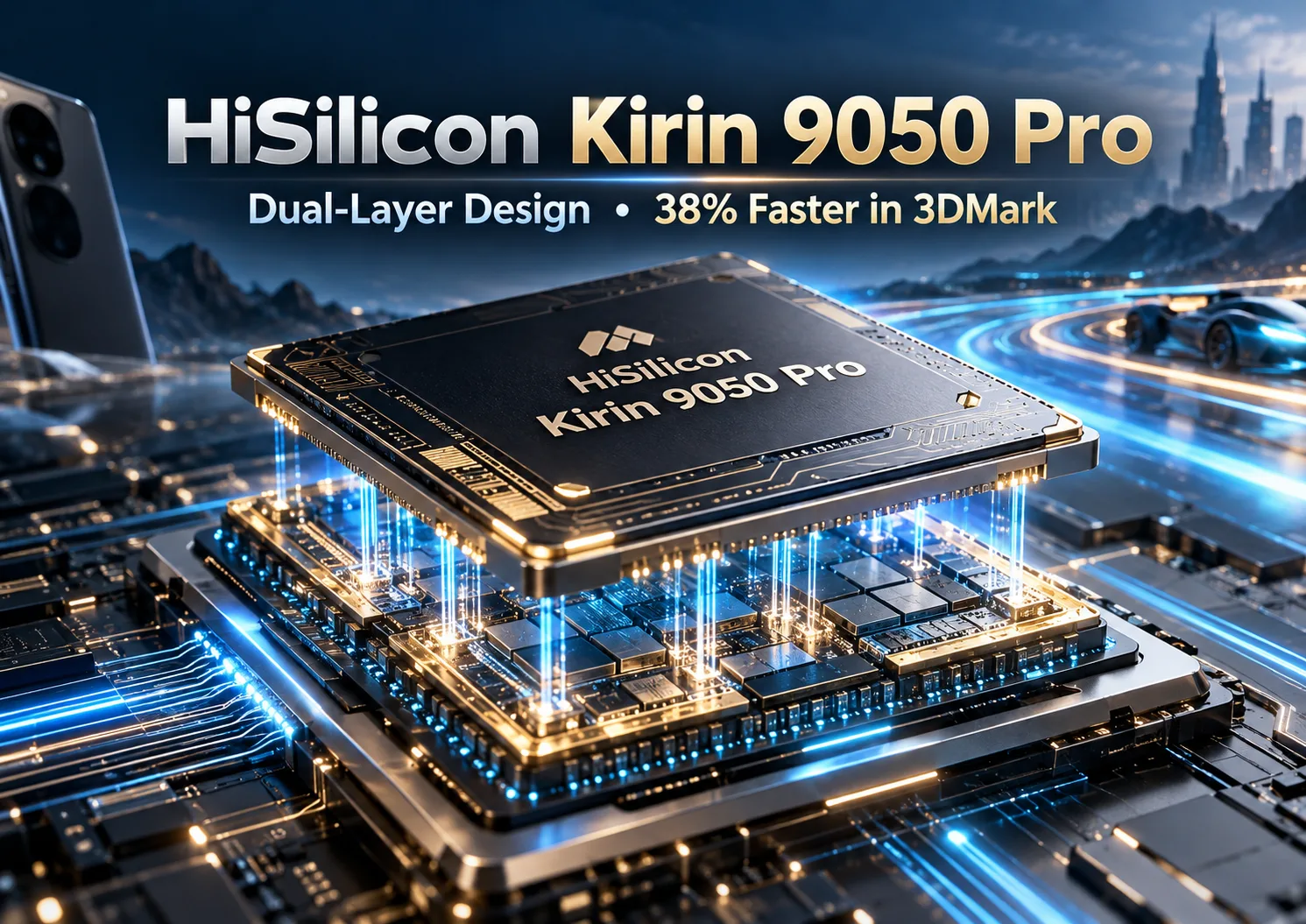
HiSilicon Kirin 9050 Pro: Dual-Layer Chip and a 38% Gain in 3DMark
The HiSilicon Kirin 9050 Pro is Huawei’s flagship mobile chip, featuring nine CPU cores, support for 16 threads, and Maleoon 955 graphics. Its key feature is LogicFolding: the compute units and cache are placed on two interconnected silicon layers.
In 3DMark Steel Nomad Light, the Mate XT 2 smartphone with the new Kirin scored 38% higher than the Mate X7 with the Kirin 9030 Pro. In the multithreaded Geekbench 7 test, the processor was just 5% behind the Dimensity 9400, but it still trails flagship competitors in single-core performance and peak graphics performance.
LogicFolding Architecture and Energy Efficiency
The Kirin 9050 Pro’s CPU consists of four clusters:
- 1 prime core - up to 3.1 GHz.
- 2 performance cores - up to 2.7 GHz.
- 4 cores - up to 2.2 GHz.
- 2 efficiency cores - up to 1.75 GHz.
In LogicFolding, two silicon dies are connected using Hybrid Bonding. The CPU, GPU, and NPU are located primarily on the upper layer, while the cache and some auxiliary blocks are on the lower layer.
Huawei claims that transistor density has increased from 155 to 238 million per mm²-a 55% increase. However, this is the density of the two-layer structure, not of an individual die.
According to Geekerwan, the upper die is manufactured using SMIC’s N+3 process, while the lower die uses N+2. Huawei and SMIC have not confirmed this.
At the same 2.75 GHz frequency, the Kirin 9050 Pro’s prime core consumes more than 30% less power than the Kirin 9030 Pro’s. The new core’s maximum frequency has increased from 2.75 to 3.1 GHz.
The two-layer design shortens the connections between the compute units and cache, helping reduce latency and power consumption.
CPU Performance
Geekbench 7
| Processor | Single-Core | Multi-Core |
|---|---|---|
| MediaTek Dimensity 9400 | 2520 | 8571 |
| HiSilicon Kirin 9050 Pro | 1813 | 8159 |
| Apple A17 Pro | 2725 | 7784 |
| Qualcomm Snapdragon 8 Gen 3 | 1987 | 7126 |
| HiSilicon Kirin 9030 Pro | 1596 | 6802 |
For testing the Kirin, Geekerwan used a build of Geekbench 7 adapted for HarmonyOS. When run through a compatibility layer, scores may be noticeably lower.
Compared with the Kirin 9030 Pro, the result increased by 14% in Single-Core and by 20% in Multi-Core.
In the multithreaded test, the new Kirin outperforms the Snapdragon 8 Gen 3 by 14% and trails the Dimensity 9400 by just 5%. The situation is reversed in Single-Core: the Kirin is 9% slower than the Snapdragon, while the Dimensity is 28% faster.
Maleoon 955 Graphics
The Maleoon 955 features six compute units and a clock speed of up to 1056 MHz. Its theoretical FP32 performance is 2.2 TFLOPS, compared with 1.4 TFLOPS for the Maleoon 935.
3DMark Steel Nomad Light
| Smartphone | Processor | Score |
|---|---|---|
| Samsung Galaxy S25+ | Snapdragon 8 Elite for Galaxy | 2272 |
| OnePlus 12 | Snapdragon 8 Gen 3 | 1676 |
| Huawei Mate XT 2 | Kirin 9050 Pro | 1378 |
| Huawei Mate X7 | Kirin 9030 Pro | 998 |
| Xiaomi Poco F6 Pro | Snapdragon 8 Gen 2 | 996 |
In Steel Nomad Light, the Huawei Mate XT 2 outperforms the Mate X7 with the Kirin 9030 Pro by 38%. It is also faster than the Poco F6 Pro with the Snapdragon 8 Gen 2, but trails the OnePlus 12 with the Snapdragon 8 Gen 3 by 18%.
The Samsung Galaxy S25+ with the Snapdragon 8 Elite for Galaxy scores 65% higher than the Mate XT 2.
Gaming: Similar FPS at Different Resolutions
In Geekerwan’s gaming tests, the gap between the Kirin 9050 Pro and the Snapdragon 8 Elite was much smaller than in 3DMark.
In Genshin Impact, the Huawei Mate XT 2 averaged 59.4 FPS at a rendering resolution of 1920 × 1346 pixels and consumed 5.4 W.
The Samsung Galaxy Z TriFold with the Snapdragon 8 Elite for Galaxy delivered 59.8 FPS at the lower resolution of 1318 × 966 pixels and consumed 5.1 W. Huawei was ahead in the 1% Low metric: 52.7 versus 46.7 FPS.
Both smartphones operated close to the 60 FPS limit, so the test does not reveal the GPU’s maximum performance. However, Huawei processed approximately twice as many pixels at similar power consumption.
The results were even closer in Wuthering Waves: 38.2 FPS for Huawei and 37.7 FPS for Samsung. The Mate XT 2 consumed 5.9 W, while the Galaxy Z TriFold consumed 6.2 W.
In these games, the Kirin delivers similar results, but differences in resolution, settings, and software platform do not allow the performance of the two GPUs to be compared directly.
Neural Processing and Local AI
The Kirin 9050 Pro features an NPU based on the Da Vinci architecture. In Geekerwan’s INT8 test, it achieved 67.7 TOPS, compared with approximately 27 TOPS for its predecessor-2.5 times higher.
The NPU accelerates local image processing and the operation of neural network models in HarmonyOS 7. The chip supports MoE models with up to 30 billion parameters, of which around 2 billion are used to process a query.
Smartphones with the Kirin 9050 Pro
| Smartphone | Configuration | Starting price |
|---|---|---|
| Huawei Mate 90 Pro Max | 16/512 GB | ~$1,490 |
| Huawei Mate 90 RS | 16/512 GB | ~$1,940 |
| Huawei Mate XT 2 | 16/256 GB | ~$2,980 |
These are the starting prices in China, converted to dollars at the exchange rate in early October 2026.
The Mate 90 Pro Max with 12 GB of RAM is equipped with the Kirin 9050, while the 16 GB version uses the Kirin 9050 Pro.
Conclusion
The Kirin 9050 Pro is significantly faster than its predecessor, especially in multithreaded workloads and graphics. At the same time, it trails the Snapdragon 8 Gen 3 in single-core performance and 3DMark results.
The two-layer design helped Huawei increase performance and reduce power consumption without switching to leading-edge process technologies. In some games optimized for HarmonyOS, the Kirin approaches more powerful Snapdragon chips, although the gap remains substantial in synthetic tests.
SOC Comparison
Compare Kirin 9050 Pro with other SOCs
Basic
GPU Specifications
Connectivity
Miscellaneous
Benchmarks
Compared to Other SoC
Share in social media
Or Link To Us
<a href="https://cputronic.com/soc/hisilicon-kirin-9050-pro" target="_blank">HiSilicon Kirin 9050 Pro</a>