NVIDIA RTX Spark N1X 18 Cores
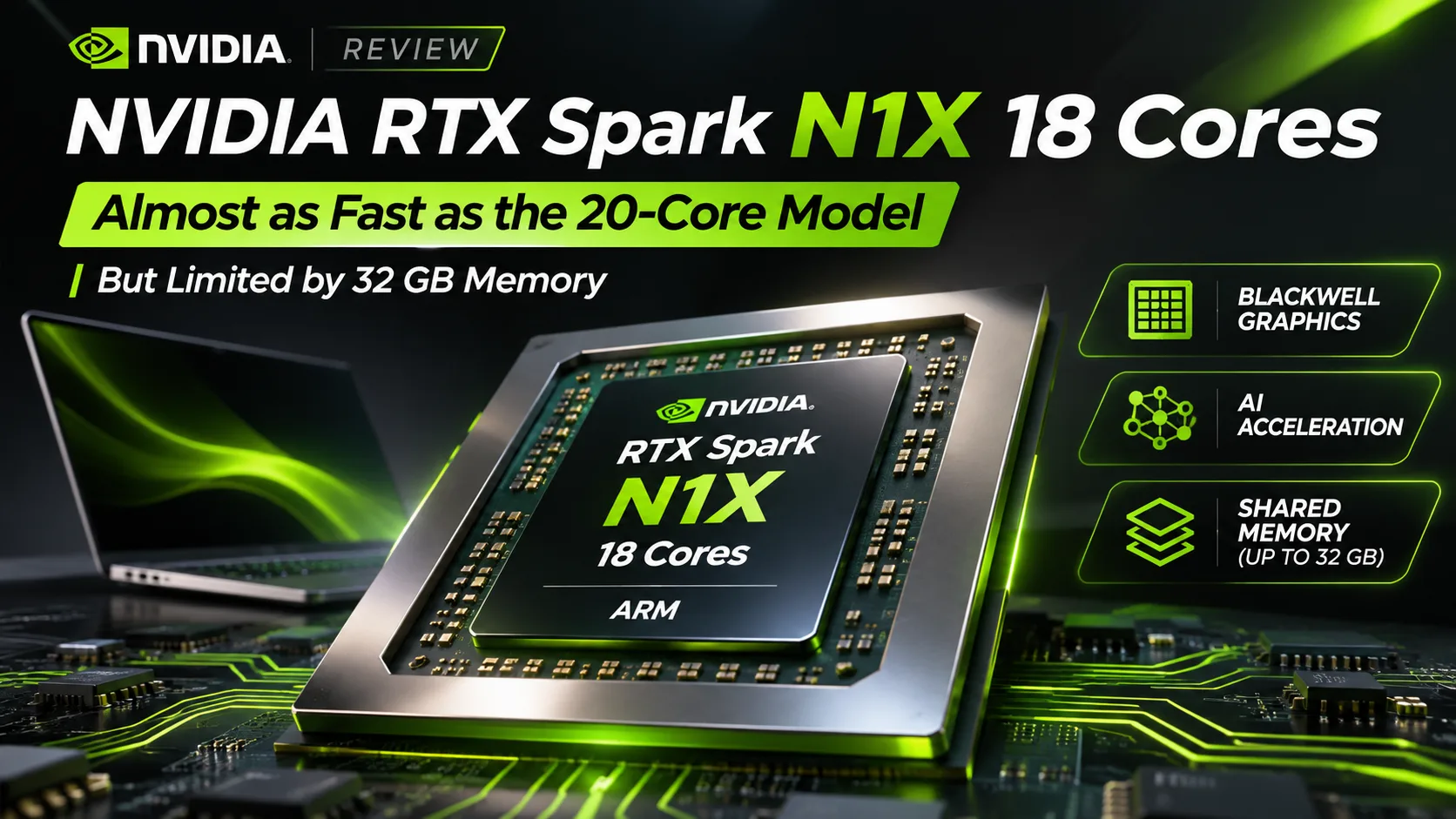
NVIDIA RTX Spark N1X 18 Cores: Nearly a 20-Core Model, but with 32 GB of Memory
The NVIDIA RTX Spark N1X 18 Cores is the lower-end version of NVIDIA’s processor for Windows 11 on Arm laptops. It combines 18 Grace cores with Blackwell graphics featuring 5120 CUDA cores. In Cinebench 2026, a laptop with this chip even outperformed one of the 20-core configurations.
However, available laptops with the lower-end N1X come with only 24 or 32 GB of memory, while the higher-end version is available in configurations with up to 128 GB. For local neural networks, this limitation matters more than the difference in CPU core count.
How It Differs from the 20-Core RTX Spark N1X
| Specification | N1X 18 Cores | N1X 20 Cores |
|---|---|---|
| CPU cores | 18 | 20 |
| Cortex-X925 | 9 | 10 |
| Cortex-A725 | 9 | 10 |
| CUDA cores | 5120 | 6144 |
| Streaming Multiprocessors | 40 | 48 |
| Memory in available configurations | 24-32 GB | 24-128 GB |
| Peak AI performance | 827 TFLOPS | 1000 TFLOPS |
Both versions use the Blackwell graphics architecture, shared LPDDR5X memory with a 256-bit bus, and support CUDA, DLSS, and hardware-accelerated ray tracing. The TDP range is 45-80 W. The stated AI performance refers to neural-network computations, not FP32.
NVIDIA’s official documentation contains a discrepancy: the detailed specifications limit the lower-end N1X to 32 GB of memory, while the general RTX Spark page lists 64 GB. Configurations with 24 and 32 GB have been confirmed for sale so far.
CPU Performance: 18 Cores Nearly Match 20
StorageReview compared the Lenovo Pro 9n 15 with the lower-end N1X against two laptops using the 20-core version. The devices were tested while plugged in and set to high-performance mode.
Cinebench 2026
| Laptop and processor | Single-Core | Multi-Core |
|---|---|---|
| Lenovo Pro 9n 15, N1X 18 Cores | 518 | 6394 |
| HP OmniBook Ultra 16, N1X 20 Cores | 565 | 6934 |
| Lenovo Yoga 9n 2-in-1, N1X 20 Cores | 557 | 6292 |
| Razer Blade 16, Ryzen AI 9 HX 370 | 480 | 5179 |
The 18-core Lenovo trailed the HP by just 8% in the multi-threaded test, but it outperformed the 20-core Yoga 9n by 2%. The difference is attributable to the laptops’ power settings and cooling systems.
In Geekbench 7, the test Lenovo Pro 9n scored 2470 points in Single-Core and 20,924 in Multi-Core. These results were obtained by Micro Center using a different methodology. Overall, the lower-end N1X is close to the higher-end version in multi-threaded workloads, including rendering and compilation.
Blackwell: Gaming Performance and 3DMark
The lower-end RTX Spark is equipped with 5120 CUDA cores, fifth-generation Tensor Cores, and fourth-generation RT Cores.
At Micro Center, the Lenovo Pro 9n’s graphics scored 2822 points in 3DMark Steel Nomad and 6737 in Port Royal. For comparison, the ASUS ProArt P16 with the 20-core N1X scored 3134 points in Steel Nomad, while the HP HyperX Omen 16 with a GeForce RTX 5070 Laptop scored 3049. The results were obtained in different laboratories, so the comparison is approximate.
In games, the integrated Blackwell generally trails discrete GeForce GPUs.
Notebookcheck gaming tests, 1920 × 1080
| Laptop and GPU | Game, settings | FPS |
|---|---|---|
| Lenovo Pro 9n, N1X 18 Cores | Cyberpunk 2077, Ultra | 78.6 |
| Lenovo LOQ 15AHP11, RTX 5060 Laptop | Cyberpunk 2077, Ultra | 88.5 |
| Lenovo Pro 9n, N1X 18 Cores | Baldur's Gate 3, Ultra | 101.9 |
| Lenovo LOQ 15AHP11, RTX 5060 Laptop | Baldur's Gate 3, Ultra | 118.6 |
The tests were conducted without resolution scaling or frame generation. The laptops differ in their power settings and cooling systems.
In Cyberpunk 2077, the lower-end Blackwell trailed the RTX 5060 Laptop by 11%; in Baldur's Gate 3, it trailed by 14%. This is a strong result for integrated graphics, although the performance cannot be judged overall based on just two games.
The limitations of Windows on Arm also remain. Games without native Arm support may run through Prism emulation, but compatibility depends on the specific game, its protection system, and the libraries it uses.
Local Neural Networks: Performance and Memory Limitations
RTX Spark uses shared CPU and GPU memory. However, in Windows, the amount available to the GPU must be allocated separately through the NVIDIA App.
In the tested Lenovo Pro 9n, 12 GB of the 32 GB of memory was allocated to the GPU, leaving 20 GB for the system. StorageReview was able to increase the allocation to 16 GB, but the NVIDIA App warned of possible instability with extreme settings.
With the initial 12 GB allocation, the laboratory was unable to run the gpt-oss:20b test, which required more available GPU memory. The result may differ with a different memory allocation or loading method.
Local LLM generation speed
| Device and model | Tokens/s |
|---|---|
| Lenovo Pro 9n, Llama 3.1 8B | 55.1 |
| HP OmniBook Ultra 16, Llama 3.1 8B | 56.4 |
| Lenovo Yoga 9n 2-in-1, Llama 3.1 8B | 54.4 |
| Lenovo Pro 9n, Bonsai 27B | 36.5-42.0 |
| Lenovo Pro 9n, Gemma 4 12B | 28.2-31.0 |
The Llama 3.1 8B results were obtained by StorageReview in MLPerf Client 2.0. Bonsai 27B and Gemma 4 12B were tested by Micro Center. The ranges reflect different scenarios with short and long prompts. The speeds of different models are not directly comparable.
In MLPerf, the lower-end N1X trailed the 20-core HP by just 2% in Llama 3.1 8B generation speed. At the same time, the Lenovo was able to run Bonsai 27B at up to 42 tokens/s.
Whether a model can run depends not only on the number of parameters, but also on quantization, context length, and the memory occupied by other applications. Therefore, successfully testing one 27B model does not guarantee that every model of that size will work.
Price: Is It Worth Saving Money on the Lower-End Version?
In November 2026, Micro Center offered two Lenovo Pro 9n configurations.
| Laptop | CPU | Memory | SSD | Price |
|---|---|---|---|---|
| Lenovo Pro 9n 15 | N1X 18 Cores | 32 GB | 1 TB | $2799.99 |
| Lenovo Pro 9n 15 | N1X 20 Cores | 64 GB | 2 TB | $3799.99 |
The prices include Micro Center discounts and may change.
The additional $1000 provides two extra CPU cores, 20% more CUDA cores, twice the memory, and a 2 TB SSD instead of a 1 TB drive.
The memory upgrade is especially useful for local LLMs. At the same time, the LPDDR5X is soldered to the motherboard, so it cannot be expanded after purchase.
Laptops with discrete GeForce RTX 5070 or RTX 5080 Laptop GPUs may be alternatives. They are better suited to gaming and traditional x64 Windows applications. However, the available amount of GPU memory in those systems is determined primarily by the graphics card’s own video memory rather than by the total system RAM.
Should You Buy the NVIDIA RTX Spark N1X 18 Cores?
The lower-end N1X is worth considering for workloads that require CUDA and supported software on Windows on Arm:
- Running local LLMs that fit within the available GPU memory.
- Developing and testing CUDA programs.
- GPU acceleration in compatible professional applications.
The lower-end N1X is close to the higher-end version in CPU performance, while its integrated graphics can even handle demanding games. However, for large local LLMs, it is better to choose a configuration with 64 or 128 GB of memory.
At a price of around $2800, the RTX Spark N1X 18 Cores remains a specialized solution. If CUDA on Arm is not required, an x86 laptop with a discrete GeForce GPU may offer better value.
CPU Comparison
Compare RTX Spark N1X 18 Cores with other CPUs
Basic
CPU Specifications
Memory Specifications
GPU Specifications
AI Specifications
Interfaces and Ports
Miscellaneous
Benchmarks
Compared to Other CPU
Related CPU Comparisons


Share in social media
Or Link To Us
<a href="https://cputronic.com/cpu/nvidia-rtx-spark-n1x-18-cores" target="_blank">NVIDIA RTX Spark N1X 18 Cores</a>