MediaTek Dimensity 8550
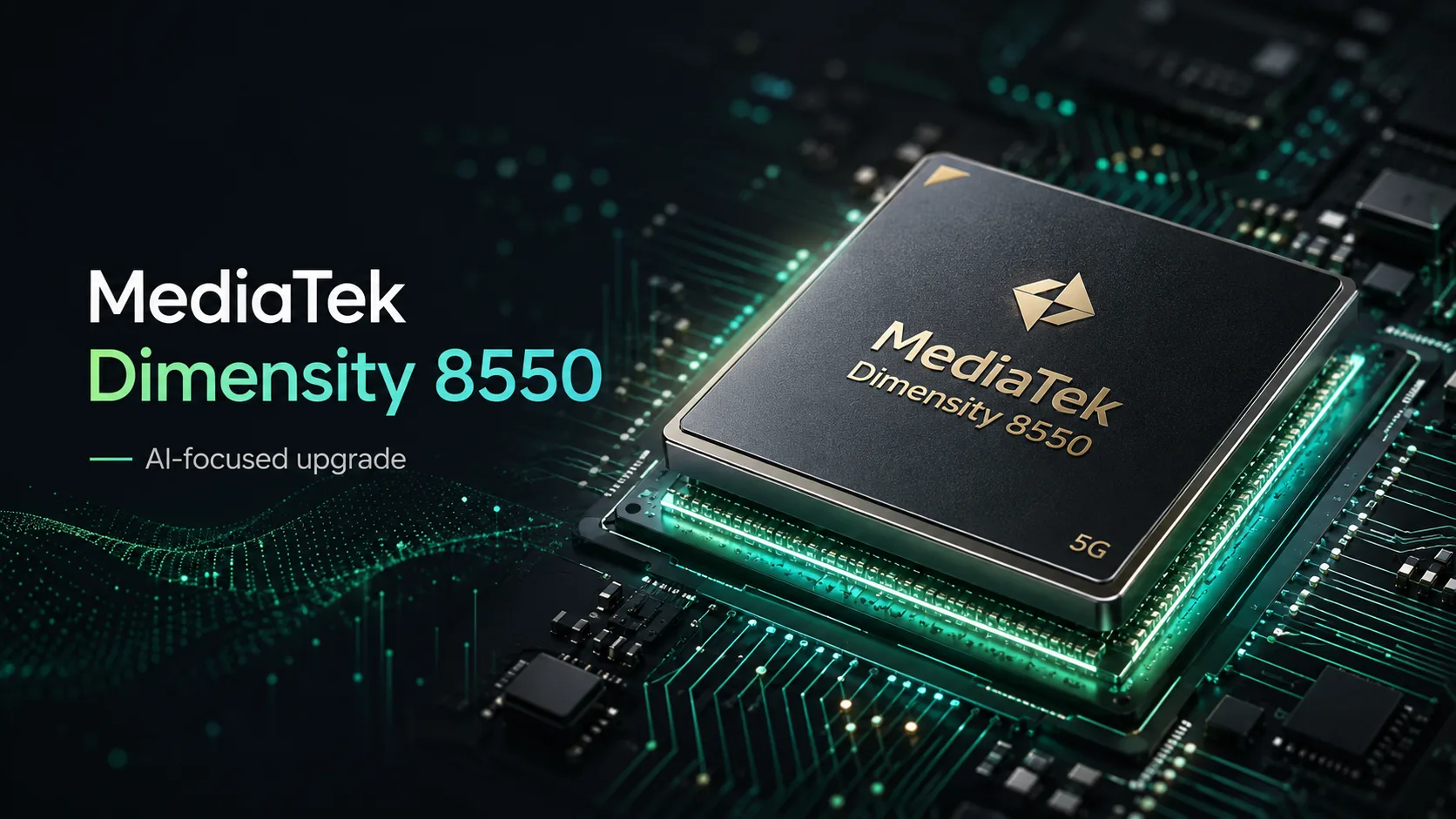
MediaTek Dimensity 8550: Almost Dimensity 8500, but with a New AI Focus
MediaTek Dimensity 8550 is a chip for premium mid-range smartphones. It is not a new platform but a revised version of Dimensity 8500; the CPU, GPU, memory, camera, and display have changed little.
The main difference is the AI block. The Dimensity 8550 features an NPU 880 with LLM Booster and supports Gemini Nano V3. In the official specifications, Dimensity 8500 simply lists the NPU 880. Thus, the 8550 is not a performance upgrade but rather an AI update to the Dimensity 8500.
Dimensity 8550 vs Dimensity 8500: What is the Real Difference
In terms of key specifications, the Dimensity 8550 replicates the Dimensity 8500. They share the same CPU, graphics, memory, storage, connectivity, video, and display support. One should not expect a significant increase just because of the 8550 index; in everyday tasks, the difference will depend on cooling, memory, and the firmware of a specific smartphone.
| Block | Dimensity 8550 | Dimensity 8500 | Conclusion |
|---|---|---|---|
| CPU | 8× Cortex-A725, up to 3.4 GHz | 8× Cortex-A725, up to 3.4 GHz | The CPU is essentially the same |
| GPU | Mali-G720 MC8 | Mali-G720 MC8 | Gaming performance should be similar |
| Memory | LPDDR5X up to 9600 Mbps | LPDDR5X up to 9600 Mbps | No differences in memory |
| Storage | UFS 4 + MCQ | UFS 4 + MCQ | Fast storage in both |
| Video | Up to 4K60 | Up to 4K60 | No flagship 8K or 4K120 support |
| Display | WQHD+ up to 144 Hz | WQHD+ up to 144 Hz | Capabilities are identical |
| AI | NPU 880 with LLM Booster, Gemini Nano V3 | NPU 880 | The main difference in 8550 |
Therefore, the main argument for the Dimensity 8550 is not FPS or interface speed, but local AI capabilities. MediaTek positions it as a platform for text generation, image processing, and device voice functions.
CPU: Eight Cortex-A725 Without Small Cores
The CPU is built on a 1+3+4 scheme: one Cortex-A725 core operates at up to 3.4 GHz, three Cortex-A725 cores at up to 3.2 GHz, and four Cortex-A725 cores at up to 2.2 GHz. There are no small Cortex-A5xx cores here-all eight cores are Cortex-A725.
For everyday tasks, multitasking, and photo processing, the performance is sufficient. The all-big-core architecture performs better in brief peak loads and multi-threading, but prolonged loads prioritize cooling and power limits. With insufficient cooling or strict frequency limits, performance will quickly drop.
Graphics and Gaming
Graphics are handled by Arm Mali-G720 MC8. For a premium mid-range segment, this configuration is compelling: it is adequate for modern games at high settings.
Dimensity 8550 does not directly compete with flagship SoCs. It is not at the level of Dimensity 9500/9500s, but rather a more accessible platform for smartphones that require high performance without flagship pricing and overheating. In games, the name of the chip is not sufficient; real FPS will only be revealed through tests of specific smartphones.
AI, Camera, and Multimedia
Practically speaking, the AI block is the only noticeable difference from the Dimensity 8500. MediaTek lists the NPU 880 with LLM Booster and support for Gemini Nano V3. This is crucial for local text, image, and voice processing, as well as generative functions.
Dimensity 8550 supports sensors up to 320 MP or three 32 MP cameras at 30 fps, video recording up to 4K60, AI Zero Shutter Lag, and ISP Imagiq 1080. For a mid-premium camera phone, this is sufficient, but video capabilities remain below flagship levels: there is no 8K or 4K120 support.
There are no significant restrictions for displays and codecs in this class: WQHD+ at 144 Hz and AV1 are supported.
Memory, Connectivity, and Storage
LPDDR5X 9600 and UFS 4 + MCQ provide a strong foundation for the premium mid-range segment. Fast memory and storage are essential for launching apps, switching tasks, handling photos, and downloading large games.
In terms of connectivity, the set is strong: 5G-Advanced, 3CC CA, up to 5.17 Gbps, Wi-Fi 6E, Bluetooth 5.4, and DSDA 2.0. However, Wi-Fi 7 is not listed in the official specifications, so the Dimensity 8550 cannot be considered fully flagship in communications.
Performance in Tests
According to early data from NanoReview, the Dimensity 8550 scores about 2.43 million points in AnTuTu 11 and approximately 1761 / 7148 points in Geekbench 6 Single-Core and Multi-Core tests. Based on these numbers, the Dimensity 8550 is closer to sub-flagships than to the regular mid-range, but it does not reach the top-tier Dimensity and Snapdragon.
These results should be viewed as a benchmark rather than a guaranteed indicator for any smartphone. In short tests, the Dimensity 8550 appears convincing, but in prolonged loads, tests of specific smartphones are more important.
When Dimensity 8550 Makes Sense
A smartphone with Dimensity 8550 should be considered if:
- It has good cooling and does not throttle performance under prolonged loads;
- It is significantly cheaper than true flagships;
- It utilizes the AI capabilities of the platform beyond marketing;
- The price difference from a similar model on Dimensity 8500 does not negate the benefits of the upgrade.
Conclusion
MediaTek Dimensity 8550 is neither a revolution nor a full replacement for flagship SoCs. It is a platform for the premium mid-range segment, mimicking Dimensity 8500 in CPU, GPU, memory, camera, and connectivity while gaining a distinct AI positioning.
The value of Dimensity 8550 does not lie in CPU or GPU enhancements. MediaTek has upgraded a familiar platform for LLM Booster, Gemini Nano V3, and AI scenarios that should operate directly on the smartphone.
Paying a premium just for the 8550 index instead of the 8500 is not always justified. In everyday tasks, it is not the chip name that matters, but the specific smartphone model.
SOC Comparison
Compare Dimensity 8550 with other SOCs
Basic
GPU Specifications
Connectivity
Memory Specifications
Miscellaneous
Benchmarks
Phones with Dimensity 8550
Comparison of Devices with Dimensity 8550
Compared to Other SoC
Related SoC Comparisons



Share in social media
Or Link To Us
<a href="https://cputronic.com/soc/mediatek-dimensity-8550" target="_blank">MediaTek Dimensity 8550</a>