MediaTek Dimensity 7500
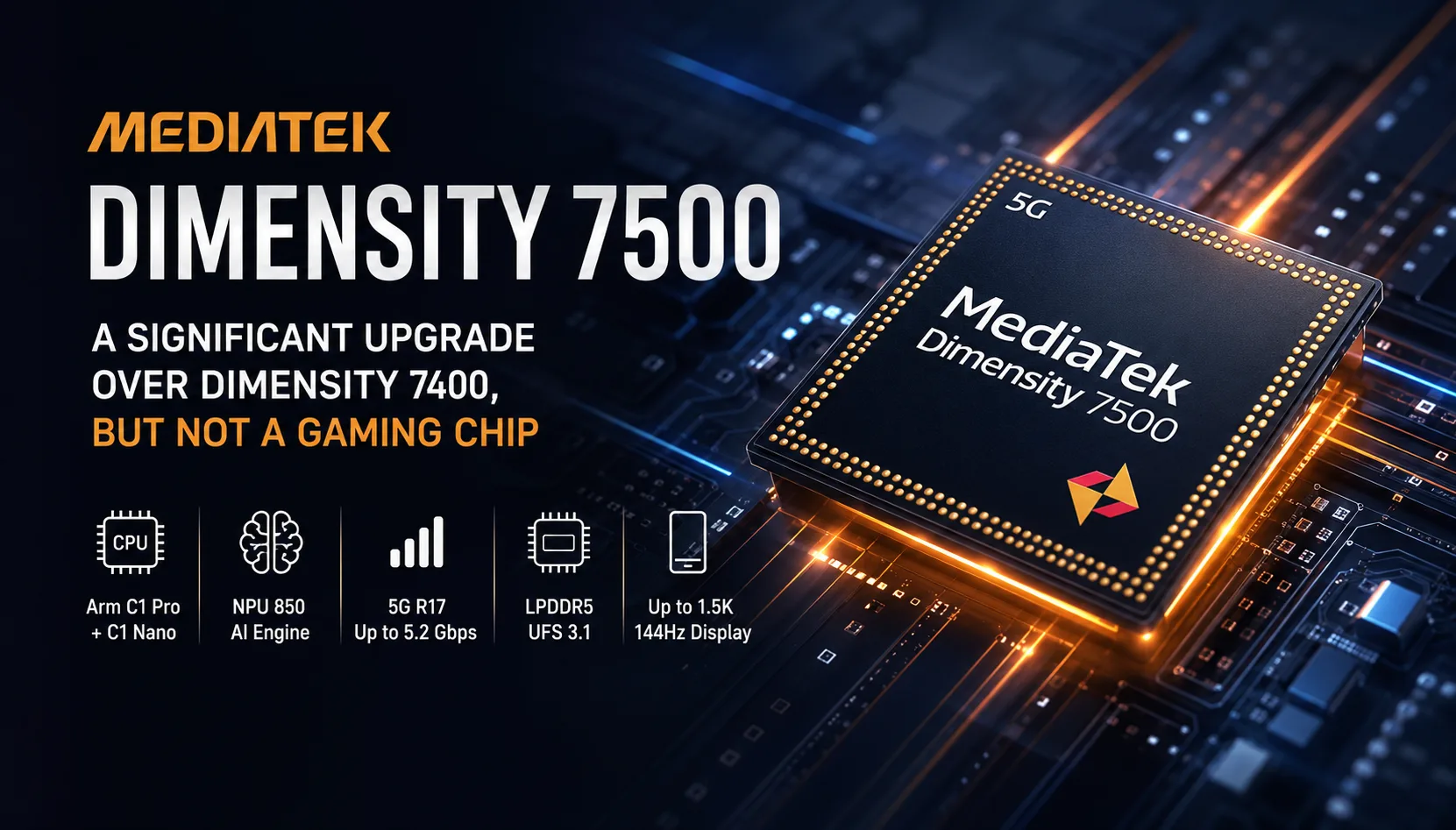
MediaTek Dimensity 7500: a noticeable upgrade from the Dimensity 7400, but not a gaming chip
MediaTek Dimensity 7500 is a new chip for mass-market 5G smartphones. It may seem like a simple replacement for the Dimensity 7400 based on its name, but the changes run deeper: it features new Arm C1 Pro and Arm C1 Nano cores, NPU 850, a faster 5G modem, and support for modern displays. The main limitation is that the Mali-G625 MC2 graphics remain moderate.
What has changed since the Dimensity 7400
The Dimensity 7400 used a configuration of 4 Cortex-A78 + 4 Cortex-A55. The Dimensity 7500 switches to 4 Arm C1 Pro up to 2.6 GHz + 4 Arm C1 Nano up to 2.0 GHz. While the clock speeds have only increased slightly, the architecture is newer: MediaTek specifies Armv9.3-A and a 4nm fabrication process.
The significance of the Dimensity 7500 lies not in the frequency increase but in the shift to a more modern CPU base. Along with this, the NPU, modem, memory, storage, and display support have also been upgraded.
| Parameter | Dimensity 7400 | Dimensity 7500 |
|---|---|---|
| CPU | 4× Cortex-A78 + 4× Cortex-A55 | 4× Arm C1 Pro + 4× Arm C1 Nano |
| GPU | Mali-G615 MC2 | Mali-G625 MC2 |
| NPU | NPU 655 | NPU 850 |
| Memory | LPDDR5 / LPDDR4x | LPDDR5 |
| Storage | UFS 2.2 / UFS 3.1 | UFS 3.1 2-lane |
| Modem | 5G R16, up to 3.27 Gbps | 5G R17, up to 5.2 Gbps |
| Video | 4K30 | 4K30 10-bit |
| Display | FHD+ 144 Hz / WFHD+ 120 Hz | up to 1344×2800 at 144 Hz |
CPU: the main upgrade of the generation
The processor part is the key technical change in the Dimensity 7500. The new 4+4 configuration is expected to have the largest impact on the interface, web browsing, app launching, and multitasking. For such smartphones, stable performance in daily tasks is more important than a short peak under heavy loads.
An early Geekbench 6 result for the vivo S60 Vitality Edition shows 1243 points in single-core and 3569 points in multi-core. This is significantly higher than typical results for the Dimensity 7400, indicating that the CPU upgrade goes beyond a mere name change. However, these results are based on a single smartphone, so final conclusions are better drawn from tests of multiple production models.
In everyday use, this should result in faster app launches, smooth task switching, and greater CPU headroom. The ultimate speed still depends on cooling, memory, and power limits of the specific smartphone.
GPU and gaming: graphics remain the main limitation
The graphics component is the Arm Mali-G625 MC2. This is sufficient for the interface, video, popular games, and medium settings, but the two graphics cores set a performance ceiling. In demanding games, not only the specifications of the SoC matter but also the screen resolution, graphics settings, cooling, and frequency stability.
Therefore, the Dimensity 7500 should not be seen as a replacement for the Dimensity 8300 or Dimensity 8400. The CPU, modem, and memory support have improved compared to the Dimensity 7400, but the graphics remain moderate.
Memory, storage, display, and connectivity
Dimensity 7500 supports LPDDR5 up to 6400 Mbps and UFS 3.1 2-lane. For a mass-market 5G smartphone, this is sufficient: fast memory and storage reduce latency in app launches, game installations, and working with large files.
The Dimensity 7500 is better suited for smartphones with 1.5K displays and high refresh rates. The chip supports a main display of up to 1344×2800 at 144 Hz and a secondary display of up to 1300×1200 at 120 Hz.
The modem is another significant difference from the Dimensity 7400. The Dimensity 7500 has transitioned to 5G R17, supporting 3CC-CA, 220 MHz NR DL, and achieving peak speeds of up to 5.2 Gbps. The Dimensity 7400's maximum was up to 3.27 Gbps. In real-world networks, these numbers depend on the operator and coverage, but the new platform offers greater speed and frequency aggregation potential. It also includes Wi-Fi 6E and Bluetooth 5.4.
Cameras and AI
The Dimensity 7500 supports cameras of up to 200 MP, with MediaTek Imagiq 1050 ISP, 14-bit DCG sensors, hardware noise reduction (MCNR), and facial recognition. Video capabilities include up to 4K30 in 10-bit. For smartphones at this level, the feature set is sufficient but lacks flagship capabilities like 4K120 or 8K.
The SoC itself does not guarantee a good camera. The final quality depends on the sensor, optics, stabilization, and image processing performed by the smartphone manufacturer.
The NPU has been upgraded to MediaTek NPU 850. MediaTek claims more than double the AI performance compared to the previous generation. In practice, this block can be utilized for speech recognition, speech-to-text conversion, local suggestions, contextual responses, and notification processing. However, the real benefits depend on the smartphone's software: if a manufacturer doesn't add the necessary features, the NPU will merely be a line in the specifications.
Practical conclusion
The main comparison for the Dimensity 7500 is with the Dimensity 7400. Here, the new chip appears not as a cosmetic update but as a more modern platform: newer CPU, NPU 850, faster modem, UFS 3.1 2-lane, and support for higher-resolution displays.
The comparison to Dimensity 8300 and Dimensity 8400 is already uneven. These chips are positioned higher, particularly in terms of graphics. The Dimensity 7500 remains a solution for mass-market 5G smartphones, where a fast interface, modern connectivity, and good battery life are more important than maximum gaming performance.
In summary, the chip’s characteristics are:
- Strengths - new CPU, fast modem, LPDDR5, UFS 3.1, support for 1.5K displays, and NPU 850;
- Main limitation - Mali-G625 MC2, which does not elevate the chip to the gaming class;
- Best scenario - mass-market 5G smartphone with a fast interface, good display, and modern connectivity;
- Weak scenario - demanding games at high settings.
One of the first devices featuring the Dimensity 7500 was the vivo S60e / vivo S60 Vitality Edition. This smartphone comes with a 144 Hz AMOLED display, a 7200 mAh battery, and 90W fast charging. Such a combination clearly illustrates the role of the Dimensity 7500: it is a platform for modern mass-market 5G smartphones, rather than for ultra-budget or gaming models.
Conclusion
The MediaTek Dimensity 7500 is a notable upgrade from the Dimensity 7400, rather than just a simple index change. The chip is stronger in CPU, modem, NPU, memory, and display support. In daily tasks, this should provide faster app launches, smoother multitasking, and greater platform headroom.
The main limitation remains the graphics of the Mali-G625 MC2. The Dimensity 7500 is suitable for mass-market 5G smartphones but does not replace the Dimensity 8300/8400 and other more gaming-focused platforms. It should be chosen for its fast interface, modern connectivity, and new CPU, rather than for handling heavy games.
SOC Comparison
Compare Dimensity 7500 with other SOCs
Basic
GPU Specifications
Connectivity
Memory Specifications
Miscellaneous
Benchmarks
Compared to Other SoC
Related SoC Comparisons


Share in social media
Or Link To Us
<a href="https://cputronic.com/soc/mediatek-dimensity-7500" target="_blank">MediaTek Dimensity 7500</a>