Google Tensor G4

Google Tensor G4: Performance and Benchmarks of the Pixel 9 Processor
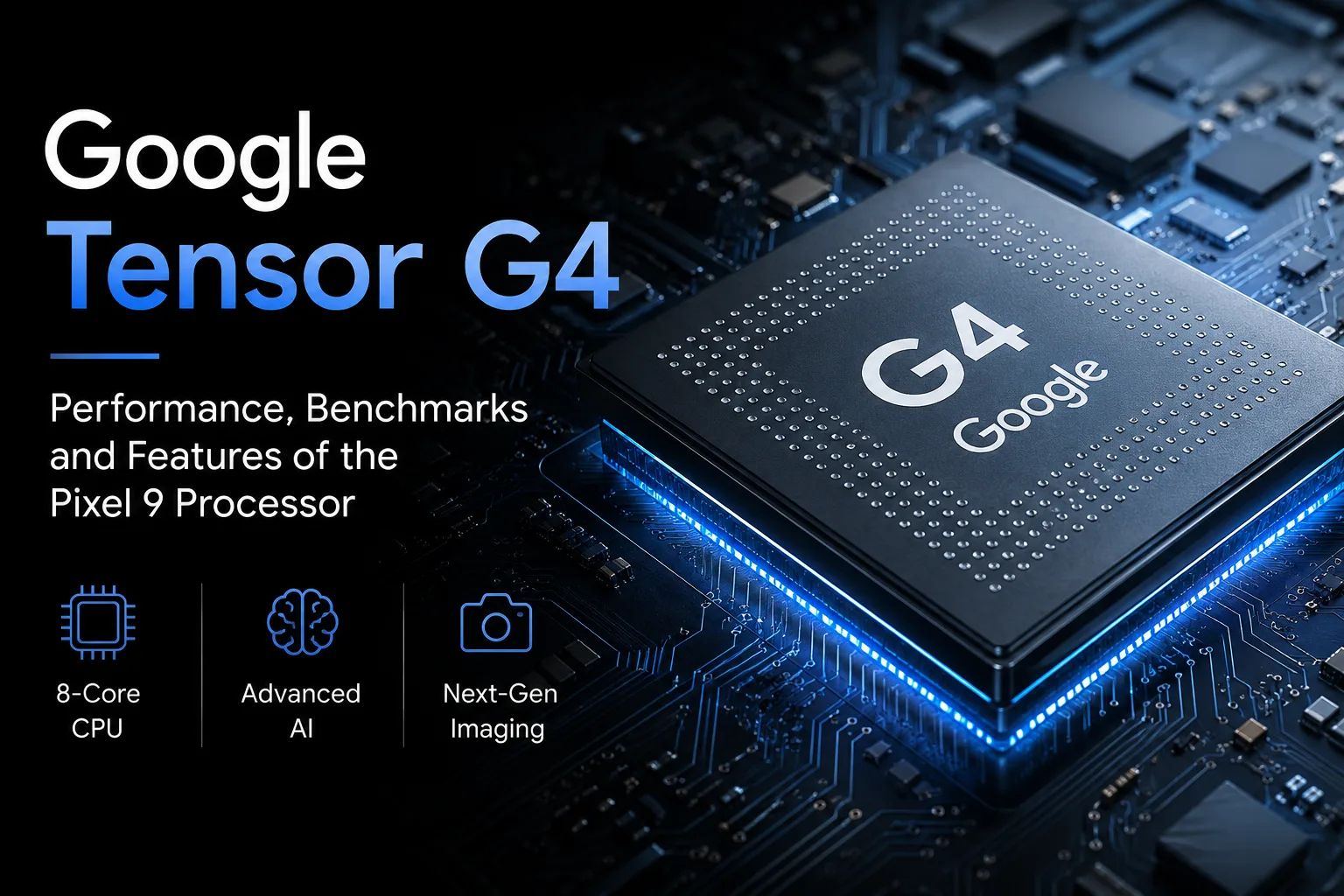
Google Tensor G4 is the processor of the Pixel 9 family. In terms of computational power, it falls behind the flagship Snapdragon and Dimensity processors of its generation, but Google has primarily designed the chip for the camera and its own AI functions in the Pixel. The Tensor G4 features an eight-core CPU with a clock speed of up to 3.10 GHz and a Mali-G715 MP7 GPU.
CPU: New Eight-Core Configuration
The Tensor G4 utilizes three CPU clusters:
| Cluster | Cores | Frequency |
|---|---|---|
| Performance | 1 | up to 3.10 GHz |
| Mid-range | 3 | up to 2.60 GHz |
| Energy-efficient | 4 | up to 1.95 GHz |
Compared to the Tensor G3, single-threaded performance has noticeably improved, while the gains in multi-threaded tasks have been moderate. At the launch of the Tensor G4, Google claimed an average of 20% faster web browsing and 17% faster app launches compared to the Pixel 8 and Pixel 8 Pro. These figures come from Google's internal tests, so they should not be directly applied to all applications.
In Geekbench 6, the Tensor G4 is faster than the Tensor G3 but significantly lags behind the Snapdragon 8 Gen 3. The Pixel 9 scores about 4500 points in Multi-Core, while smartphones with the Snapdragon 8 Gen 3 often score around 6600-6900 points.
The difference with more powerful SoCs is more pronounced in rendering, video encoding, and other prolonged multi-threaded tasks.
Mali-G715 MP7 Graphics
The Tensor G4 makes use of the Mali-G715 MP7 GPU. In 3DMark Wild Life Extreme, the Pixel 9 scored 2567 points, the Pixel 9 Pro scored 2547, and the Pixel 9 Pro XL scored 2548. For comparison, the OnePlus 12 with the Snapdragon 8 Gen 3 scores around 4444 points, while the Xiaomi 14 scores roughly 4744.
| Smartphone | SoC | 3DMark Wild Life Extreme |
|---|---|---|
| Google Pixel 9 | Tensor G4 | 2567 |
| Google Pixel 9 Pro | Tensor G4 | 2547 |
| Google Pixel 9 Pro XL | Tensor G4 | 2548 |
| OnePlus 12 | Snapdragon 8 Gen 3 | 4444 |
| Xiaomi 14 | Snapdragon 8 Gen 3 | 4744 |
For most games, the performance is sufficient, but in demanding projects, the Snapdragon 8 Gen 3 delivers significantly higher FPS, especially at maximum graphics settings.
The increase in graphics performance over the Tensor G3 is modest. In one independent test, the Tensor G4 scored 2618 points in Wild Life Extreme compared to 2445 for the Tensor G3-a difference of about 7%.
AI and Pixel Functions
The Tensor G4 is responsible for some of the local AI functions in the Pixel. The processor is optimized for Gemini models and performs certain AI tasks directly on the smartphone.
The Tensor G4 is the first Google platform for Gemini Nano with multimodal processing, allowing the model to work not only with text but also with images and audio.
Some of Gemini's capabilities still rely on cloud services. The presence of the Tensor G4 does not mean that all AI functions of the smartphone are performed locally.
Synthetic CPU and GPU tests do not reflect this aspect of the platform very well. However, the presence of specialized AI blocks does not make the Tensor G4 faster in typical CPU and GPU tasks.
Tensor G4 in Specific Smartphones
The Tensor G4 is used in several Pixel models. The table shows the results of specific smartphones rather than record runs from the benchmark database.
| Smartphone | Geekbench 6 Single-Core | Geekbench 6 Multi-Core | 3DMark Wild Life Extreme |
|---|---|---|---|
| Google Pixel 9 Pro XL | 1950 | 4741 | 2548 |
| Google Pixel 9 Pro | 1971 | 4820 | 2547 |
| Google Pixel 9 | 1798 | 4501 | 2567 |
| Google Pixel 9a | 1702 | 4453 | 2615 |
The Pixel 9 Pro and Pixel 9 Pro XL show nearly identical scores, while the standard Pixel 9 and Pixel 9a fall slightly behind in CPU tests. In the graphics test, the difference among all four devices is minimal.
In terms of SoC performance, the difference between the Pixel 9 and the Pro models is not significant. The Pro models primarily differ in camera capabilities, display, and memory capacity.
Conclusion
The Tensor G4 falls short of the Snapdragon 8 Gen 3 and Dimensity 9300+ in multi-threaded and graphical tests, so the Pixel 9 does not rank among the most powerful Android smartphones of its generation.
In everyday use, the difference with more powerful SoCs is much less noticeable. Google has primarily oriented the Tensor G4 toward its own Pixel features, camera, and local AI tasks.
For gaming and prolonged computational loads, competing flagship SoCs offer significantly higher performance.
SOC Comparison
Compare Tensor G4 with other SOCs
Basic
3x 2.6 GHz – Cortex-A720
4x 1.92 GHz – Cortex-A520
GPU Specifications
Connectivity
Memory Specifications
Miscellaneous
Benchmarks
Phones with Tensor G4



Comparison of Devices with Tensor G4
Compared to Other SoC
Related SoC Comparisons



Share in social media
Or Link To Us
<a href="https://cputronic.com/soc/google-tensor-g4" target="_blank">Google Tensor G4</a>