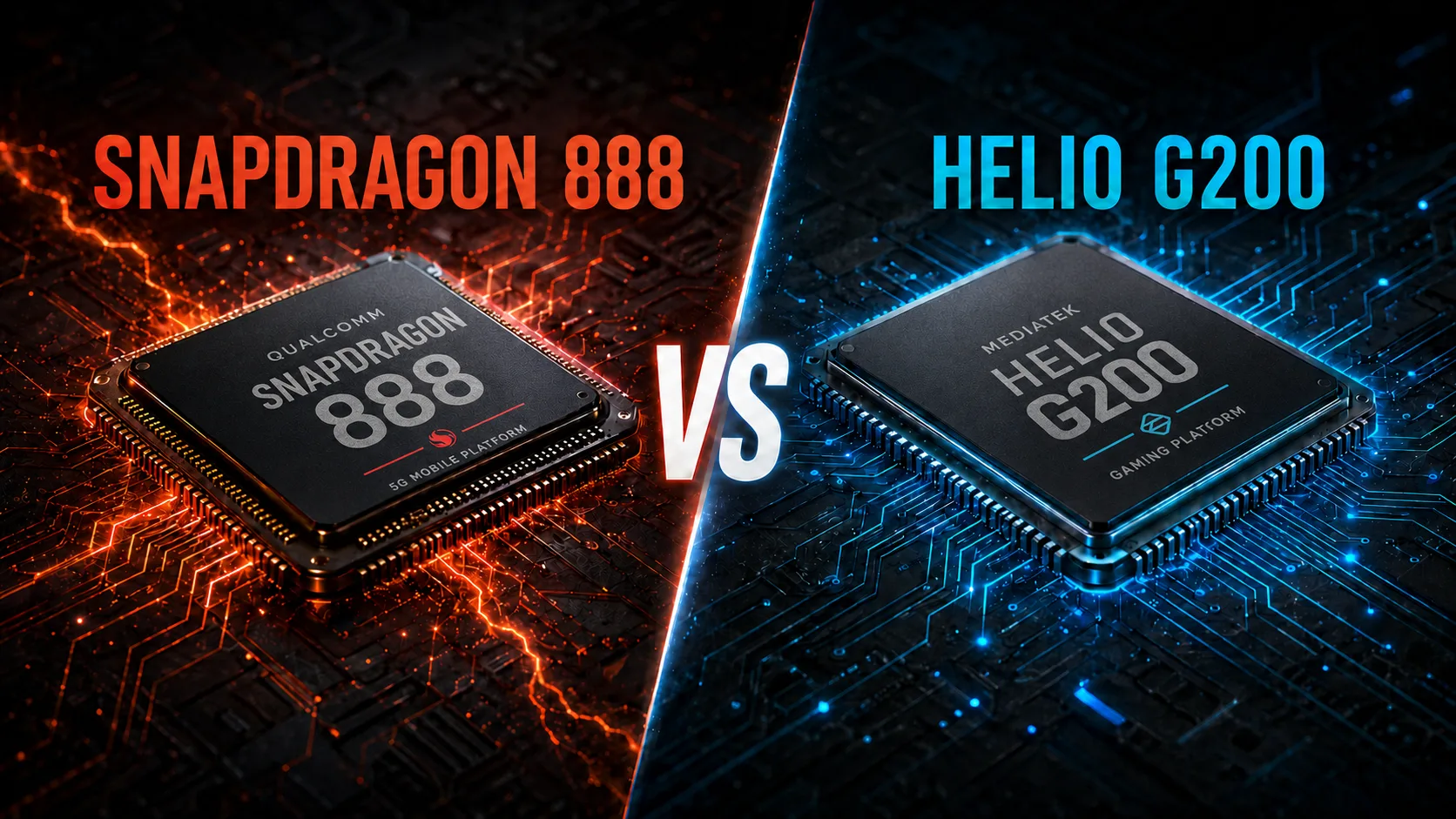
Qualcomm Snapdragon 888
vs
MediaTek Helio G200

SoC Comparison Result
Snapdragon 888 vs Helio G200: An Old Flagship Up to Four Times Faster
The Snapdragon 888 debuted nearly five years before the Helio G200 but belongs to a much higher class. Qualcomm's old flagship chip is noticeably faster in CPU tasks, almost twice as strong in terms of overall AnTuTu 10 results, and about four times better in graphics. The advantages of the Helio G200 include lower heat generation, extended battery life, and availability in new budget smartphones.
Key Differences
| Parameter | Snapdragon 888 | Helio G200 |
|---|---|---|
| Platform Class | Flagship | Budget |
| Process Technology | Samsung, 5 nm | TSMC, 6 nm |
| Performance Cores | 1× Cortex-X1 + 3× Cortex-A78 | 2× Cortex-A76 |
| Graphics | Adreno 660 | Mali-G57 MC2 |
| RAM | LPDDR5 / LPDDR4X | LPDDR4X |
| Storage | Typically UFS 3.1 | UFS 2.2 |
| Mobile Connectivity | 5G and 4G | Only 4G |
| Wi-Fi | Wi-Fi 6E | Wi-Fi 5 |
| Video Recording | Up to 8K at 30 fps | Up to 2K at 30 fps |
| Main Advantages | CPU, gaming, cameras, and connectivity | Price, battery life, and moderate heating |
Helio G200 is Newer Only by Date
The Helio G200 represents another update to the Helio G100, which almost mirrored the Helio G99. The CPU configuration remains unchanged: two Cortex-A76 cores operate at up to 2.2 GHz, while another six Cortex-A55 cores clock up to 2.0 GHz. The main changes revolve around an increased frequency for the Mali-G57 MC2, support for 12-bit DCG HDR, and enhanced 4G connectivity.
The Snapdragon 888 utilizes one Cortex-X1 core at up to 2.84 GHz, three Cortex-A78 cores, and four Cortex-A55 cores. These cores were introduced earlier but were originally intended for a flagship platform and are significantly more powerful than the G200’s budget configuration.
In selected smartphones, the Snapdragon 888 shows an advantage of approximately 30-60% in Geekbench 6 for single-core performance and 60-75% for all cores. The difference is evident when installing apps, processing photos, decompressing files, and heavy multitasking. For browsing, messaging, and video, the Helio G200 suffices, but background processes and a full storage drive can quickly lead to interface lags.
Results in Specific Smartphones
The figures are approximate: they depend on firmware, temperature, memory capacity, and performance mode. All rows show the result of a standard 3DMark Wild Life test.
| Processor and Smartphone | Geekbench 6, single core | Geekbench 6, all cores | AnTuTu 10 | 3DMark Wild Life |
|---|---|---|---|---|
| Snapdragon 888 - Xiaomi Mi 11 | 956 | 3205 | ≈806,000-850,000 | 5030 |
| Snapdragon 888 - OnePlus 9 | 1192 | 3485 | ≈881,000 | 5761 |
| Helio G200 - Infinix Hot 60 Pro | 740 | 2006 | 473,196 | 1365 |
| Helio G200 - Infinix Hot 60 Pro+ | 738 | 2017 | 449,488 | 1363 |
The gap in graphics performance is particularly significant. The Adreno 660 scores around 5000-5800 points in Wild Life, while the Mali-G57 MC2 hovers around 1360 points. This represents a fourfold difference between the flagship and budget GPUs.
Gaming and Throttling
The Snapdragon 888 allows for higher resolutions, better texture quality, and frame rates in demanding games. It also has more headroom for emulators and heavy projects like Genshin Impact or Wuthering Waves.
A weak point of the Snapdragon 888 is its high power consumption under prolonged load. In thin devices, frequencies drop quickly, and the stability of the OnePlus 9 in the stress test Wild Life may drop to about 55%. A larger chassis and enhanced cooling system mitigate the issue but do not eliminate it entirely. Even after throttling, the Adreno 660 usually remains faster than the Mali-G57 MC2.
The Helio G200 is designed for casual games, MOBA, and less demanding online projects. Heavy games typically run at low settings. A screen with a 120 or 144 Hz refresh rate makes the interface smoother but does not transform the G200 into a high-class gaming platform.
Heating and Battery Life
The Helio G200 consumes less power under heavy load thanks to its simple architecture, lower frequencies, and 6 nm production from TSMC. This eases cooling and helps smartphones with batteries around 5000 mAh last longer without recharging. However, lower consumption does not equate to higher efficiency in the same computational tasks: many operations take significantly longer for the G200.
When buying a smartphone with a Snapdragon 888, it's essential to consider the battery's condition, repair history, and the device's behavior under sustained load. A new device with a Helio G200 is more predictable in this regard, though it lags significantly in speed.
Cameras, Memory, and Connectivity
Both platforms formally support cameras up to 200 MP, but the same sensor resolution does not imply equal processing capabilities. The Snapdragon 888 features a triple Spectra 580 ISP, capable of simultaneously handling multiple video streams and supporting 8K recording at 30 fps or 4K at 120 fps. The Helio G200 is limited to 2K at 30 fps or Full HD at 60 fps.
The Qualcomm platform also supports LPDDR5, 5G, and Wi-Fi 6E, and smartphones based on it typically include UFS 3.1 storage. The Helio G200 is limited to LPDDR4X, UFS 2.2, Wi-Fi 5, and LTE. The age of the Snapdragon 888 is hardly felt here: its communications and multimedia capabilities remain superior.
Which Processor is Better
The Snapdragon 888 wins decisively in performance. It is significantly faster in CPU tasks, about four times more powerful in graphics, and offers more advanced capabilities in cameras, memory, and wireless connectivity.
A smartphone with a Snapdragon 888 is justified if gaming and demanding applications are a priority and the condition of the battery and cooling has been verified. The Helio G200 is preferable for a new budget device with a warranty, extended battery life, and the latest version of Android. Its name conveys a sense of significant improvement, although technically it is just another version of an old budget platform.
Advantages
- Higher Technology: 5 nm (5 nm vs 6 nm)
- Higher Frequency: 2840 MHz (2840 MHz vs 2200 MHz)
- Newer Launch Date: May 2025 (December 2020 vs May 2025)
Basic
3x 2.42 GHz – Kryo 680 Gold (Cortex-A78)
4x 1.8 GHz – Kryo 680 Silver (Cortex-A55)
GPU Specifications
Connectivity
Memory Specifications
Miscellaneous
- AIFF
- CAF
- MP3
- MP4
- WAV
- H.265
- VP9
Benchmarks
Comparison of Devices
Related SoC Comparisons



Share in social media
Or Link To Us
<a href="https://cputronic.com/soc/compare/qualcomm-snapdragon-888-vs-mediatek-helio-g200" target="_blank">Qualcomm Snapdragon 888 vs MediaTek Helio G200</a>