Intel Core Ultra 5 322

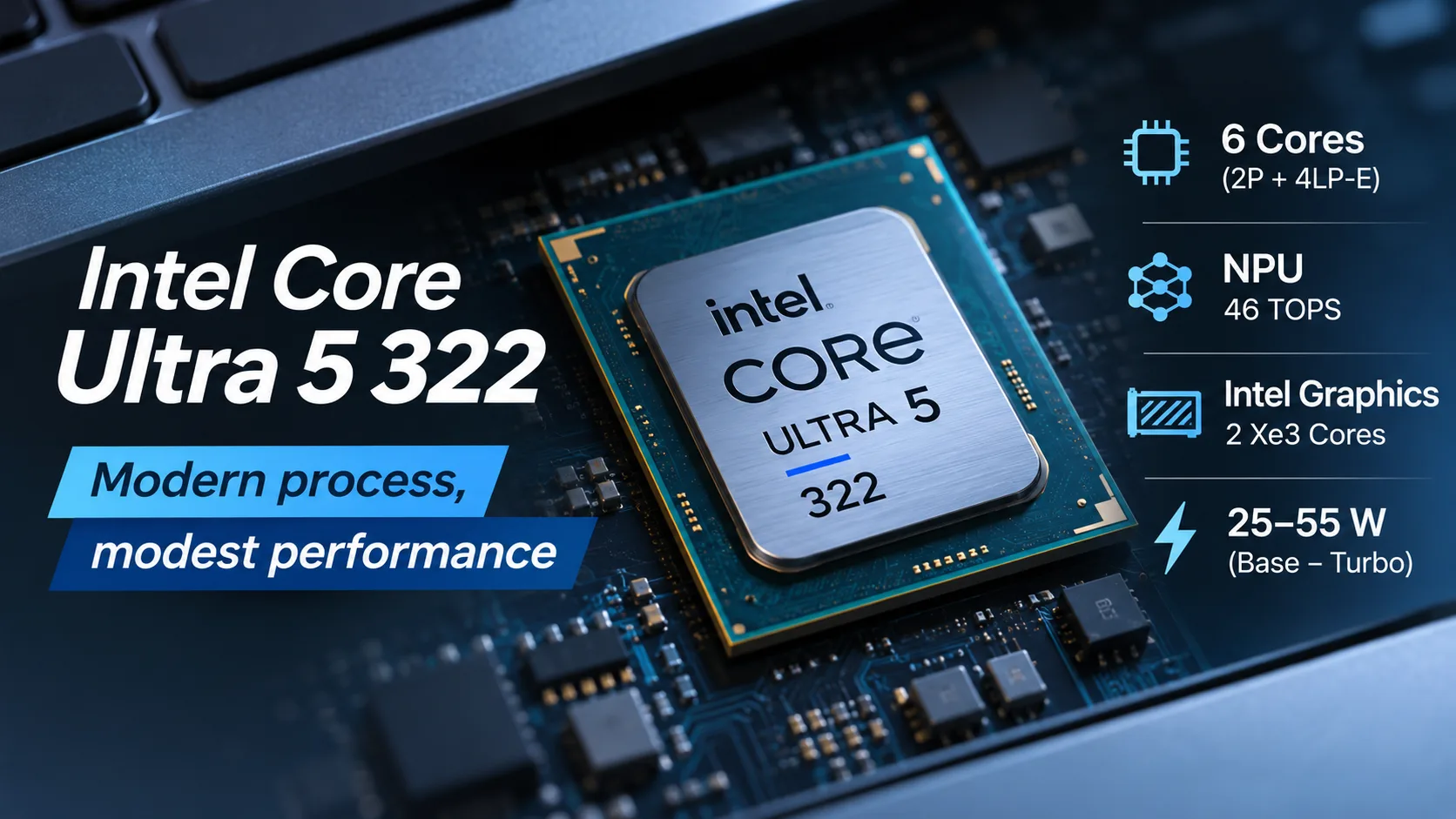
Intel Core Ultra 5 322: Advanced Process Technology, Modest Performance
The Intel Core Ultra 5 322 belongs to the Panther Lake family, but in Cinebench R23 Multi it is only 6% faster than the 2022 Core i7-1255U. The processor has just two performance P-cores, four low-power LP E-cores, and integrated graphics with two Xe3 blocks.
The Core Ultra 5 322 delivers good results in single-threaded tests, while a Lenovo IdeaPad with this processor lasted 15 hours and 20 minutes in the Wi-Fi test. However, this result reflects the battery life of the entire laptop, not just the CPU’s power efficiency.
Two P-Cores and Four LP E-Cores
The Core Ultra 5 322 appeared in early 2026 and belongs to the lower-end Panther Lake models. It has two performance Cougar Cove P-cores and four low-power Darkmont LP E-cores. There are no conventional E-cores.
The maximum P-core frequency is 4.4 GHz, while the LP E-cores reach 3.3 GHz. Without Hyper-Threading, the six cores can run six threads simultaneously. The L3 cache totals 12 MB.
The compute block is manufactured using Intel 18A, while the graphics block uses Intel 3. The processor’s base power is 25 W, and it can reach 55 W during short-term boosting. It supports DDR5-6400 and LPDDR5X-7467.
The NPU delivers 46 TOPS, meeting the requirements for Copilot+ PC.
Performance: A Small Lead Over the Core Ultra 5 115U
Notebookcheck tested the Lenovo IdeaPad 5i 2-in-1 14IPH11 with 16 GB of DDR5-5600 memory. Under sustained load, processor power was limited to 24 W.
| Laptop and processor | Geekbench 6 Single | Geekbench 6 Multi | Cinebench R23 Multi |
|---|---|---|---|
| Lenovo IdeaPad 5i 2-in-1, Core Ultra 5 322 | 2556 | 8048 | 7862 |
| Acer Aspire Spin 14, Core Ultra 5 115U | 2096 | 7409 | 7569 |
| Dell Inspiron 14 7420 2-in-1, Core i7-1255U | - | - | 7385 |
| Lenovo Yoga 7a 2-in-1, Ryzen AI 5 435 | 2576 | 10116 | 11333 |
| HP OmniBook Ultra Flip 14, Core Ultra 7 258V | 2673 | 10967 | 10416 |
In the single-threaded Geekbench 6 test, the Core Ultra 5 322 scores 2556 points, nearly matching the Ryzen AI 5 435. However, in the multi-threaded Geekbench test, the AMD processor is 26% faster, and in Cinebench R23 Multi it is 44% faster.
Compared with the Core Ultra 5 115U, the performance gain is about 9% in Geekbench 6 Multi and just 4% in Cinebench R23. Even the Core i7-1255U in the Dell Inspiron 14 7420 2-in-1 scores 7385 points in Cinebench R23 Multi, compared with 7862 for the Core Ultra 5 322. The difference is about 6%.
The new architecture does not give the entry-level Panther Lake model a major advantage in multi-threaded tests. During extended rendering and compilation of large projects, the two P-cores become a limitation.
Xe3 Graphics: Too Weak for Modern Games
The Core Ultra 5 322 includes Intel Graphics with two Xe3 graphics blocks and a frequency of up to 2.3 GHz.
| Laptop and integrated graphics | 3DMark Time Spy Graphics | 3DMark Fire Strike Graphics |
|---|---|---|
| Lenovo IdeaPad 5i 2-in-1, Intel Graphics 2 Xe3 | 1362 | 3085 |
| Acer Aspire Spin 14, Intel Graphics 4-Core | 1565 | 3906 |
| Lenovo Yoga 7a 2-in-1, Radeon 840M | 1335 | 3706 |
| HP OmniBook Ultra Flip 14, Intel Arc 140V | 4139 | 9534 |
In Time Spy, Intel Graphics scores nearly as many points as the Radeon 840M, but in Fire Strike it trails by about 17%. The Intel Arc 140V scores roughly three times as many points in both tests.
Lenovo IdeaPad gaming results at a resolution of 1920 × 1080:
- Dota 2 Reborn: 52 FPS at high settings, 35 FPS at maximum settings.
- Cyberpunk 2077: 19 FPS at low settings without FSR.
- Kingdom Come: Deliverance II: 16 FPS at low settings.
Dota 2 remains playable, but the other two games do not reach even 20 FPS at low settings. For modern games, it is better to choose a laptop with more powerful graphics.
Battery Life: More Than 15 Hours in the Lenovo IdeaPad
The Lenovo IdeaPad 5i 2-in-1, with a 60 Wh battery, lasted 15 hours and 20 minutes while browsing websites over Wi-Fi. Screen brightness was set to 150 cd/m².
For comparison, the Lenovo Yoga 7a with the Ryzen AI 5 435 lasted about 14 hours and 36 minutes, while the Acer Aspire Spin 14 with the Core Ultra 5 115U lasted about 12 hours and 30 minutes.
The test shows that a laptop with the Core Ultra 5 322 can run for a long time without recharging. However, battery life depends not only on the processor, but also on the display, battery capacity, and power settings. The Lenovo result cannot automatically be applied to other models.
Core Ultra 5 322 vs. 325: What Is the Difference?
| Specification | Core Ultra 5 322 | Core Ultra 5 325 |
|---|---|---|
| P-cores | 2 | 4 |
| LP E-cores | 4 | 4 |
| Total cores / threads | 6 / 6 | 8 / 8 |
| Maximum P-core frequency | 4.4 GHz | 4.5 GHz |
| Xe3 graphics blocks | 2 | 4 |
| GPU frequency | 2.3 GHz | 2.45 GHz |
| NPU | 46 TOPS | 47 TOPS |
The Core Ultra 5 325 has twice as many P-cores and Xe3 graphics blocks. At the same time, both processors have the same specified power limits: 25 W in base mode and 55 W during short-term boosting.
Doubling the core count does not guarantee a twofold performance increase, but the Core Ultra 5 325 has more computing resources for multi-threaded workloads and graphics tasks.
Conclusion
The Intel Core Ultra 5 322 is worth considering for an affordable work laptop if the main tasks are limited to browsing, documents, video calls, and video playback. Its performance is sufficient for this type of workload. However, the laptop should not be purchased specifically for the new Panther Lake architecture: in multi-threaded tests, it is only slightly faster than the Core Ultra 5 115U, while its integrated graphics are too weak for modern games.
The purchase makes sense if a laptop with the Core Ultra 5 322 costs at least 15-20% less than a comparable model with the Core Ultra 5 325. For example, if the entry-level model costs $700 and the higher-end model costs $850, the savings are reasonable for office use. If the difference is only $50-70, it is better to pay extra for the Core Ultra 5 325 with four P-cores and twice as many graphics blocks.
The Core Ultra 5 322 is best avoided for programming involving frequent compilation of large projects, video editing, and gaming. For these tasks, the Core Ultra 5 325 or more powerful AMD Ryzen models are preferable.
The main argument in favor of the Core Ultra 5 322 is the laptop’s low price combined with sufficient performance for everyday work. Without noticeable savings, the entry-level Panther Lake model offers few advantages over more powerful alternatives.
CPU Comparison
Compare Core Ultra 5 322 with other CPUs
Basic
CPU Specifications
Memory Specifications
GPU Specifications
Interfaces and Ports
Benchmarks
Compared to Other CPU
Related CPU Comparisons






Share in social media
Or Link To Us
<a href="https://cputronic.com/en/cpu/intel-core-ultra-5-322" target="_blank">Intel Core Ultra 5 322</a>