Intel Core Ultra 7 356H
Intel Core Ultra 7 356H: a powerful Panther Lake, but not for those who expect strong integrated graphics
The Intel Core Ultra 7 356H is a mobile processor from the Core Ultra Series 3 built on the Panther Lake architecture. At first glance, it appears to be an almost perfect modern H-chip: 16 cores, the new Intel 18A manufacturing process, an NPU for local AI tasks, support for fast memory, and a turbo power of up to 80 watts. However, this model has an important nuance: while the CPU portion is solid, the integrated graphics is noticeably simpler than that of the higher-end Panther Lake models.
The Core Ultra 7 356H is best viewed not as a universal flagship without compromises, but as a strong CPU for high-performance laptops, where graphics either isn't the primary consideration or is handled by a discrete graphics card.
Architecture and Performance: 16 Cores for Mixed Loads
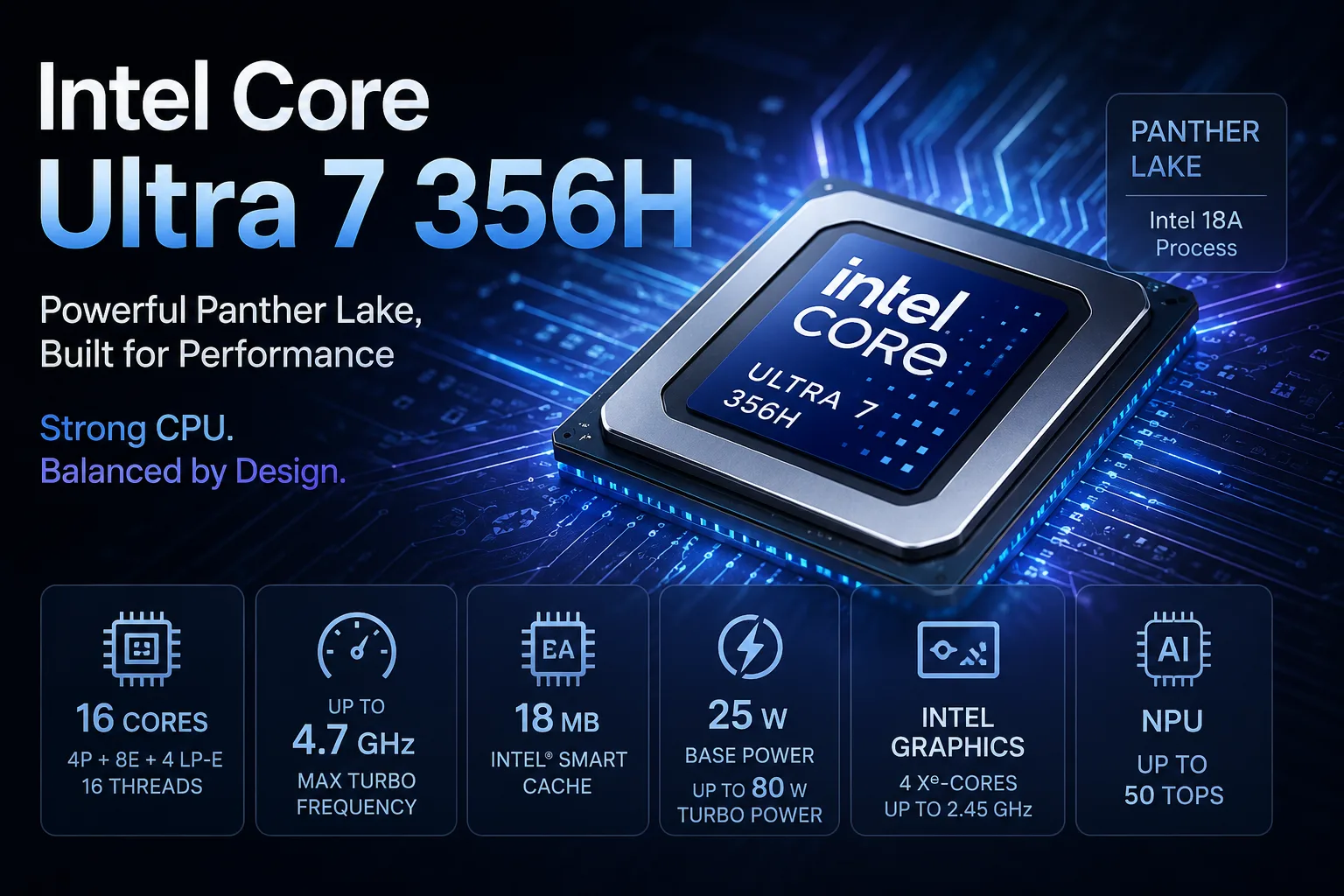
The Core Ultra 7 356H features 16 cores: 4 performance (P) cores, 8 efficiency (E) cores, and 4 additional low-power efficiency (LP-E) cores for light background tasks. There are also 16 threads because Intel bets on a hybrid scheme with different types of cores rather than Hyper-Threading in this architecture.
The maximum frequency of the P cores reaches 4.7 GHz, the E cores reach 3.5 GHz, and the LP-E cores go up to 3.3 GHz. The Intel Smart Cache size is 18 MB. The base power is rated at 25 watts, with a maximum turbo power of up to 80 watts. For an H-class processor, this is a moderate profile: it doesn’t appear to be a power-hungry monster but should hold up well under short to medium loads in an appropriate chassis.
The main purpose of this configuration is not record-breaking raw power but mixed workloads. This is typical for high-performance laptops: browsing, IDE, office tasks, photo editing, light video editing, and several background tasks simultaneously. The fast P cores ensure responsiveness, the E cores handle parallel tasks, and the LP-E cores assist with light processes.
This is not an alternative to the HX class. In long rendering, heavy compiling, or professional software packages, power limits, cooling solutions, and the specific laptop will determine performance. The Core Ultra 7 356H is interesting not as a mobile workstation at any cost, but as a modern processor for fast, versatile models.
What Has Changed Compared to the Core Ultra 7 255H and 265H
Against the backdrop of the Core Ultra 7 255H and 265H, the new 356H does not appear to be a straightforward enhancement across the board, but rather a balance shift. The previous Arrow Lake-H models had 6 performance cores, 24 MB of cache, and a higher turbo package reaching up to 115 watts. The Core Ultra 7 356H has only 4 P cores and 18 MB of cache, but it benefits from the new Panther Lake architecture, Intel’s 18A process, faster LP-E cores, an updated platform, and a significantly more powerful NPU.
This is an important point: the 356H should not be described as “just faster than 255H/265H.” With certain legacy CPU workloads, the higher-end Arrow Lake-H may not perform any worse or could even be stronger due to its 6 P cores, 24 MB of cache, and higher power limit. The strength of the 356H lies elsewhere: in efficiency, a fresh platform, a next-gen AI block, and a more modern profile for laptops in 2026.
| Processor | Architecture | CPU Configuration | Cache | Power | Integrated Graphics | NPU |
|---|---|---|---|---|---|---|
| Core Ultra 7 255H | Arrow Lake-H | 6P + 8E + 2 LP-E | 24 MB | 28-115 W | Arc 140T, 8 Xe-cores | 13 TOPS |
| Core Ultra 7 265H | Arrow Lake-H | 6P + 8E + 2 LP-E | 24 MB | 28-115 W | Arc 140T, 8 Xe-cores | 13 TOPS |
| Core Ultra 7 356H | Panther Lake-H | 4P + 8E + 4 LP-E | 18 MB | 25-80 W | Intel Graphics, 4 Xe-cores | 50 TOPS |
Therefore, the upgrade from 255H/265H to 356H does not seem obvious when only looking at the CPU and integrated graphics. However, for new laptops, the 356H may be more appealing as a fresher platform with a different power and efficiency balance.
The Main Difference from Neighboring Panther Lake Models
Within the Core Ultra Series 3 lineup, the 356H also appears shrewd. CPU-wise, it is close to the higher-end H chips but significantly lags behind versions with Arc B390 in terms of graphics.
| Processor | CPU Configuration | Maximum Frequency | Integrated Graphics | Model Purpose |
|---|---|---|---|---|
| Core Ultra 7 356H | 4P + 8E + 4 LP-E | up to 4.7 GHz | Intel Graphics, 4 Xe-cores | strong CPU, basic iGPU |
| Core Ultra 7 366H | 4P + 8E + 4 LP-E | up to 4.8 GHz | Intel Graphics, 4 Xe-cores | slightly faster, same graphics |
| Core Ultra X7 358H | 4P + 8E + 4 LP-E | up to 4.8 GHz | Arc B390, 12 Xe-cores | similar CPU, significantly stronger iGPU |
This table clearly shows the positioning. The Core Ultra 7 356H is not a weak processor, but it is not the Panther Lake one to choose for integrated graphics. If a laptop is purchased without a discrete graphics card and is intended for gaming or graphics tasks, models with Arc B390 make more sense.
Integrated Graphics: The Main Compromise of 356H
The integrated graphics are the main limitation of the Core Ultra 7 356H. It features Intel Graphics with 4 Xe-cores and a frequency of up to 2.45 GHz. For tasks like interfacing, video playback, hardware encoding and decoding, multiple monitors, and lightweight gaming, this is sufficient. Features include Quick Sync, AV1 encode/decode support, HEVC, H.264, and modern video outputs.
However, for gaming and graphics tasks, this is not a flagship iGPU. Given the name Ultra 7, one might expect something more powerful, but in reality, the graphics component here is closer to the base version of Panther Lake. If the laptop will be used with a discrete graphics card, this is not an issue. If there is no discrete graphics, this point needs to be considered right away.
Simply put, the Core Ultra 7 356H excels as a processor but is lacking when it comes to integrated graphics performance.
Platform: Memory, Interfaces, and NPU
The Core Ultra 7 356H supports up to 128 GB of memory, including LPDDR5X up to 8533 MT/s and DDR5 up to 7200 MT/s. This provides a solid foundation for a high-performance laptop: fast memory is important for overall responsiveness, integrated graphics, and heavy workloads alike.
In terms of interfaces, everything is modern: Thunderbolt 4, PCIe 5.0/4.0, and up to 20 PCIe lanes. This allows manufacturers to install fast SSDs, use discrete graphics, connect docking stations, and assemble advanced configurations. However, the specific set of ports, drives, and capabilities depends on the laptop itself, not just on the processor.
The NPU delivers up to 50 TOPS in INT8. This is a considerable step forward compared to the Core Ultra 7 255H/265H, where the NPU is limited to 13 TOPS. Practical benefits still depend on the software, but for local AI functions, camera effects, noise reduction, and future Windows features, the headroom on the 356H is already more substantial.
In Conclusion: Who is the Intel Core Ultra 7 356H Suitable For
The Intel Core Ultra 7 356H should be considered for versatile high-performance laptops: work, programming, office multitasking, photo processing, light video work, multimedia, and scenarios where overall system responsiveness is important.
This processor shines best in laptops with discrete graphics. In such a configuration, the weak iGPU hardly detracts from performance: the CPU remains modern, the platform is fresh, and gaming, 3D, and graphics tasks are handled by a dedicated GPU.
Without discrete graphics, the choice becomes more contentious. If a fast work machine is needed, the 356H is suitable. If high performance from integrated graphics or maximum iGPU power is crucial, it’s better to look at Panther Lake with Arc B390 or other models with stronger integrated graphics.
The hard conclusion: The Core Ultra 7 356H is a good processor but not the best "all-around" Core Ultra 7. Its strengths lie in the CPU, platform, and NPU; its weak point is integrated graphics. In a laptop with discrete graphics, this is a rational choice; without it, this model should be chosen cautiously.
CPU Comparison
Compare Core Ultra 7 356H with other CPUs
Basic
CPU Specifications
Memory Specifications
GPU Specifications
Interfaces and Ports
Benchmarks
Compared to Other CPU
Related CPU Comparisons




Share in social media
Or Link To Us
<a href="https://cputronic.com/cpu/intel-core-ultra-7-356h" target="_blank">Intel Core Ultra 7 356H</a>